








In the TV drama Ode to Joy, a conversation about Green Mountain Coffee and Blue Mountain Coffee left many viewers confused: Does Green Mountain Coffee really exist in the United States? What exactly is its relationship with Blue Mountain Coffee? This article, from the perspective of Front Street Coffee, will sort out the brand background of Green Mountain Coffee, the K-Cup business model, and the historical reasons why Blue Mountain Coffee is so expensive, and further introduce the grading of Blue Mountain No. 1, its flavor characteristics, and Front Street's brewing suggestions. If you are curious about these two coffees with similar names but completely different origins, this article will clarify them one by one for you, from brand origin and market positioning to tasting methods.
For more specialty coffee knowledge, please follow: Front Street Coffee (Frontsteet Coffee)
In the domestic drama Ode to Joy, there is a conversation centered on Green Mountain Coffee. In the show, someone mentions bringing Green Mountain Coffee back from the United States, while another character corrects them, saying it should be called Blue Mountain Coffee, and even thinks Green Mountain is just a counterfeit version of Blue Mountain. In fact, there really is a coffee brand in the United States called Green Mountain. So what exactly is Green Mountain Coffee's background? Front Street will talk with everyone about it here.
Green Mountain Coffee (Keurig Green Mountain)
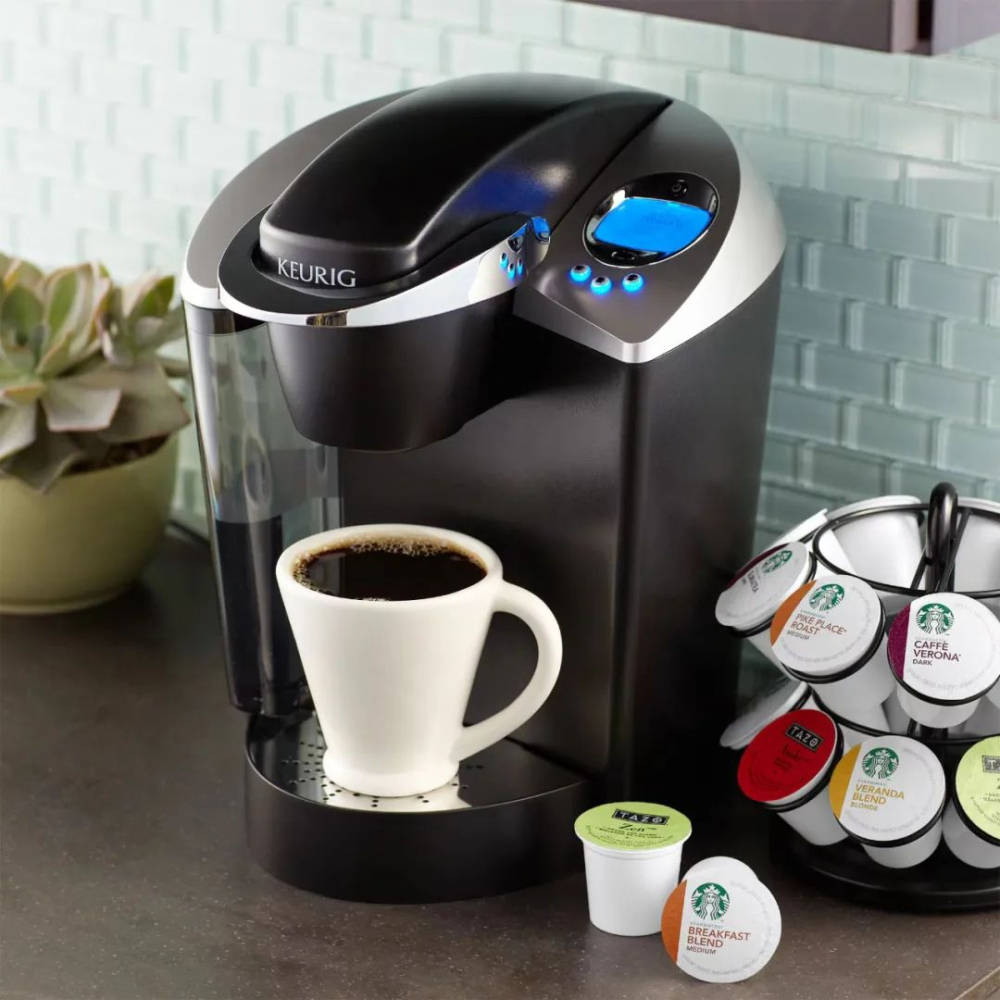
Green Mountain is not the name of a coffee-producing region, but an American coffee brand from Vermont, founded in 1981. The brand launched the Keurig single-serve coffee machine and the accompanying K-Cup coffee, allowing office workers to easily get a rich cup of black coffee anytime at the office, which made it very popular in the market. There is no need to grind coffee beans, no weighing, no cleaning, and no residue left at the bottom of the cup. Each time it makes exactly one cup, and there is no need to worry about using too much or too little material. Compared with traditional coffee machines, this method is more convenient, and the coffee's aroma is also richer.
Unlike Starbucks' route, which emphasizes high taste and high prices, Green Mountain Coffee sells high-quality Arabica coffee beans at more affordable prices. The Green Mountain coffee machine sells for only over 100 US dollars, basically close to cost, and the brand mainly relies on selling K-Cups to make profits. A 24-count pack of K-Cups is usually priced at 12 US dollars, which works out to about 0.5 US dollars per cup. Today, households and offices in North America consume more than 3 million K-Cups every day. Of Green Mountain's more than 2 billion US dollars in sales revenue, nearly one-third comes from the office market. In addition, Green Mountain also allows other beverage manufacturers to make K-Cup packaging, and these companies only need to pay Green Mountain a licensing fee of 6 cents per cup. In other words, Green Mountain turned the K-Cup into an open platform for the beverage industry.

Green Mountain Coffee's sales model is undoubtedly very successful, but its popularity in China is not high because the brand mainly targets the North American domestic market. Around the turn of the millennium, China's coffee culture was far less active than it is now, and at that time the only name people could really mention was basically Blue Mountain Coffee.
Why is Blue Mountain Coffee so expensive?
In the past, people often heard sayings like "Blue Mountain Coffee is too expensive to afford" and "only Blue Mountain Coffee sold in Japan is authentic." The formation of these impressions is related to the coffee contract signed between Jamaica and Japan in the 1970s.
As early as before the 1960s, Jamaican coffee beans were already quite favored in the specialty coffee market. In 1969, Jamaica suffered a severe hurricane disaster, and many industries fell into difficulty, with the coffee industry not escaping either. At this time, Japan's UCC company provided financial assistance to Jamaica's coffee industry and introduced scientific ecological cultivation methods. In return for this help, the Jamaican government signed a 30-year contract with Japan, promising to supply 90% of the quota of high-quality Blue Mountain Coffee to Japan, with the remaining 10% allocated to European and American countries. When the contract between the two sides expired, it coincided with the global economic crisis. Japan's economy was sluggish and its purchasing power declined, and Jamaican coffee farmers were unwilling to continue being monopolized by Japanese merchants, so they sharply raised the price of green coffee beans. At present, the proportion of Jamaican Blue Mountain Coffee purchased by Japan has dropped from the original 90% to less than 60%.
Today, with coffee culture becoming increasingly active, we can already directly import Blue Mountain coffee beans from Jamaica. At Front Street, you can drink authentic Blue Mountain Coffee. Front Street Blue Mountain No. 1 is sold at 158 yuan per 100 grams, and direct tasting as pour-over is 60 yuan per cup, which is a relatively affordable price.
What grade does Blue Mountain No. 1 belong to?
Blue Mountain No. 1 is the highest grade among Jamaican Blue Mountain coffees. Through professional and meticulous processing methods, it produces extremely high-quality Blue Mountain beans and is a Jamaican national treasure-level product.
Before export, Blue Mountain green beans are packed and sent for testing, and the coffee beans produced in Blue Mountain are graded according to various standards. CIB is the earliest institution to use scientific and objective methods to assess coffee quality grades, and it determines grades based on a comprehensive evaluation of green bean size, color, uniformity, defect rate, moisture content, and cup performance. Blue Mountain Coffee is divided into four grades: Blue Mountain No. 1, Blue Mountain No. 2, Blue Mountain No. 3, and Blue Mountain Peaberry. Blue Mountain No. 1 is the highest tier among them.
Top-grade Blue Mountain No. 1 green beans must meet specifications of 17 screen size or above, a defect rate below 3%, and a moisture content of around 13%, and in cupping they present a rich coffee aroma, a smooth and balanced taste, low and weak acidity, and a lasting sweet aftertaste. In order to keep Blue Mountain coffee beans in better quality before roasting and avoid moisture from seeping in during transportation, Jamaicans insist on using handmade wooden barrels as the carriers for Blue Mountain green beans, and the wooden barrel has therefore become one of the important symbols of Jamaican Blue Mountain Coffee.
Front Street's roasting philosophy is to present coffee's most classic flavor profile, such as the bright lemony acidity of Yirgacheffe and the rich, full-bodied, toasty taste of Indonesian Mandheling coffee. Blue Mountain naturally also needs to highlight the classic Blue Mountain flavor. Front Street uses a medium-dark roast to maximize the coffee's chocolate and nutty aromas while preserving soft acidity and sweetness, making the overall taste more balanced.
How do you drink authentic Blue Mountain No. 1 coffee?
Authentic Blue Mountain No. 1 coffee has a dense and full aroma and a rich, varied taste. Front Street recommends tasting it best as pour-over black coffee. In addition, Blue Mountain Coffee's variety is the ancient Arabica variety Typica, with a relatively low caffeine content and an elegant, pure flavor, making it easy to accept even for friends drinking coffee for the first time.
Front Street's brewing parameters for Blue Mountain No. 1 in-store are:
Dripper: KONO dripper
Water temperature: 88 degrees Celsius
Coffee-to-water ratio: 1:15
Coffee grounds: 15g
Grind size: EK43s - setting 10.5 (75% passing rate on No. 20 standard sieve)
When brewing coffee beans that are mainly bitter in profile, Front Street gives priority to the KONO dripper, with the aim of highlighting the coffee's rich, full-bodied taste. The upper part of the KONO dripper allows the filter paper to fit better. Compared with the v60 dripper, the extraction method is mainly immersion extraction, which increases the overall concentration of the coffee and enhances its body. Similarly, the KONO dripper is also suitable for brewing Brazil Queen's Estate coffee beans and Golden Mandheling coffee beans.
At Front Street, first wet the KONO dripper, then align and place the filter paper so it fits the dripper better. After pouring out the water in the sharing pot, add 15g of coffee grounds, bloom with 30g of water for 30s, then begin pouring in a small stream in a circular motion around the center until it reaches 125g, at which point begin分段. Wait until the coffee bed drops to the halfway point of the dripper, then begin the second pour using the same method until 225g. Once all dripping is complete, remove the dripper.
Blue Mountain No. 1 coffee tastes of the sweet fragrance of dark chocolate, the sweetness of caramel, and soft, elegant acidity. Each flavor is balanced in combination, and the taste is smooth, rich, and full-bodied, with a very typical Blue Mountain flavor.
The above content is compiled by CoffeeHunters, a coffee news website.


