







In the world of specialty pour-over coffee, Geisha is almost an unavoidable name, and Panama's Hacienda Esmeralda is precisely the key driving force that brought this variety to its peak. This article will explore the estate's history, the discovery and rise to fame of Geisha, the Red Label and Green Label grade classifications, the differences between natural and washed processing, as well as Front Street Coffee's brewing recommendations, helping coffee enthusiasts systematically understand Hacienda Esmeralda's Geisha system and the terroir and craftsmanship logic behind the classic "Geisha flavor."
When it comes to specialty pour-over coffee, Geisha is almost an unavoidable name. Taking Front Street Coffee's bean list in recent years as an example, there are at least dozens of Geisha-related products, offering quite a rich selection. However, if you want to truly understand Geisha and taste the representative classic flavor, Front Street suggests starting with Panama's Hacienda Esmeralda. The reason is that Geisha's reputation today owes much to this estate's promotion.
Hacienda Esmeralda: The Discoverer and Promoter of Geisha
Hacienda Esmeralda was purchased by American banker Rudolph Peterson when he moved to Panama after retiring in 1964. It is located in the Boquete region of western Panama. This area is influenced by both the Pacific and Atlantic Oceans, forming a typical tropical maritime climate; the high altitude brings frequent mist, providing an ideal shading environment for coffee trees. Mineral-rich volcanic ash soil, abundant rainfall, pronounced day-night temperature differences, and microclimates formed by undulating terrain all help coffee accumulate fuller flavors. For more background on Hacienda Esmeralda, you can also visit its official website directly: haciendaesmeralda.com.
Geisha was originally introduced to Panama to improve varieties, but its low yield and mediocre flavor performance at low altitudes made it unpopular among farmers. In the 1960s, Rudolph A. Peterson, planning for his retirement, bought Hacienda Esmeralda in Boquete, initially focusing on dairy production. In 1973, his son returned to Boquete to help with operations, coffee production gradually gained importance, the estate expanded its planting area, and introduced more new varieties including Geisha.
In the 1990s, many coffee trees on the farm were infected with leaf rust, but Daniel Peterson discovered that Geisha trees were not seriously affected, so he decided to move the Geisha that had been mixed with other varieties to more areas of the farm, while also raising its cultivation altitude. In 2003, the Peterson family finally realized Geisha's potential: during the first cupping, it displayed intense white floral aromatics, berry and citrus notes, a bergamot-like finish, and an exceptionally clean mouthfeel, thereby establishing the typical Panama Geisha flavor profile. Astonished by its performance, they decided to enter it in the 2004 BOP (Best of Panama) competition, and won consecutive championships over multiple years.
In 2005, Hacienda Esmeralda sent Geisha to compete in the Specialty Coffee Association of America (SCAA) evaluation, defeating many strong opponents to win the honor of world-class specialty coffee, and swept the world championships in 2006 and 2007, once again drawing global attention from the coffee industry. Thereafter, Central and South America and many producing regions introduced Geisha, including Colombia, Guatemala, Bolivia, and others; in recent years, a small amount of Geisha beans has also appeared in Yunnan, China. But to experience the classic Geisha flavor, Front Street believes that Geisha from the Panama producing region is the most representative.
What Makes Hacienda Esmeralda's Geisha So Special?
In 2004, Geisha emerged on the scene with its performance at that year's Best of Panama competition, and repeatedly broke auction price records year after year, attracting attention from the coffee world ever since. Hacienda Esmeralda not only made Geisha famous, but was also the first coffee estate to strictly grade Geisha, and its annual Geisha lots draw industry attention. After Geisha won the championship, estate owners the Peterson siblings managed the estate's Geisha coffee trees more systematically based on altitude, region, and cupping performance.
Broadly speaking, Geisha cultivation areas are divided into three major plots: Cañas Verdes, Jaramillo, and El Velo. To ensure every coffee lot is traceable, Peterson further subdivided each major plot into different small plots, so buyers purchasing Geisha can trace specific cultivation plot information through the lot.
Geisha was originally discovered in the Jaramillo plot, and Daniel and his sister's decision to raise Geisha's cultivation altitude was also first implemented from this plot. As Geisha's place of discovery and cultivation, Jaramillo became Hacienda Esmeralda's most famous plot. Jaramillo's average altitude is above 1650 meters, and the cold, humid mountain air allows the Geisha coffee here to contain more abundant natural essence, with an intoxicating aroma. Currently Jaramillo is divided into five small plots: Mario, Noria, Reina, Bosque, and Buenos Aires. Among them, the Mario and Bosque plots have performed particularly well in major competitions.
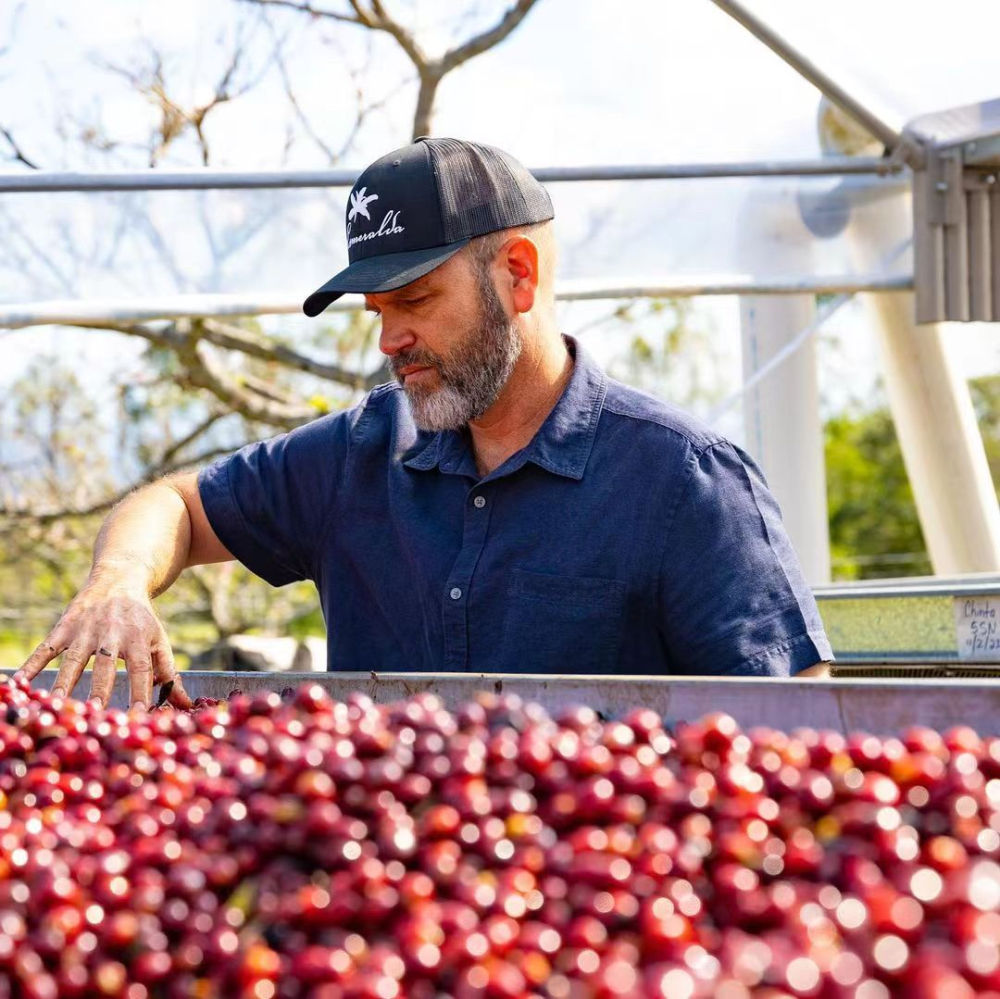
Hacienda Esmeralda's green bean processing plant is located in Cañas Verdes, at the foot of Baru Volcano, about a twenty-minute drive from the town of Boquete. When coffee cherries ripen, the estate owner arranges for workers to strictly follow standards, picking fresh fruit only at optimal ripeness, with full manual picking and selection, and transporting them to the factory in the shortest time for the next stage of sorting.
What Is Red Label? What Is Green Label?
On Front Street's bean list, there are about 10 Geisha coffee options alone. Some friends who see the words "Red Label" and "Green Label" may wonder what they actually represent.
The so-called Red Label is the Esmeralda Special grade (including auction lots). The highest-grade Red Label is picked from high-altitude Geisha (1600-1800 meters) coffee cherries, with cupping scores exceeding 90 points, mainly from the Jaramillo and Cañas Verdes farms. Although high altitude brings challenges in cultivation and harvest, in the Boquete region, Geisha's floral and fruity charm is most prominent. Hacienda Esmeralda holds independent auction events, and the Red Label lots put forward for competition from divided plots are called auction lots. Auction lots have unique numbers, each corresponding to an entire lot from a plot. The one most often mentioned is probably the Mario plot of the Jaramillo farm. The Hacienda Esmeralda Red Label Geisha coffee beans that Front Street obtained come from the Mario plot, using natural processing.
Front Street believes that brewing coffee is like cooking: variety and growing environment determine the refined flavor of the "ingredients" themselves, while the processing method is the key step in preparing those "ingredients." Traditional natural processing allowed Geisha coffee to display rich and diverse fruity aromas at the 2004 Best of Panama competition. Hacienda Esmeralda has extremely high requirements for detail control at every stage of green bean processing, which is also the guarantee of its Geisha coffee beans' high quality.
Hacienda Esmeralda spreads the harvested ripe fruit directly on the patio to dry, letting the coffee fruit slowly dry with its pulp and skin, absorbing more fruit aromas. For natural processing, the number of drying days is determined by weather conditions and drying space. Generally, Hacienda Esmeralda sun-dries coffee cherries on concrete beds for 3-5 days, 8 hours per day, then places them in a dryer for 72 hours of rotation to complete drying and prevent fermentation. After drying is complete, a huller is used to remove the outer layers of the beans. Front Street believes that specialty-lot natural Geisha flavor presents more of the sweet-and-sour sensation of fruit fermentation.

The other grade is Green Label, referring to Geisha lots named Private Collection. Green Label is selected from cultivation altitudes of 1600-1800 meters, all picked from the Jaramillo and Cañas Verdes plots, but Hacienda Esmeralda does not specifically identify plot information, so it does not participate in auctions. Although the grade is not as high as Red Label, it mainly expresses the signature classic flavor of high-altitude Geisha. The Green Label Geisha that Front Street obtained uses washed processing, with cupping notes of fresher, more natural lemon, berry, pomelo, and Tieguanyin tea flavors.
Washed processing first involves putting selected coffee cherries into a depulper to initially remove the skin and pulp; then placing the green coffee beans with residual pulp and mucilage into water to ferment for about 24 hours; after fermentation, washing the parchment-covered green beans in flowing water channels to remove pulp and mucilage; after washing, drying the coffee beans in the sun or with a dryer to reduce moisture content to about 12%. Finally, the parchment of the green beans is removed. Front Street believes that washed processing, as one of the most traditional green bean processing methods, not only makes coffee quality more stable, but also gives Geisha higher cleanliness, with a fresh and bright flavor that drinks like a cup of Tieguanyin tea with floral notes.
Front Street Coffee Barista's Pour-Over Recommendations
Since Front Street takes into account the different growing environments of different Geisha lots, the roaster makes corresponding adjustments based on the coffee beans' characteristics, but the main roasting direction is to highlight Geisha's floral aroma and fruity acidity, using a medium-light roast. Generally, when brewing high-altitude hard beans with a flavor profile leaning toward prominent acidity, Front Street recommends using a higher water temperature of 92-93°C to extract more aromatic substances.
For brewing, Front Street uses staged extraction: after grinding the coffee and placing it in the filter paper, start pouring 30g of water from the center for a 30-second bloom, taking care to keep a steady small stream circling gently from inside to outside throughout; for the second stage, pour 95g of water, and when the coffee liquid has nearly finished draining, begin pouring the third stage of 100g, until all the coffee has filtered through, then remove the dripper. The time is about 2 minutes, with about 10 seconds of tolerance.
Front Street compared the naturally processed Red Label Geisha lot with the Green Label Geisha: the Red Label Geisha gives off an intense rose aroma as soon as it is ground, with mango tropical fruit on the palate, and a smooth, creamy mouthfeel, completely unlike drinking a cup of coffee—more like a cup of floral-fruity tea; the Green Label Geisha's flavor is clearer, with jasmine aroma, the sweet-and-sour taste of berries and lemon, and a long-lasting green tea finish.
The above content is compiled by CoffeeHunters, a coffee news website.


