









For more coffee origin news and coffee knowledge, please followCoffeeHuntersToutiao account
The weather has started to get muggy recently. Whether indoors or outdoors, a cup of iced coffee is like a summer treasure. And iced coffee isn't something only coffee shops can offer—a small drip bag coffee packet can also give you a cup of refreshingly chilled iced coffee.
Drip bag coffee packets
First, let's talk about drip bag coffee packets. Simply put, a drip bag coffee packet is a super simplified version of pour-over coffee. The structure is a coffee filter bag with "ears" containing a measured amount of pre-ground coffee powder. It eliminates the tedious steps of pour-over coffee such as grinding coffee beans and preparing filter paper and a dripper, going straight to brewing. It's a coffee product very suitable for office workers stealing a moment of leisure from their busy schedules.

Every advantage has its disadvantage. While drip bag coffee gains convenience, due to the pre-ground coffee powder and the lack of a dripper's assistance, it falls slightly short of freshly ground pour-over coffee in terms of flavor.

Drip bags can also make iced coffee
The specification of a drip bag coffee packet is 10g per sachet, and the grind size is also preset by the vendor. So if you brew the drip bag following the normal process and then add ice cubes, the taste will be as thin as water. Therefore, the brewing method needs to be adjusted. In order to uphold the simplicity of drip bag coffee, Front Street will keep the method and auxiliary tools as simple as possible.

The materials to prepare are also very simple—just ice cubes, a short cup, hot water, and a drip bag coffee packet. If conditions allow, you can also prepare an electronic scale.
①Open the outer packaging bag of the drip bag coffee, tear off the seal along the "open" line, spread open the ears, and hang it on a tall cup.

②Prepare hot water at around 93℃. If you don't have a thermometer, you can boil the water, remove the lid, and let it sit for 2 minutes—the temperature will then be around 90-94℃.

③Pour 100ml of hot water into the coffee filter bag, making sure all the coffee grounds are submerged in the water, and let it steep for 3 minutes. Then pull the drip bag out of the cup and discard it.
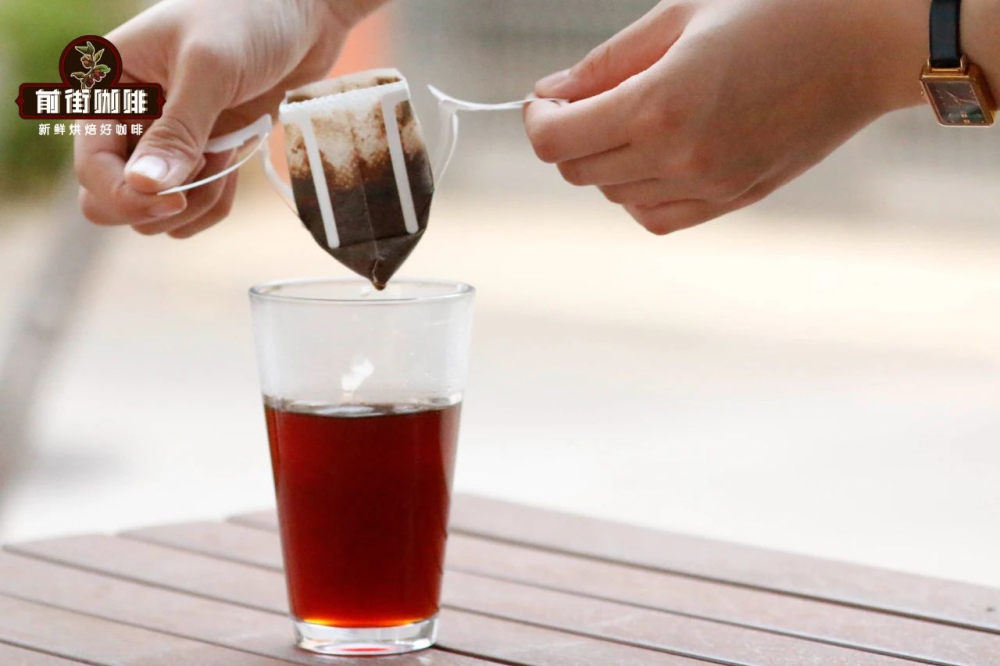
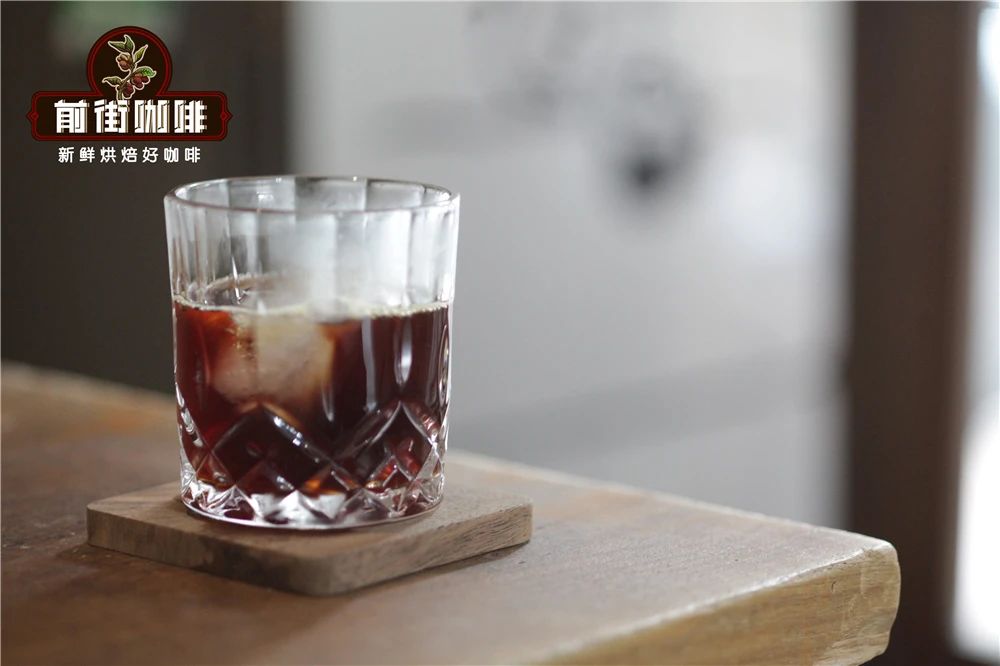
④The last step is to add ice cubes to cool it down. You can directly put large hard ice cubes into the cup, or prepare another cup with ice cubes and pour the hot coffee liquid into it. Front Street prefers the latter, as the ice cubes will last longer, making the iced coffee's flavor and mouthfeel even better.
Recommended drip bags suitable for making iced coffee
Many office workers have asked Front Street to recommend some coffee beans suitable for making drip bags. All fifty-plus single-origin coffee beans from different regions on Front Street's bean list can be made into drip bag coffee packets. Below, Front Street recommends a few drip bag coffees with relatively classic flavors.
1. Front Street Gute Gute Cooperative Drip Bag Coffee
This Front Street Gute Gute Cooperative coffee bean comes from Ethiopia's famous Yirgacheffe region, and the harvested coffee beans undergo washed processing. Traditionally, Yirgacheffe coffee used the oldest natural (sun-dried) processing method, but because early sun-dried coffee beans were mostly spread flat on the ground to dry, they inevitably picked up earthy and dusty off-flavors, and combined with a lack of proper sorting, the quality of sun-dried beans was generally average. In 1972, in order to improve coffee quality, Ethiopia introduced washed processing technology from Central and South America, which made Yirgacheffe coffee's jasmine aroma and bright citrus-lemon acidity clearer and more transparent, propelling it to become one of the representatives of the world's specialty coffee.

Front Street Yirgacheffe Gute Gute Cooperative Coffee
Region: Yirgacheffe Gedeo Zone
Producer: Gute Gute Cooperative
Altitude: 1900-2300m
Variety: Local heirloom varieties (Heirloom)
Processing method: Washed
Grade: G1
Flavor: Citrus, berries, lemon, cane sugar, green tea
2. Front Street Brazil Queen's Farm Coffee Beans
Queen's Farm is located in the Mogiana region of São Paulo State, Brazil. Unlike many large-scale regions in Brazil that win by quantity, this area has higher terrain, forming a relatively unique microclimate. Combined with the farm's hand-picking of coffee cherries at suitable ripeness, and each batch being processed with small-batch refined methods, most of the coffee beans produced are of specialty quality. Queen's Farm is most proud of its Yellow Bourbon variety, which, with its refined and delicate flavor, has won awards in multiple editions of Brazil's COE competition. This Front Street Queen's Farm coffee bean uses a medium-dark roast, highlighting the classic rich aroma of Brazilian coffee while showcasing Bourbon's own sweetness. We can not only taste the intense coffee aroma but also enjoy a clear, sweet aftertaste on the palate.

Front Street Brazil Queen's Farm Coffee Beans
Region: Mogiana region, Brazil
Farm: Queen's Farm
Altitude: 1400–1950m
Variety: Yellow Bourbon
Processing method: Natural (sun-dried)
Flavor: Dark chocolate, cream, peanut, sugarcane, nuts
3. Front Street Natural Huakui Drip Bag Coffee
This Huakui coffee bean introduced by Front Street Coffee (FrontStreet Coffee) was the champion of the natural group in the 2017 Ethiopia TOH coffee competition. It appeared before everyone with its unique strawberry-cream flavor, making a stunning debut. So in that year, this batch of green beans was introduced to China by Beijing green bean trader Hongshun, and in the same year Li Jianfei used this bean to win second place in the 2017 World Brewers Cup China region. This Ethiopian bean stood out particularly among the many Geisha competition beans, hence it was given the name Huakui.

Front Street Sidamo Huakui Coffee
Country: Ethiopia
Region: Sidamo
Altitude: 2250-2350m
Variety: Local heirloom varieties
Processing method: Natural (sun-dried)
Flavor: Berries, flower tea, honey, lemon, black tea
The above content is compiled by CoffeeHunters, a coffee news website.


