







Geisha coffee is the most dazzling variety in the specialty coffee wave of the past two decades, constantly setting new global coffee price records. In 2022, the Lamastus family of Panama auctioned a batch of just 7 pounds of honey-processed Geisha for a staggering $6,034 per pound, drawing attention once again. However, Geisha's legend was not built overnight—it was discovered in Ethiopia in 1931, and after being cultivated and propagated in places such as Kenya, Tanzania, and Costa Rica, it finally took root in Panama as the T2722 line. This article will trace the complete story of Geisha from wild collection to fame, introduce in detail Hacienda La Esmeralda's Red Label and Green Label product lines, and share Front Street Coffee's Geisha brewing recommendations, giving you a comprehensive understanding of this rare variety.
For professional coffee knowledge exchange and more coffee bean information, please follow Front Street Coffee.
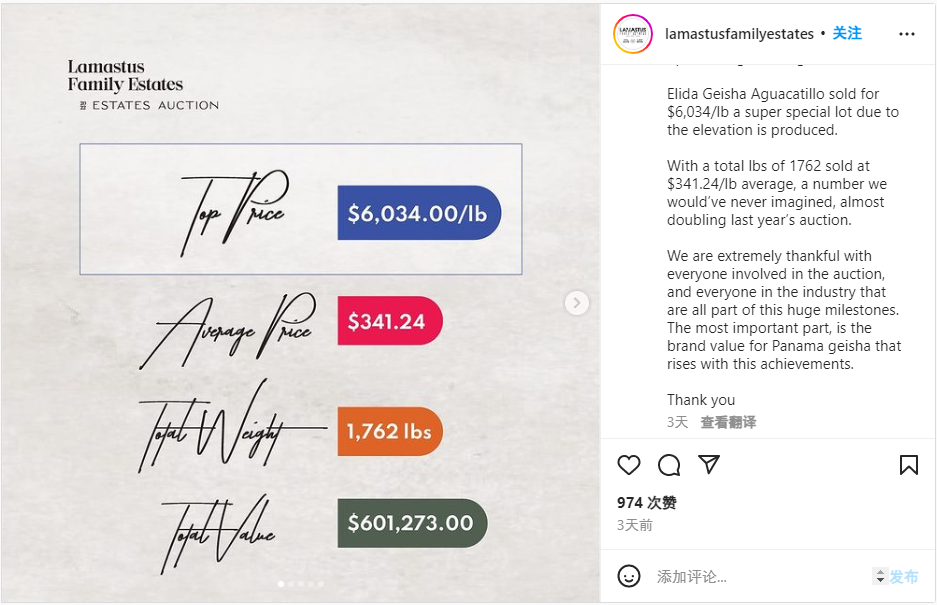
Geisha coffee can be called the "chosen bean" of the third wave specialty coffee movement, and for nearly two decades it has stood at the very top of the coffee price pyramid. The latest data shows that Panama's renowned Lamastus family, in an independent auction held in September 2022, set a new record for the world's most expensive coffee at more than $6,000 per pound.
This Lamastus private auction, managed by Panama coffee auction house Sensible Coffee, presented a total of 24 lots from three estates under the family: Elida, El Burro, and Luito.
According to data released by Lamastus Family Estates of Panama, the auction totaled 1,762 pounds of Geisha coffee beans, with total sales of $601,000 and an average price of $341.24 per pound. Among them, one lot of Geisha from Elida Estate fetched a high price of $6,034 per pound, equivalent to about 40,000 RMB per pound.
This batch of Geisha was grown at 2,000 meters above sea level at Elida Estate, using a honey processing method, and was officially stated to be only 7 pounds. It was ultimately purchased jointly by the well-known Taiwanese coffee bean merchants Oklao Specialty Coffee and Black Gold Specialty Coffee, Australia's Clay Coffee Collective, and the UAE's The Espresso Lab for a total price of $42,238.
Why can Geisha coffee beans capture so many people's hearts? And why did it only rise to fame in the past dozen years or so? Next, Front Street Coffee will take everyone back through a story about Geisha coffee beans.
Although Geisha only became famous in 2004, the discovery of this variety can be traced back 73 years earlier. In 1931, a British colonel collected coffee samples in the Bench Maji region of Ethiopia. At that time, there was no concept of distinguishing coffee varieties, so the officer mixed all the coffee samples collected in the area, as well as those purchased at the market, labeled them as Gesha, and sent them to a British plantation in Kenya.
By 1936, after completing his final sample harvest, the colonel wrote in a letter to the British envoy: "I thought the best Geisha coffee in this region was a cultivated variety, but never expected it to be wild." Thereafter, when European researchers recorded Gesha samples, they adopted the spelling Geisha.
It can thus be seen that the Geisha variety is actually a mixture of many native Ethiopian coffees, and it is more accurate to define it as a line. The now widely known Panama Geisha, as well as the Geisha grown in Central America, is only one branch of the Geisha line, numbered T2722.
The origin of T2722 Geisha coffee
After the British plantation in Kenya received all the Gesha samples, it first planted them at the Kitale Agricultural Center on the eastern side of Mount Elgon, and further selected lines such as Geisha1, Geisha9, Geisha10, Geisha11, and Geisha12. These seeds were then handed over to the Lyamungu Research Center in Kilimanjaro, Tanzania, for planting and cultivation research.
Later, the Lyamungu Research Center in Tanzania selected a total of five lines, VC496 to VC500, from the cultivated Geisha plants and distributed them to research centers in Uganda, Malawi, India, and elsewhere. From a Geisha mother plant different from VC496, Malawi then selected a variety resistant to Fusarium wilt and anthracnose, naming it Geisha56.
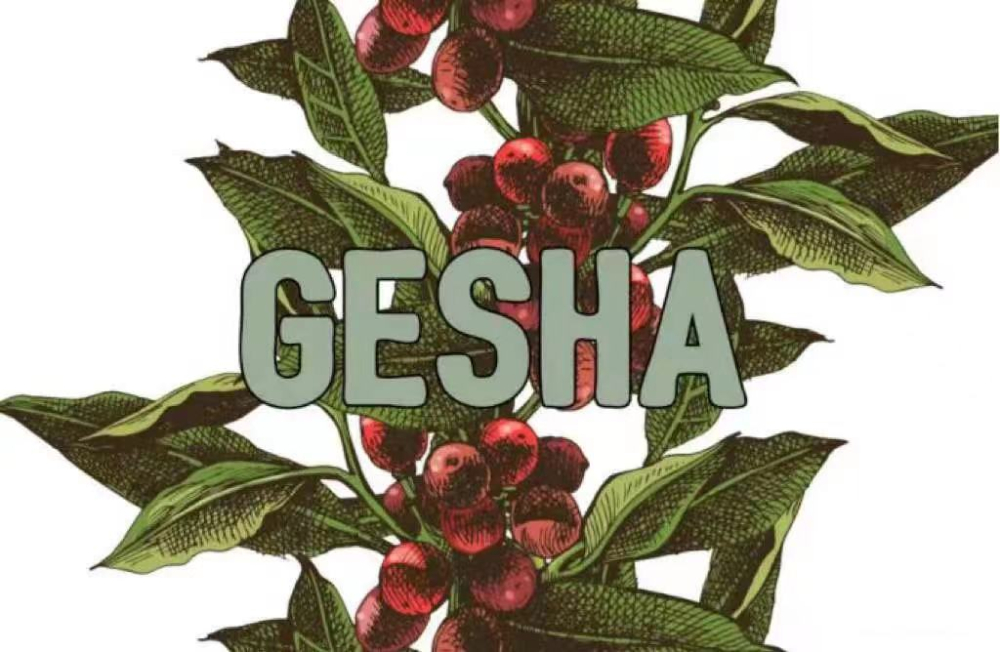
In 1953, the Lyamungu Research Center sent the more disease-resistant VC496 to the Costa Rican coffee research center CATIE. CATIE received and planted it, and after the variety adapted to the local terroir, changed its number to T2722 and gifted it to the owner of Panama's Don Pachi Estate for disease-resistant variety research. The owner of Don Pachi Estate then shared it with other local estates in Panama, including Hacienda La Esmeralda.
So why was T2722 undiscovered for so many years? On the one hand, as a crop, adapting to a new environment takes time, and the flavor does not necessarily improve. The reason T2722 tastes so good is inseparable from favorable timing and conditions, and even more so from a group of people who dared to break with traditional dark roasting and switch to light roasting to preserve coffee's acidity.
- Daniel, Daniel's sister Rachel, Daniel's father Price
T2722 became widely known thanks to Daniel, the third-generation manager of Hacienda La Esmeralda. He insisted on entering a batch of Geisha coffee beans with enchanting floral and fruity aromas—which did not suit the tastes of coffee connoisseurs at the time—into the 2004 Best of Panama (BOP) green bean competition. From that year on, Geisha coffee was like a dark horse, not only changing people's pursuit of coffee flavor but also reshaping Panama coffee's standing in people's minds.
Geisha coffee from Hacienda La Esmeralda
Today, although the most expensive Geisha coffee does not come from Hacienda La Esmeralda, when people mention Geisha coffee beans, the first estate that comes to mind is still Hacienda La Esmeralda.
Hacienda La Esmeralda is located in Boquete, a specialty bean-producing region of Panama, and consists of three farms: Jaramillo, Canas Verdes, and El Velo. Each farm is further divided into smaller plots.
Jaramillo has an average elevation of 1,600-1,700 meters and is subdivided into 5 small plots: Mario, Noria, Reina, Bosque, and Buenos Aires. The "Panama Hacienda La Esmeralda Natural Red Label Coffee Beans" sold by Front Street Coffee comes from the Mario plot.
Canas Verdes has an average elevation of 1,600-1,800 meters and contains 9 small plots: Lino, Coronado, Fundador, León, Montaa, Trapiche, Chinta, Cabaa, and Tumaco.
El Velo is the most recently purchased farm of Hacienda La Esmeralda, with an average elevation of 1,700-1,900 meters, and contains 7 small plots: Guabo, Portón, Durazno, Higuerón, Higo, Buena Vista, and guila.
Hacienda La Esmeralda's current Geisha product lines are divided into "Esmeralda Special" and "Private Collection," which are the Red Label and Green Label we are familiar with. The Blue Label, namely "Geisha 1500," was officially discontinued by Hacienda La Esmeralda in 2021.
The Esmeralda Special series (Red Label) is the highest-quality Geisha coffee bean sold by Hacienda La Esmeralda, grown in specific plots at 1,600-1,800 meters above sea level, and each lot must score more than 90 points in cupping. This series usually comes from the two sub-farms Jaramillo and Canas Verdes. Red Label lots also have another feature: each lot has an independent number, and all coffee beans in a lot come from the same small plot. The Red Label currently sold by Front Street Coffee comes from the Mario plot and uses natural processing.
The Private Collection series (Green Label) emphasizes the iconic flavor of Hacienda La Esmeralda's high-altitude Geisha coffee. Unlike the Red Label, it does not highlight specific plots, but is blended from lots produced by various specific plots. The Green Label Geisha coffee beans currently sold by Front Street Coffee use washed processing.
In order to preserve the enchanting flavor of Hacienda La Esmeralda's Geisha coffee beans, Front Street Coffee uses light roasting to retain Geisha coffee's bright acidity and captivating floral and fruity aromas. Front Street Coffee believes that the key to a delicious cup of coffee is, most importantly, freshness, so all shipped coffee beans are sent out 5 days after roasting is completed! Front Street Coffee is currently only on Taobao and Tmall.
Because Geisha coffee grows at high altitude, the temperature difference between day and night gives the coffee beans enough time to grow and develop flavor, so Geisha variety beans are relatively hard and tend to sink and clog the drainage holes. Therefore, Front Street Coffee recommends a grind size with a 78% pass rate on the Chinese standard No. 20 sieve (about the size of fine granulated sugar), and a brewing water temperature of 90-91°C.
Geisha coffee brewing parameters & pouring technique:
Front Street Coffee recommends using 15g of coffee grounds to brew Geisha coffee, paired with a Hario V60 small dripper, and then brewing with a 1:16 coffee-to-water ratio.
Once everything is ready, use a three-stage brewing technique: start the timer, pour water for the first time to 30g, and let it bloom for 30s; then begin the second pour, circling with a small stream of water to 125g, wait until the water level in the coffee bed drops halfway before pouring again, then continue circling with a small stream of water to 225g, and after all dripping is complete, the total extraction time is about 2 minutes 10 seconds to 2 minutes 20 seconds.
The above content is compiled by CoffeeHunters, a coffee news website.


