







Faced with the dazzling array of coffee grinders on the market, beginners often don't know where to start. From the perspective of Front Street, this article systematically sorts out three core lines of thinking for choosing a grinder: power source, price tier, and burr structure. The article first distinguishes the applicable scenarios and pros and cons of hand grinders versus electric grinders, then divides hand grinder tiers and the timing for getting an electric grinder according to budget, and reminds readers that electric grinders for espresso and single-origin cannot be used interchangeably. Finally, it deeply analyzes the grinding methods of the three burr types—flat burrs, conical burrs, and ghost teeth—and their effects on coffee particle shape, particle size distribution, and final flavor. Whether you are a student just getting started or an advanced player with a sufficient budget, you can find a purchasing direction that suits you.
Divided by extraction method, coffee grinders are usually classified into two categories: one serving atmospheric extraction scenarios such as pour-over and cold brew, and the other designed specifically for espresso. If viewed by burr structure, there are three types: flat burrs, conical burrs, and ghost teeth. If distinguished by drive method, they can also be divided into manual hand grinders and electric ones. However, Front Street has always believed that no matter which category it belongs to, the most critical thing when purchasing is still to act according to one's means and choose a suitable grinder based on one's own financial situation.
Today Front Street will talk with everyone about the dimensions beginners should consider when getting a grinder.
1. The power source of the grinder
At present, coffee grinders on the market are broadly divided into hand grinders and electric grinders, and the most fundamental difference between the two lies in where the power comes from.
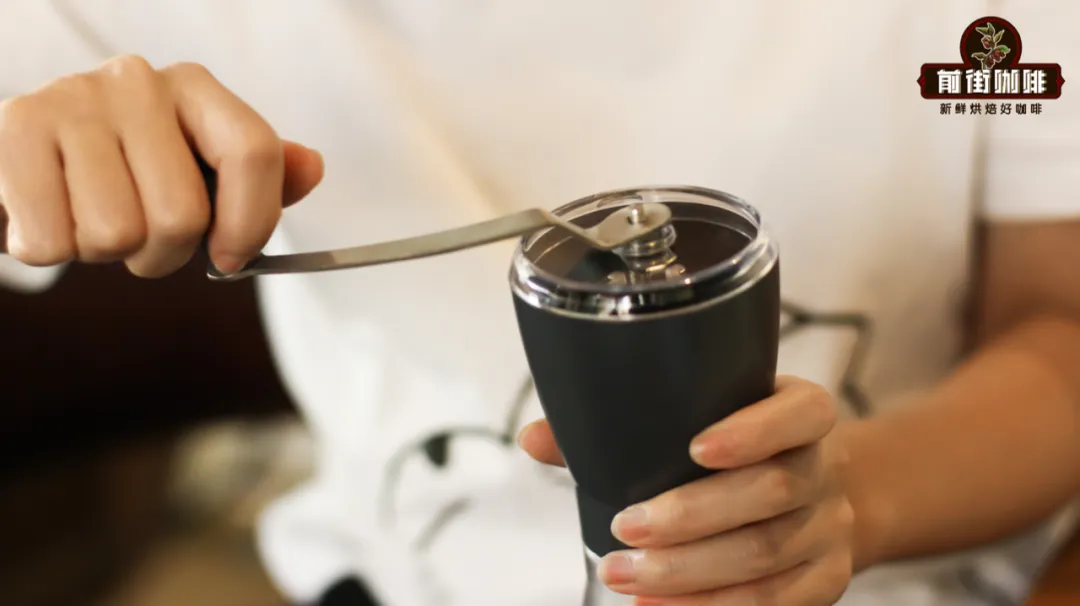
Hand grinders rely entirely on human power to drive the burrs. The user turns the handle at the top, and the internal burrs rotate accordingly, grinding the coffee beans into powder.
Because there is no built-in motor, hand grinders are usually made very compact and are effortless to carry around. If you have just been introduced to coffee and want to explore slowly, or if you are a student, or someone who frequently travels on business or vacation and cannot do without coffee, then a hand grinder that needs no electricity and is affordably priced will be a very ideal choice.
Electric grinders drive the burrs through a motor and must be connected to a power source to work. Their advantage lies in fast grinding, saving time and effort, and requiring less manual input and time.
But precisely because of the built-in motor, most electric grinders are rather large in size. Add to that the need to plug them in to operate, and their usage scenarios are relatively fixed and not easy to move around. If your budget is ample, the place where you brew coffee is relatively fixed, and you are unwilling to spend too much time and energy on grinding beans, then an electric grinder is worth considering.
2. The price range of the grinder
As Front Street mentioned at the beginning, the prices of coffee grinders on the market vary enormously, from a few dozen yuan to tens of thousands of yuan. Setting aside the few-dozen-yuan bean choppers and the tens-of-thousands-yuan commercial equipment, the budgets of ordinary household users for buying a grinder are mainly concentrated in the range of several hundred yuan to around one thousand yuan. We can narrow down our choices according to our own budget.
If the budget is relatively ample, an electric grinder is a very good choice. Whether in grinding precision or durability, electric grinders can be said to be comprehensively superior to hand grinders.
However, this advantage has a precondition, namely that the price must reach a certain level for it to be demonstrated. Usually only electric grinders priced at over one thousand yuan can ensure high-precision grinding quality. Below one thousand yuan, hand grinders are instead more advantageous. Because hand grinders do not contain a motor, their cost can be invested heavily in the grinding quality itself. Electric grinders, on the other hand, need to allocate part of their cost to the motor, so at the same price point, cheap electric grinders often perform worse than hand grinders.
If you plan to choose a hand grinder, you can select according to the following four tiers: 200–499 yuan, 500–799 yuan, 800–999 yuan, and above one thousand yuan.
The 200–499 yuan range belongs to entry-level hand grinders and is very suitable for beginners. The price is not high, but the grinding quality is still acceptable and can meet the basic requirements for grinding particle size. The 500–799 yuan range counts as advanced hand grinders. The quality of the burrs and bearings has improved somewhat, and the grinding quality and durability are also enhanced accordingly. The 800–999 yuan range belongs to high-end hand grinders, but based on Front Street's actual experience, compared with grinders in the previous tier, there is not much obvious difference.
As for the tier above one thousand yuan, Front Street will not introduce it much, because their quality and experience show visible improvements compared with those below one thousand yuan. Basically, hand grinders at this price point will not have major problems, so if your budget is above one thousand yuan, you can simply choose the hand grinder you like. If you want to play it safe, you can choose that relatively well-known German brand hand grinder.
But if the budget reaches several thousand yuan, then in fact you can consider getting an electric grinder. Basically, within four thousand yuan you can buy a quite good electric grinder. So what options are there?
Royal Fuji, Fellow ODE, Timemore Sculptor, and others are models that Front Street considers relatively worth buying, with guaranteed grinding precision and quality and relatively high cost performance. It is just that when buying an electric grinder, you should note that electric grinders are divided into two different types: espresso and single-origin. Because the two extraction methods have very different requirements for grind size, the vast majority of grinders on the market cannot serve both purposes. Before purchasing, it is best to confirm clearly to avoid trouble such as needing returns or exchanges.
3. Burr types of the grinder
In fact, the above two lines of thinking are already enough to help you choose a suitable grinder. But if you want to go further, we can even comprehensively consider the shape and particle size distribution of the ground particles, and the main factor determining these is the grinder's burrs.
Grinder burrs are mainly divided into three types: flat burrs, conical burrs, and ghost teeth. Because the grinding methods differ, the resulting coffee particles also differ in shape and particle size distribution.
Flat burrs are a relatively common type of burr, and their grinding method is mainly "shaving." After coffee beans are fed in, they are shaved by the sharp patterns of the flat burrs into flakes or chunks. Coffee powder of this shape has a larger surface area exposed to water, and during extraction the substances dissolve relatively faster, so the coffee taste is richer and the layers are more complex.
Conical burrs are also common. Their grinding method is mainly "crushing," and the ground coffee particles are mostly irregular chunks with relatively fewer fines. Such particles are larger in volume and thicker, and water takes longer to penetrate into the interior of the coffee particles, which can slow down the dissolution rate of substances and make the brewed coffee less prone to over-extraction.
Ghost teeth burrs, strictly speaking, count as an improved version of flat burrs. Their structure is the same as flat burrs, both composed of two burr discs, except that the cutting edges have been changed into a gear shape. This change can effectively reduce the extrusion phenomenon during grinding, making the particles more uniform while also reducing fines.
The grinding method of ghost teeth is mainly "rubbing," and the ground particles are mostly spherical-like polygons. In addition, the distribution of coarse and fine particles is relatively uniform, so the consistency and body of the brewed coffee will both be relatively high.
The above are the three lines of thinking on choosing a grinder shared by Front Street. Everyone can, according to their own budget and needs, find a grinder suitable for themselves and then buy with confidence.
The above content is compiled by CoffeeHunters, a coffee news website.


