







Arabica coffee is the dominant variety in the global specialty coffee market, but many people find that products labeled as Arabica beans can taste vastly different. The reasons behind this are closely tied to variety branches, growing conditions, and genetic evolution. This article will systematically outline the origin and taxonomic position of Arabica coffee, analyze its demanding requirements for growing environments and its weaknesses in disease resistance, and introduce the bean characteristics and flavor profiles of common branch varieties such as Typica, Bourbon, Caturra, Catuai, SL28, SL34, and Geisha one by one. It also includes representative product recommendations from Front Street Coffee to help coffee enthusiasts build a clear framework for understanding varieties.
Everyone opening this article should already be very familiar with the name "Arabica coffee"~ When shopping in supermarkets or browsing coffee product pages, products labeled with Arabica coffee beans are everywhere, yet they actually taste different from one another. Why exactly is that?
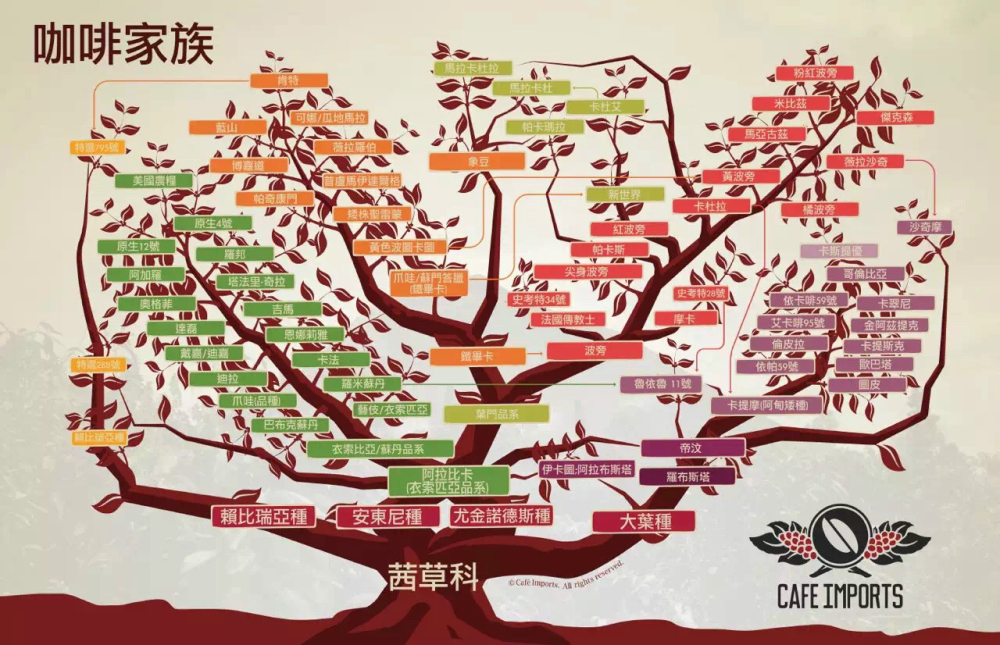
The coffee we drink daily mostly belongs to the subdivided varieties under the broad category of Arabica. From a botanical classification perspective, the Arabica species is the offspring of a cross between the Anthony variety and the Eugenioides variety in the Rubiaceae family, and falls under the category of small-seed coffee beans, so Arabica coffee beans are also often called small-seed coffee. Looking at the coffee family chart below, you can clearly see that Robusta belongs to medium-seed coffee, while Liberica (also called Liberia) is the representative of large-seed coffee.
Compared with the other two major categories, the various branch varieties derived from the Arabica species have clearly more demanding requirements for growing environments. Generally speaking, they need to grow at higher altitudes (the common growing altitude range for Arabica coffee is 600 to 2,000 meters), while also requiring fertile soil, moderate humidity, warm temperatures year-round, and a certain temperature difference between day and night, as well as sufficient and appropriate sunlight during the day... In addition, they cannot do without careful management and care from coffee farmers. For this reason, Arabica coffee beans often present richer and more delicate flavor layers than Robusta and Liberica (these two varieties are almost undemanding about growing environments).
Every advantage has its disadvantage... What humans find delicious, insects naturally will not let pass! Many Arabica varieties lack sufficient insect-resistant substances in the plants and fruits themselves, because nutrients and energy are prioritized for developing flavor. Moreover, because they have long been in a state of "delicate care," many varieties also lack sufficient resistance to coffee leaf rust, which is fatal to coffee trees... Thus, in order to adapt to the specific environments of different regions, many coffee trees differentiated into more varieties through natural evolution, but many of them are "specialists"... Those with strong disease resistance have weak insect resistance; those with good insect resistance have mediocre flavor performance; and those with outstanding flavor cannot achieve high yields...
It is precisely for this reason that humans have used pairing and hybridization between varieties to cultivate more Arabica varieties with balanced performance in flavor, resistance, and yield. In the Arabica branch system, the oldest varieties currently recognized are Bourbon and Typica, and the remaining branch varieties are basically derived from the natural evolution of these two or from human pairing and hybridization.
Typica — native to Ethiopia and southeastern Sudan, it is one of the oldest coffee varieties in the Arabica species. The top leaves of the Typica plant are copper-red, hence it is also nicknamed "red-top coffee." Most of the Arabica varieties we see today are derived from Typica. Typica coffee beans are oval-shaped, relatively slender and plump, with a clean mouthfeel and a quiet, elegant flavor. The "Jamaica Blue Mountain No. 1 Coffee Beans" sold by Front Street Coffee is the most representative work among Typica varieties!
Bourbon — a natural mutation of Typica, and the most notable change in its coffee beans is that the bean shape shifted from Typica's long shape to a round shape. Bourbon coffee was first grown on Reunion Island in Brazil, which was called Bourbon Island (le Bourbon) before 1789, and the variety was named "Bourbon" because of this. According to observations by Front Street Coffee, Bourbon coffee beans are short and round, thick-bodied, with a smooth mouthfeel and especially prominent sweetness. The "Brazil Queen Estate Coffee Beans" sold by Front Street Coffee is the best representative among Bourbon varieties!
Because there are simply too many branches derived from these two varieties, this article only selects some of the more common and more frequently drunk coffee varieties for introduction.
Caturra, Catuai — Caturra is a natural mutation of the Bourbon variety, while Catuai is the product of artificial hybridization between Caturra and Mundo Novo. These two varieties are most common in Central and South America, and their flavors are relatively similar, so they are usually planted mixed together. Caturra has higher yield, a bright mouthfeel, and obvious sweetness; Catuai not only inherits Caturra's high-yield characteristics but also has strong disease resistance, a clean mouthfeel, and rich fruity aroma. The "Costa Rica Region Daily Coffee Beans" sold by Front Street Coffee is the best representative of the Caturra and Catuai varieties.
SL28 and SL34 — SL28 comes from the Bourbon genetic group, with a short and round bean shape, a thick body, elevated acidity, and outstanding sweetness. SL34 comes from the Typica genetic group, with an oval bean shape that looks less plump from the side than Typica and appears relatively flat; in flavor it is balanced and full with acidity and sweetness, carrying a caramel-like finish. The "Kenya Asalia Coffee Beans" sold by Front Street Coffee is the best representative of SL28 and SL34.
Geisha — Geisha originates from the Geisha Forest in Ethiopia. Compared with other varieties, the most prominent feature of Geisha coffee is its extremely low yield, with plants showing long internode spacing, few flowers, and few fruits. Geisha coffee beans are slender, pointed at both ends and plump in the middle, and in flavor they possess rich floral aromas, clean citrus-like acidity, and a tea-like sweet aftertaste. The "La Esmeralda Washed Green Label Geisha Coffee Beans" sold by Front Street Coffee is the best representative of the Geisha variety!
For professional coffee knowledge exchange and more coffee bean information, please follow Coffee Workshop (WeChat public account: cafe_style)
For more specialty coffee beans, please add the private WeChat of Front Street Coffee: qjcoffeex
The above content is compiled by CoffeeHunters, a coffee news website.


