







Typica is one of the oldest varieties of Arabica coffee, originating in Ethiopia and traveling through Yemen, India, Europe, and Southeast Asia before finally taking root in Central and South America, shaping the map of today's coffee-producing countries. This article will systematically review Typica's botanical characteristics and global dissemination paths, and provide a detailed reconstruction of how a single Typica seed grows into a coffee tree. At the same time, Front Street Coffee will combine the roasting, cupping, and brewing practices of Jamaican Blue Mountain Typica to let you experience the clean, serene, and balanced flavor of this classic variety.
For more specialty coffee knowledge, please follow: Front Street Coffee (Frontsteet Coffee)
Today Arabica coffee beans account for about 70% of global production, and Typica, as one of the oldest varieties in the Arabica family, has spread from its place of origin in Ethiopia to all parts of the world, driving the development of many coffee-producing countries. How exactly did it spread across the globe? And how is Typica cultivated? In this article, Front Street will discuss the history of Typica coffee's spread and how Typica grows from a single coffee bean into a coffee tree.
Typica Coffee Bean Variety
Typica belongs to a sub-variety under Arabica coffee and was first grown on Martinique. Currently, Central America, Jamaica, the Kona region of Hawaii, Papua New Guinea, and East Timor are the main cultivation areas for Typica. In order to obtain higher coffee yields from high-quality Typica, Typica coffee varieties are usually crossbred with other species.
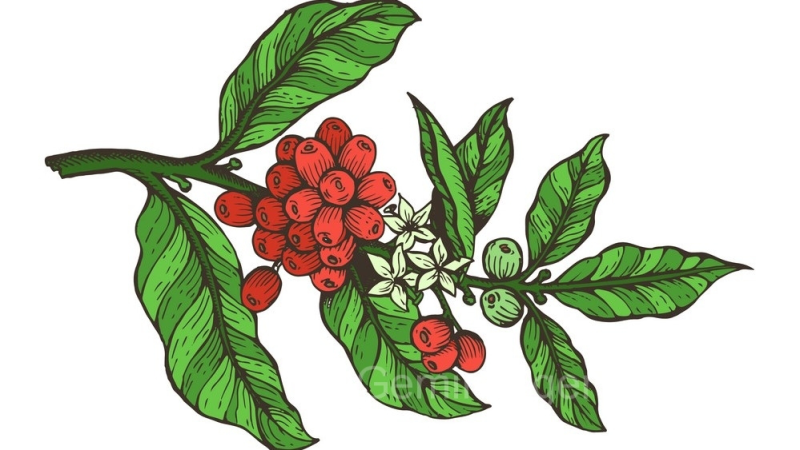
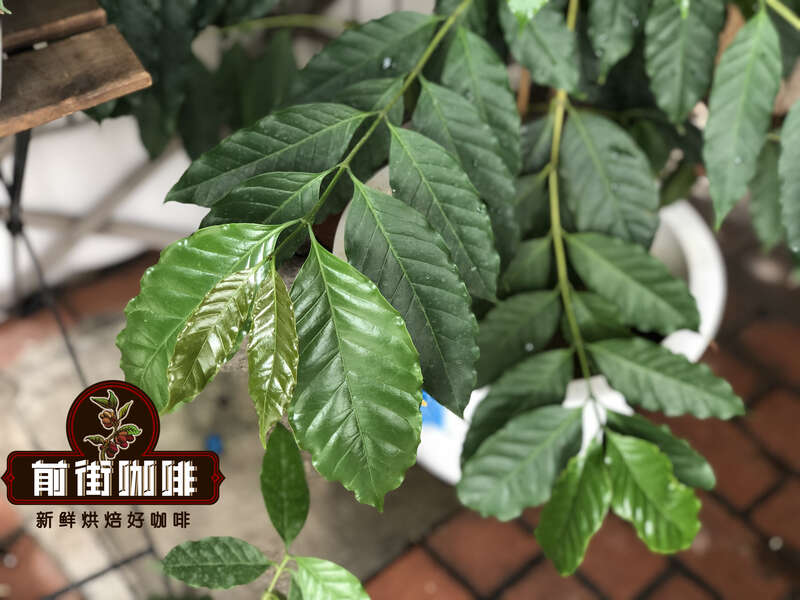
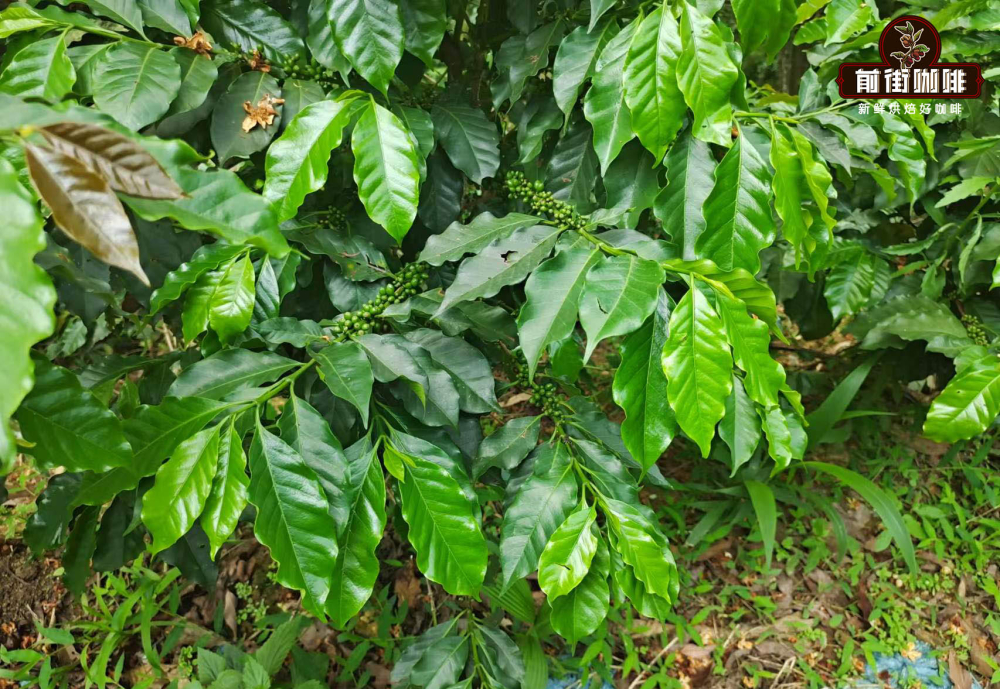
The Typica tree has distinctive characteristics and may be the easiest variety to identify. These plants are conical in shape, with a main vertical trunk that can reach up to 5 meters in height. This height means that, compared with other varieties, the distance between branches and between nodes on the same branch is longer. The side branches form an acute angle of 50 to 80 degrees with the vertical trunk. Neither the trunk nor the branches are very thick. The leaves, fruit, and green beans are usually slender. The tips of new leaves are bronze-colored. Compared with other Arabica varieties, Typica leaves have a smoother surface and fewer wavy edges. Typical Typica fruit is bright red when ripe.
The growing tip of Typica is bronze-colored, which is one of the important signs for identifying it. Its beans are relatively large, with a pointed oval or slender pointed shape, so some people also call it "red top coffee." However, Typica also has obvious shortcomings: low yield, high altitude requirements, susceptibility to leaf rust, and weak resistance to pests and diseases. Through cupping, Front Street Coffee has found that Typica coffee has a uniquely clean and serene flavor, as well as balanced characteristics and a high degree of cleanliness in the mouthfeel.
The Global Spread Path of Typica Coffee
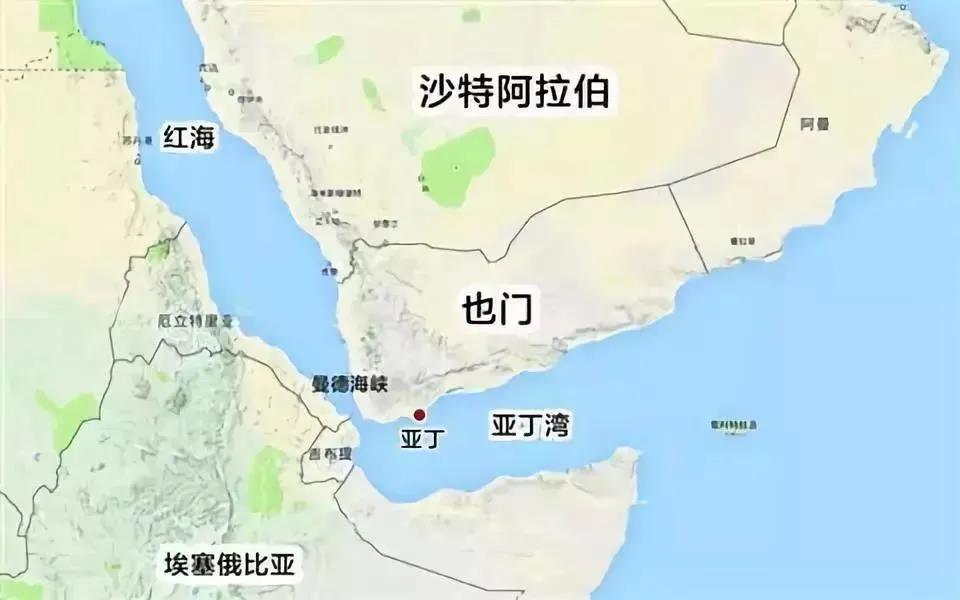
The homeland of Typica—Ethiopia: As for the name Arabica, it is easy to mistakenly assume that its homeland is the Arabian Peninsula, but it actually originated in Ethiopia. The reason it is called Arabica is entirely due to the key geographical position of the Arabian Peninsula, a place linking Asia, Europe, and Africa. Before the Age of Exploration, this was a gathering place for world cultural exchange. It was not until 1753 that the botanist Linnaeus mistakenly believed that the coffee originated in the Middle East and gave it the scientific name Coffea arabica L. In 2002, a coffee genetic material research project funded by Europe found that the genetic diversity of coffee in places such as Yemen was far lower than in Ethiopia, which finally "helped" Arabica find its homeland. The first stop of Typica's spread—Yemen: After coffee was first introduced to the Arabian Peninsula, it was initially used only as medicine. After taking root over several centuries, around 1500, the ports of Mocha and Aden in Yemen began to brew a drink by crushing dried coffee fruit pulp and soaking it in water, which became "Qishr." Later, it developed into "Qahwa," made by grinding and boiling roasted coffee beans with the fruit pulp and cinnamon.
The second stop of Typica's spread—India: Around 1600, a devout Indian Muslim named Baba Budan traveled to Mecca on pilgrimage, became fascinated with coffee, and attempted to illegally smuggle green beans back to India. He stole 7 Yemeni Typica coffee seeds, returned to the state of Karnataka in southwestern India, and planted them on the Chandragiri Hills, where they successfully propagated. This was the first recorded successful case in history of smuggling coffee green beans out of Yemen for cultivation elsewhere.
The third stop of Typica's spread—Europe: Around the 17th century, Yemen's Mocha Port had already become a world-famous coffee export port, and at that time, in order to prevent coffee seeds from falling into other places for cultivation, exported coffee was all roasted beans, so coffee was also called black gold. When coffee was introduced to Europe in the 17th century, the Dutch, known as the "sea coachmen," smelled enormous business opportunities. It could be said that whoever possessed coffee possessed gold.
In the early 17th century, Europeans led by the Dutch seized Yemeni coffee saplings through illegal theft or armed robbery, but Europe's cold climate meant that even the stolen coffee saplings could not survive and withered. It was not until 1616 that Captain De Boeye of the Dutch East India Company stole coffee trees from Mocha, Yemen, transported them back to Amsterdam, and carefully cultivated them in a large greenhouse, where they finally flowered and bore fruit. This Typica coffee tree was also called the "European mother plant." In 1699, the Dutch transplanted Typica from India to Java and succeeded in trial cultivation, and in 1706 they transported Java's Typica back to the Netherlands for cultivation.
The fourth stop of Typica's spread—Southeast Asia: As early as 1658, the Dutch transplanted descendants of the "European mother plant" to Sri Lanka, but unfortunately the cultivation failed. Later, in 1699, the Dutch transplanted coffee trees from Malabar in eastern India to Java. This trial cultivation succeeded, and Typica grew steadily in Java. In 1718, the Dutch transplanted the successfully trial-grown Typica from Java to Sumatra and Sulawesi. After more than a century of propagation, just when Indonesian Typica was at its peak, a leaf rust epidemic at the end of the 19th century swept through most of Indonesia's Typica, and later they had no choice but to introduce the more disease-resistant Robusta variety. The fifth stop of Typica's spread—Central and South America: In 1708, France stole coffee trees from Mocha but failed in trial cultivation in Dijon. In 1714, the mayor of Amsterdam presented Java coffee saplings to King Louis XIV of France, and France also built a greenhouse to carefully care for this single plant. Between 1715 and 1719, descendants of this mother plant were transplanted to French territories in Central and South America, but none succeeded.
In 1720, a naval officer named Gabriel de Clieu stole a Typica sapling from the Royal Botanical Garden in Paris and escorted it across the Atlantic to the Americas, finally arriving in 1723 at the French island of Martinique in the Caribbean, where he carefully planted this sole coffee sapling. Three years later, this "European mother plant" was heavy with fruit. By 1777, 19 million Typica trees had been planted on Martinique. In the mid-to-late 18th century, countries in Central and South America such as Jamaica, Colombia, Guatemala, Costa Rica, and Venezuela also successively introduced Typica coffee trees, and thus Typica firmly took root in Central and South America.
The sixth stop of Typica—a small journey in the 19th century: In 1825, Hawaii introduced improved Typica coffee from Guatemala and planted it in the Kona region, thus becoming today's famous island coffee—Kona coffee. In 1904, French missionary Father Tian Deneng went to Dali to preach and planted a Typica coffee tree in Zhukula Village. This coffee tree also became the ancestor of Yunnan coffee.
Now that we understand the spread history of Typica coffee, let us follow Front Street Coffee to learn about the growth process of Typica coffee. In recent years, Front Street has been growing Typica coffee beans on land at the border of Yunnan and Myanmar, with the aim of improving the quality of Yunnan coffee by changing the existing varieties grown in Yunnan. Next, follow Front Street to learn about the process from a coffee bean to a coffee tree.
Seed selection: This still starts with a single coffee seed. The coffee seed is the "coffee bean." At the very beginning, seeds must be selected, and high-quality varieties and high-quality beans must be chosen. Variety refers to varieties such as Typica and Bourbon. Front Street believes that only high-quality varieties can produce high-quality coffee, while high-quality beans refer to quality. Front Street believes that the fruit selected for breeding must be fully ripe, normal in shape, plump and full, and basically uniform in size. If short-term storage is needed, the seed moisture content should be reduced to 13%. If sown within 1-3 months, the germination rate can reach 100%, while within 4-7 months the germination rate is only 29%.
Germination promotion: First, soak the prepared coffee seeds in 45% warm water for 24 hours, then sow the seeds in medium-coarse sand (river sand), cover with 1-2 cm of coarse sand, and then spread a layer of 3-5 cm of rice straw, keeping the sand layer moist. About 20 days after sowing, the coffee seeds begin to sprout, and after 40-60 days they begin to break through the soil. At this time, a shade shed must be built, requiring a shade rate of 80%.
Seedling cultivation: When the sprouts begin to grow their first pair of leaves, Front Street's coffee farmers screen the coffee seedlings, selecting high-quality coffee seedlings and moving them into nutritional bags for seedling cultivation.
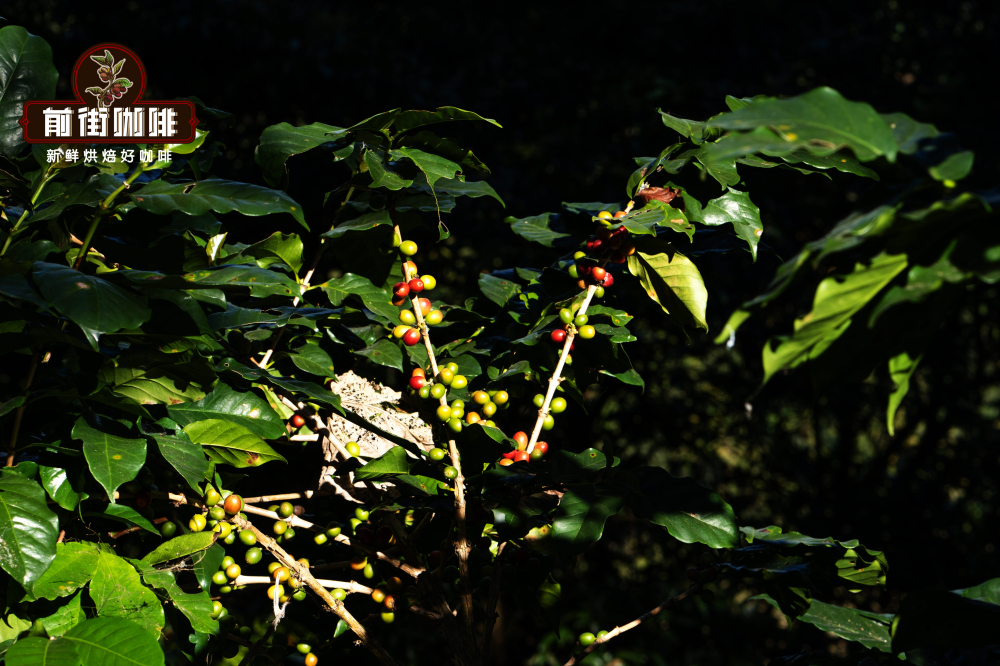
Becoming a tree: After seedling cultivation is completed, the plants must be transplanted into the field. Altitude is closely related to coffee quality. Front Street believes that Arabica coffee planted above 1,200 meters will have better quality. In the first and second years after the coffee tree is planted, vegetative growth is dominant, and only in the third year and afterward will it begin to flower and bear fruit.
Flowering: After the dry season, the coffee tree will bloom on rainy days. The first flowering period of a coffee tree is about 3 years after planting. The flowers are white and grow in clusters on the second branch of the coffee tree, with 5-6 petals. At this time, you can smell the pure white flowers carrying a rich jasmine fragrance.
Fruiting: A few months after the coffee flowers wither, the coffee tree begins to bear fruit. The newly formed coffee cherries are green. As they gradually mature, the color changes from green to yellow, and when fully ripe they turn red.
Harvesting: When the coffee cherries are ripe, the fruit farmers must begin picking. The best picking method is manual selective picking, choosing only fully ripe red cherries. Training a skilled coffee picker requires a great deal of cost. There is a saying, "Who knows that every grain on the plate is the fruit of hard work?" Whether it is rice, coffee beans, or other crops, behind all cultivation is a group of farmers carefully tending the plants, so Front Street would like to remind everyone here not to waste any food that was not easily obtained~
All right, back to the topic. The most famous place in the world for growing Typica today is none other than Jamaica's Front Street Blue Mountain Coffee. Next, through roasting, cupping, and brewing, Front Street will see how the flavor of Jamaican Blue Mountain Typica coffee performs. The Blue Mountain range is located in the eastern part of Jamaica, at an altitude of 1,000-1,700 m. Blue Mountain lies in the coffee-growing belt and has fertile volcanic soil, fresh air, no pollution, and a humid climate with frequent fog and rain all year round (average precipitation is 1,980 mm, temperature around 27°C). Such a climate creates the world-renowned Jamaican Front Street Blue Mountain Coffee. Only Blue Mountain grown in this region is authentic Front Street Blue Mountain Coffee. Blue Mountain Typica was transplanted from Martinique to Jamaica's Blue Mountains in the 1720s. After more than 200 years, Blue Mountain Typica evolved better disease resistance, especially resistance to coffee berry disease, superior to ordinary Typica. However, once Blue Mountain Typica leaves Jamaica, it cannot replicate its sweet and subtly fragrant characteristics.
The Front Street Blue Mountain No. 1 coffee currently listed by Front Street comes from Clifton Farm, which is also the only estate in the Blue Mountain growing area with rainforest certification. Before 2019, Clifton Farm's Blue Mountain coffee had always used the washed method to process green coffee beans. During processing, the skin and pulp are first removed, and the beans are allowed to ferment for 12-18 hours. Then the fermented beans are placed in a tank and moved back and forth, using the friction of the beans and the force of flowing water to wash the coffee beans until smooth and clean. After washing, at this point the coffee beans are still wrapped in the parchment layer, with a moisture content of 50%, and must be dried in the sun to reduce the moisture content to 12-14%; otherwise they will continue to ferment and become moldy and spoiled. After that, the coffee beans are screened and then stored in dedicated warehouses.
Front Street Coffee Blue Mountain Coffee Roasting Notes
Front Street Jamaican Blue Mountain: Charge when the drum temperature reaches 170°C, set the airflow to 3, and after 1 minute adjust the heat to 140°C, keeping the airflow unchanged. Roast until 5'10'', at 153°C, when the bean surface turns yellow, the grassy smell completely disappears, and dehydration is complete. Adjust the heat to 115°C and change the airflow to 4. At the 8'00" minute, ugly wrinkles and dark patches appear on the bean surface, and the toast aroma clearly turns into coffee aroma, which can be defined as the prelude to first crack. At this time, you must listen clearly for the sound of first crack. At 8'12", first crack begins. Reduce the heat to 90°C and fully open the airflow (adjusting the heat must be very careful; do not reduce it so much that there is no cracking sound). Drop the beans at 201.3°C.
Front Street Coffee Blue Mountain Coffee Cupping Report
Front Street Coffee conducts cupping within 8-24 hours after sample coffee beans are roasted. The cupping bowls generally used by Front Street Coffee's roasters are 200 ml ceramic bowls, marked with 150 ml and 200 ml scale lines. According to SCAA standards, the TDS of the water is about 150 ppm. Too low TDS can easily cause over-extraction, while too high TDS affects the mouthfeel and easily causes under-extraction. The water temperature used for cupping is 94°C. According to SCAA cupping standards, the grinding degree is controlled so that the passing rate through a No. 20 standard sieve (0.85 mm) is 70%-75%. Ratio: 11 grams of coffee grounds plus 200 ml of hot water, that is, 1:18.18. The concentration extracted in this way is exactly within the golden cup range of 1.15%-1.35%. Steeping time: 4 minutes. Front Street Washed Blue Mountain Coffee Cupping
Dry aroma: roasted peanut, hazelnut, melon, chocolate Wet aroma: oolong tea, caramel, honey, chocolate, almond Flavor: roasted nuts, chocolate, almond, melon, honey, balanced sweet-acid-bitter
Front Street Natural Blue Mountain Coffee Cupping Dry aroma: nuts, woody Wet aroma: caramel Flavor: berries, smoked plum, mulberry, dark cocoa, nuts, slight fermented note
Front Street Coffee Blue Mountain Coffee Brewing Suggestions
Dripper: Kono dripper Coffee dose: 15 g Coffee-to-water ratio: 1:15 Water temperature: 88-89°C Grind size: medium-coarse grind (75% passing rate through No. 20 standard sieve)
Front Street brewing method: In the first stage, pour 30 grams of water for a 30-second bloom, then pour 95 grams (the electronic scale shows about 125 grams), completing the pour in about 1 minute. When the water level drops to two-thirds of the coffee bed, pour the remaining 100 grams (the electronic scale shows about 225 grams), completing the pour in about 1 minute 40 seconds to 1'45". At 2 minutes 05 seconds to 2 minutes 1 second, the drip filtration is completed. Remove the dripper and finish extraction.
[Front Street Jamaican Blue Mountain Coffee]: On the palate, there are flavors of dark chocolate and nuts, high cleanliness, very bright, good body, and a balance of acidity, sweetness, and bitterness.
The above content is compiled by CoffeeHunters, a coffee news website.


