







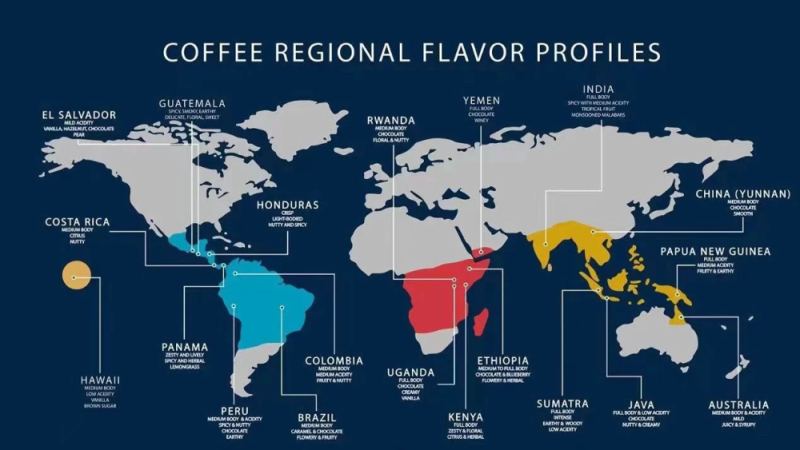
When selecting coffee beans, in addition to checking the packaging information, it is often more accurate to start with the basic flavors of the three major coffee-producing regions and then narrow it down by specific estate to find the one that suits you best. Front Street Coffee stores mainly focus on single-origin beans, covering more than fifty types of coffee beans from the three major regions worldwide. This article will focus on the Asian coffee-producing regions, highlighting the varieties, processing methods, and flavor differences of two representative origins, Yunnan, China, and Indonesia, while also introducing the coffee characteristics of Papua New Guinea. Yunnan coffee has continued to gain strong market momentum in recent years, with a regional flavor profile based on brown sugar and nuts, full-bodied and mellow; Indonesia, on the other hand, is known for the herbal, medicinal aroma of Mandheling, with the wet-hulled process giving it a unique character. The article also summarizes Front Street's cultivation practices at its Baoshan estate in Yunnan, as well as the differences among several Mandheling coffee beans, for coffee lovers' reference.
For more specialty coffee knowledge, please follow: Front Street Coffee (Frontsteet Coffee)
When choosing coffee beans, in addition to checking the information on the packaging, Front Street Coffee (FrontStreet Coffee) also suggests starting with the basic flavors of the three major coffee-producing regions, and then further narrowing the choice by estate.
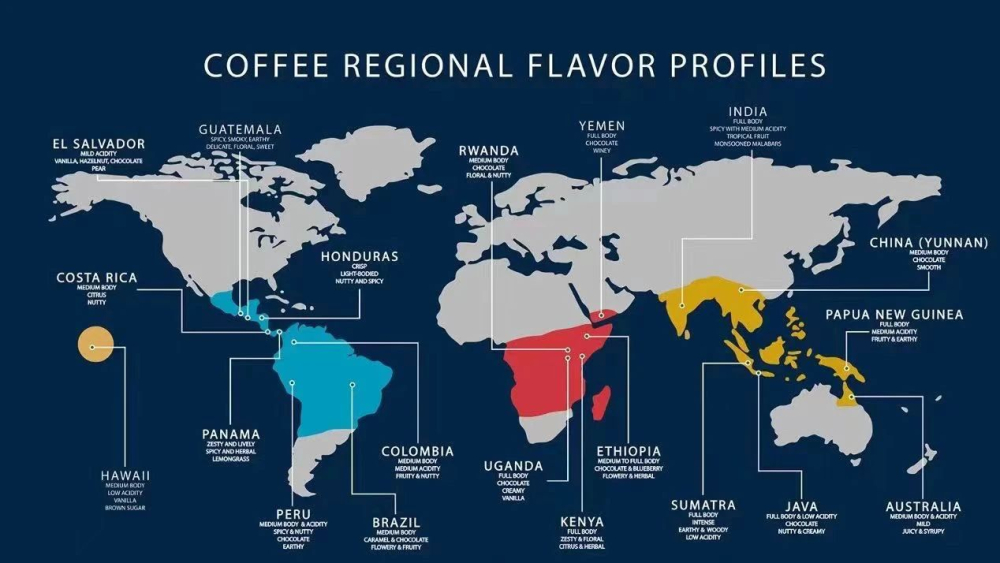
Front Street Coffee (FrontStreet Coffee) stores mainly feature single-origin coffee beans, covering more than fifty different origins across the world's three major coffee-producing regions. After cupping many coffees from the three major regions, Front Street Coffee (FrontStreet Coffee) has concluded that African origins are known for their acidity, American origins lean toward nutty and chocolatey notes, while Asian origins stand out for their full body, with strong and rounded sweetness.
Recently, the Yunnan origin has maintained a strong market trend. During the Spring Festival holiday, fresh fruit picking in Yunnan did not stop, and more than half of the producing areas have now entered the final stage. Coffee farmers and coffee enterprises are fairly satisfied with current prices, market confidence is strong, and production and processing enthusiasm has increased compared with before the holiday, with the volume of parchment and green beans clearly rising. Yunnan is China's largest coffee-producing region, with a full-bodied flavor based on brown sugar and nuts. In this article, Front Street will talk with you about the Asian coffee-producing region to which Yunnan coffee belongs.
Asian Coffee-Producing Regions
Well-known producing countries in the Asian coffee-producing region include Indonesia, China, Vietnam, India, and Papua New Guinea. This region as a whole presents a full-bodied character, but due to differences in terrain, climate, and altitude, the flavors of each country vary. Take the highly popular Yunnan coffee of recent years as an example: from being overlooked more than a decade ago to now becoming one of the top choices for many green bean traders and roasters, Front Street Coffee (FrontStreet Coffee) has seen the enormous potential of Yunnan coffee.
Yunnan, China
Yunnan is located south of the Tropic of Cancer and belongs to a subtropical mountainous climate zone. Its distinctive plateau red soil is fertile and loose, and the climate is mild, making it very suitable for growing small-seed coffee. Small-seed refers to Arabica coffee beans; when it was first introduced to China, it was called small-seed for ease of promotion and memory. The representative variety of small-seed coffee in Yunnan is Catimor.
Yunnan's unique natural conditions create the special flavor of small-seed coffee: strong but not bitter, fragrant but not harsh, with a slight fruity note. The growing areas are mainly distributed in Lincang, Baoshan, Simao, Xishuangbanna, Dehong, and other places. Baoshan has an average temperature of 21.5°C, with a maximum of 40.4°C, and essentially no frost year-round, and is widely recognized as the best small-seed coffee producing area.
Yunnan Coffee Varieties
Front Street has been deeply involved in the coffee industry for eight years and has also established its own coffee estate in Baoshan, mainly planting the Typica variety. In fact, this was a planting direction Front Street Coffee (FrontStreet Coffee) decided on only after countless explorations. When Front Street Coffee (FrontStreet Coffee) reviewed materials on Yunnan coffee, it found that what Yunnan initially planted was not Catimor, but Typica and Bourbon. Later, because these two varieties had low yields and weak disease resistance, coffee farmers were unwilling to continue planting them and switched in succession to the higher-yielding, more disease-resistant Catimor.
The Catimor currently planted in Yunnan originated in 1959, when the Portuguese moved the Brazilian Bourbon mutation Caturra to East Timor and crossed it with Timor, which carried Robusta lineage, successfully breeding Catimor with excellent disease resistance and productivity. As leaf rust swept through coffee-producing countries worldwide, with the assistance of international organizations, producing countries vigorously promoted Catimor to resist leaf rust and increase yields.
Processing Methods for Yunnan Coffee
Processing methods for Yunnan coffee beans are now becoming more diverse, with sun-dried, washed, anaerobic, and other methods contending like a hundred schools of thought. But the most important processing method in Yunnan is still washing. After coffee farmers hand-pick the coffee cherries entirely, they process the green beans according to the following steps: sorting coffee cherries — removing pulp — fermentation — washing — drying — hulling. Farmers first use a pulper to separate most of the pulp from the coffee beans, then transfer the parchment beans into a clean tank, soak them in water for fermentation, and thoroughly remove the remaining mucilage layer. After washed processing, the coffee shows clear fruit acidity and a cleaner mouthfeel.
Among the Yunnan coffees offered by Front Street Coffee (FrontStreet Coffee), the washed beans include Yunnan small-seed coffee and Huaguoshan Typica coffee. The reason Front Street Coffee (FrontStreet Coffee) chose these two as representatives of Yunnan washed processing is that after multiple roasts and brews, repeated adjustments to the roasting curve, and cupping to a satisfactory flavor, it decided to put them on the shelf.
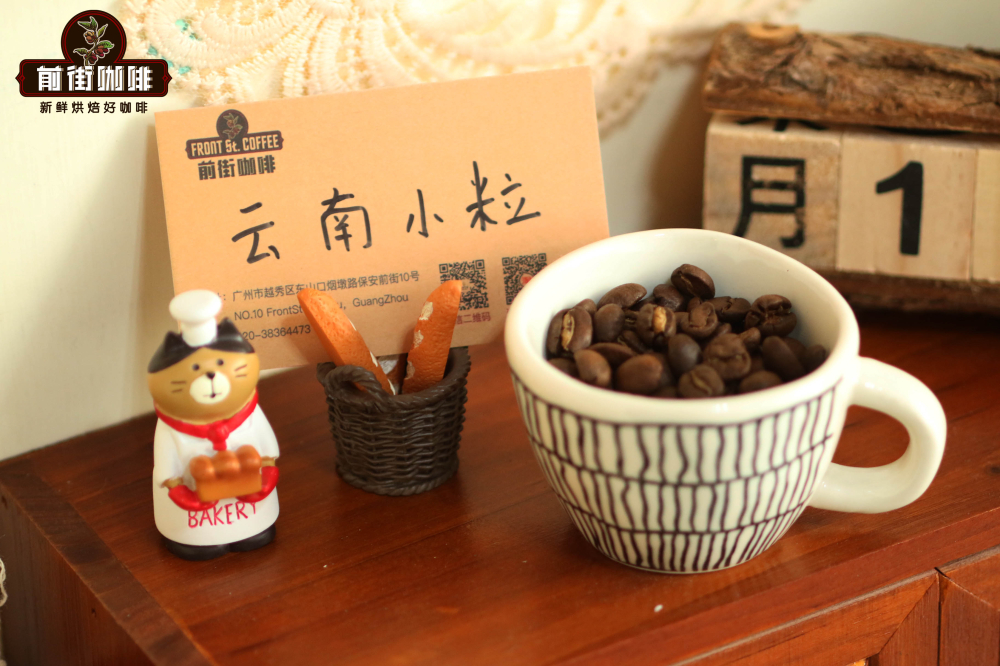
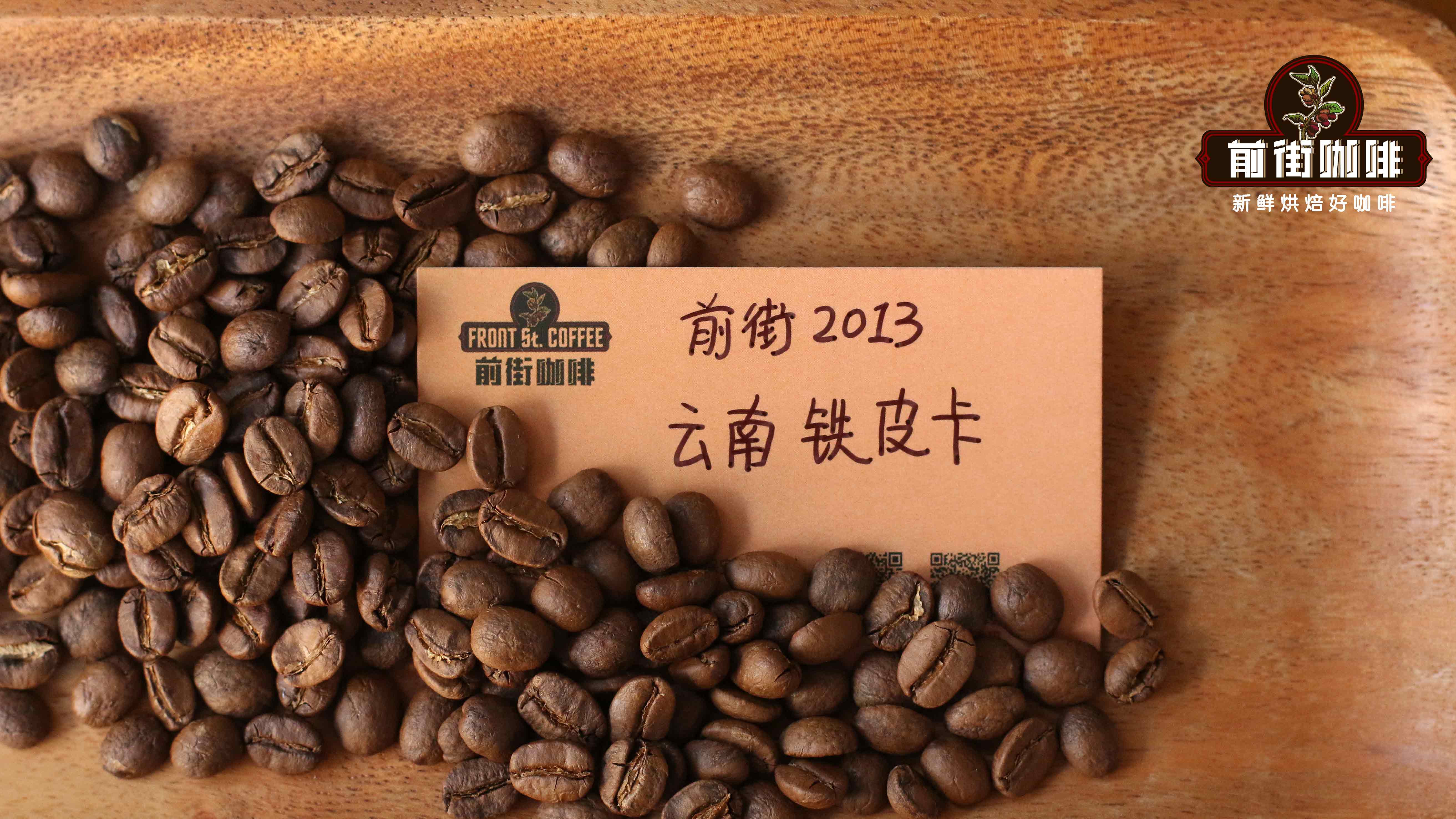
If you want to try Yunnan coffee, Front Street Coffee (FrontStreet Coffee) suggests starting with the washed processing method, because washed beans have a clean and bright mouthfeel and best represent the basic flavor of the Yunnan origin. For example, these two beans from Front Street Coffee (FrontStreet Coffee) carry a very original Yunnan regional flavor. According to Front Street Coffee's (FrontStreet Coffee) cupping, the dry aroma is nutty, and on the palate it presents more chocolate, nut, and cream flavors, with brown sugar sweetness especially prominent, and the overall taste is relatively balanced.
Of course, not all Asian regional flavors are like Yunnan coffee. Next, Front Street Coffee (FrontStreet Coffee) will share with you another of the most representative coffee regions in Asia — Indonesia.
Indonesia
Indonesia is located in Southeast Asia. In 1696, in order to expand its coffee planting base, the Dutch found Indonesia and first planted coffee in large quantities on the country's Java Island. However, in 1877 leaf rust swept through Indonesia, almost all coffee trees became infected, and Arabica coffee beans were nearly wiped out, causing heavy losses. Later, Indonesia introduced Robusta coffee beans from Africa; their strong disease resistance made up for the economic losses caused by Arabica's weak disease resistance.
Today Indonesia is the world's most important producer of Robusta coffee beans. Robusta is concentrated in southern Sumatra, while Arabica is in northern Sumatra. Although Arabica accounts for only about 10% of Indonesia's total coffee, Indonesia's Mandheling is famous worldwide for its distinctive herbal, medicinal flavor.
Indonesian Mandheling Coffee Beans
Mandheling coffee beans are mainly produced in the area around Lake Toba at the northern tip of Sumatra, Indonesia. The Golden Mandheling, Lintong Mandheling, Aged Mandheling, and Tiger Mandheling offered by Front Street all come from this area.
Front Street Coffee (FrontStreet Coffee) believes that everyone often finds it difficult to choose when buying Mandheling coffee beans. What exactly are the differences among so many Mandhelings? Next, Front Street Coffee (FrontStreet Coffee) will briefly introduce the differences among these Mandhelings for everyone's reference when purchasing.
The differences among Front Street Coffee's (FrontStreet Coffee) Mandhelings are as follows: Lintong Mandheling represents the most classic Mandheling flavor, with a strong herbal note; Golden Mandheling is the selected-grade PWN (a local Indonesian Mandheling company) Mandheling, with uniform bean size, all above screen 18, and hand-sorted more than four times, with a clean and bright mouthfeel and excellent body and sweetness; Aged Mandheling uses a different wet-hulled process and is stored for more than three years, giving it a richer flavor, though not everyone can accept it; Tiger Mandheling is the one with the strongest aroma, so those who like herbal flavors and aromas can give it priority.
Front Street Coffee (FrontStreet Coffee) has introduced so many Mandheling coffee beans, and I believe the term everyone hears most often is wet-hulled process. So what is the wet-hulled process?
Processing Methods for Indonesian Coffee Beans —— Wet-Hulled Process
Indonesia has a humid climate and frequent rain, so in pursuit of more efficient drying, the wet-hulled process is mostly used, and Indonesia's most famous processing method is indeed the wet-hulled process. The wet-hulled process mainly has two stages: removing the skin and pulp of the coffee fruit, then briefly fermenting and drying until the moisture content drops to 12-13%. This rapid processing method causes the coffee beans to be compressed and develop cracks, which are what we call goat-foot beans; this is a characteristic of Mandheling and cannot be considered a defect.
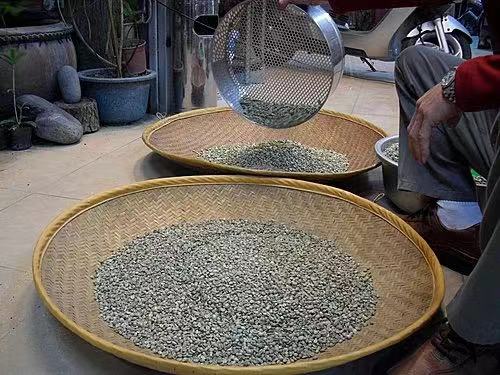
In addition to the regular wet-hulled process, there is also an aged wet-hulled process. The coffee beans are first processed by the ordinary wet-hulled method, then sealed and stored in a warehouse for 2-3 years. During this period, the acidity of the coffee beans gradually weakens and turns into sugar, and Mandheling using this processing method is also called Aged Mandheling coffee beans.
Next, Front Street Coffee (FrontStreet Coffee) will introduce another country in the Asian coffee-producing region — Papua New Guinea.
Papua New Guinea
The people of Papua New Guinea regard the bird of paradise as a symbol of freedom and happiness. The Arabica coffee from PNG AA Sigri estate is named Bird of Paradise coffee, and its flavor is just like its name, with a particularly spicy note and rich sweet acidity. Front Street Coffee (FrontStreetCoffee) has also offered a Bird of Paradise coffee bean from Papua; this bean was cultivated after Jamaican Blue Mountain Typica traveled a long way to Papua New Guinea, and it carries the same-root lineage as Jamaican Blue Mountain, so Front Street Coffee (FrontStreet Coffee) also often calls it Little Blue Mountain coffee bean.
There is another reason Front Street chose to offer Papua New Guinea Bird of Paradise coffee beans: when sourcing each coffee, Front Street Coffee (FrontStreet Coffee) hopes it has a unique character and will not select beans with the same flavor. The reason Front Street spends a great deal of time on bean selection, adjusting roasting curves and parameters, and many other steps is that a coffee bean can have similarities, but it must also have its own uniqueness.
Coffee Bean Processing Methods
In Papua New Guinea, coffee is a national-level crop, 90% of which is grown by smallholder farmers, supporting one-third of the national income. Small estates mostly use the washed processing method, and the taste is intense but without an earthy note; a small amount of sun-dried processing is also used, with greater richness in flavor compared with the washed method; while coffee from large estates has a relatively clean and delicate mouthfeel.
It uses washed processing. Front Street believes that the coffee flavor of Papua New Guinea differs from Indonesia's stuffy aroma and low, deep notes, and instead has bright sweet acidity and floral and fruity aromas, similar to the flavors of South America.
The above is a brief introduction to the Asian coffee-producing regions. If you would like to learn more about coffee beans from the American and African regions, you are welcome to follow the Front Street Coffee (FrontStreet Coffee) official account to study and exchange related coffee knowledge together.
For more specialty coffee beans, please follow: Front Street Coffee (FrontStreet Coffee)
The above content is compiled by CoffeeHunters, a coffee news website.


