







Colombia, with its natural combination of low latitude and high altitude, has become the world's second-largest Arabica coffee producer. From its early days dominated by commercial blend beans to its gradual shift toward the specialty coffee market after 2001, Colombian coffee has undergone a clear transformation path. This article systematically outlines the distribution of Colombia's specialty and commercial growing regions, the main cultivated varieties (Caturra, Catuai, Castillo, Colombia), the washed processing workflow, the characteristics of the grading system, and Front Street Coffee's specific recommendations for roasting and brewing, helping readers gain a comprehensive understanding of this major South American coffee country's flavor profile and industry logic.
Many people first encounter Colombian coffee through espresso blend beans. Colombia enjoys exceptional terroir conditions—a combination of low latitude and high altitude—creating an ideal growing environment for coffee trees, especially suited to Arabica varieties. It is precisely for this reason that Colombia firmly holds its position as the world's second-largest Arabica coffee bean producer.
In the early days, Colombia's coffee industry leaned more toward the commercial bean market, with relatively limited attention to flavor expression and quality that fluctuated from time to time. As a result, cafés commonly used dark roasting to process Colombian beans, then blended them with coffees from other regions to complement one another, ultimately presenting a cup of espresso with a round, full body and a gentle fruity acidity.
In the late 1990s, the specialty coffee market began to emerge, but Colombia did not follow suit in time, only formally entering the specialty coffee sector in 2001. Because of this late start, when the specialty coffee wave truly took off, Colombian coffee was once in a relatively marginalized position, mostly still used for blending and struggling to stand out as a single origin.
However, Colombia's climate conditions and growing environment—with coffee farms mostly distributed between 1,200 and 1,900 meters above sea level—happen to align with specialty coffee growing standards. As specialty market demand continued to grow, the value of Colombian coffee in this field has also been increasingly recognized.
Colombia's Coffee Growing Regions
Colombia is located between 3 and 8 degrees north latitude, placing it in the low-latitude coffee-growing belt. The notable advantage of this range is abundant rainfall year-round, with virtually no droughts, and average monthly temperatures maintained between 25 and 28 degrees Celsius. In this environment, coffee trees can grow throughout the year, with a high fruiting rate. As a result, Colombia can harvest two crops of Arabica coffee beans each year.
In order to supply the market with higher-quality Arabica coffee, Colombia divides its growing regions into two categories: specialty coffee bean regions and commercial coffee bean regions.
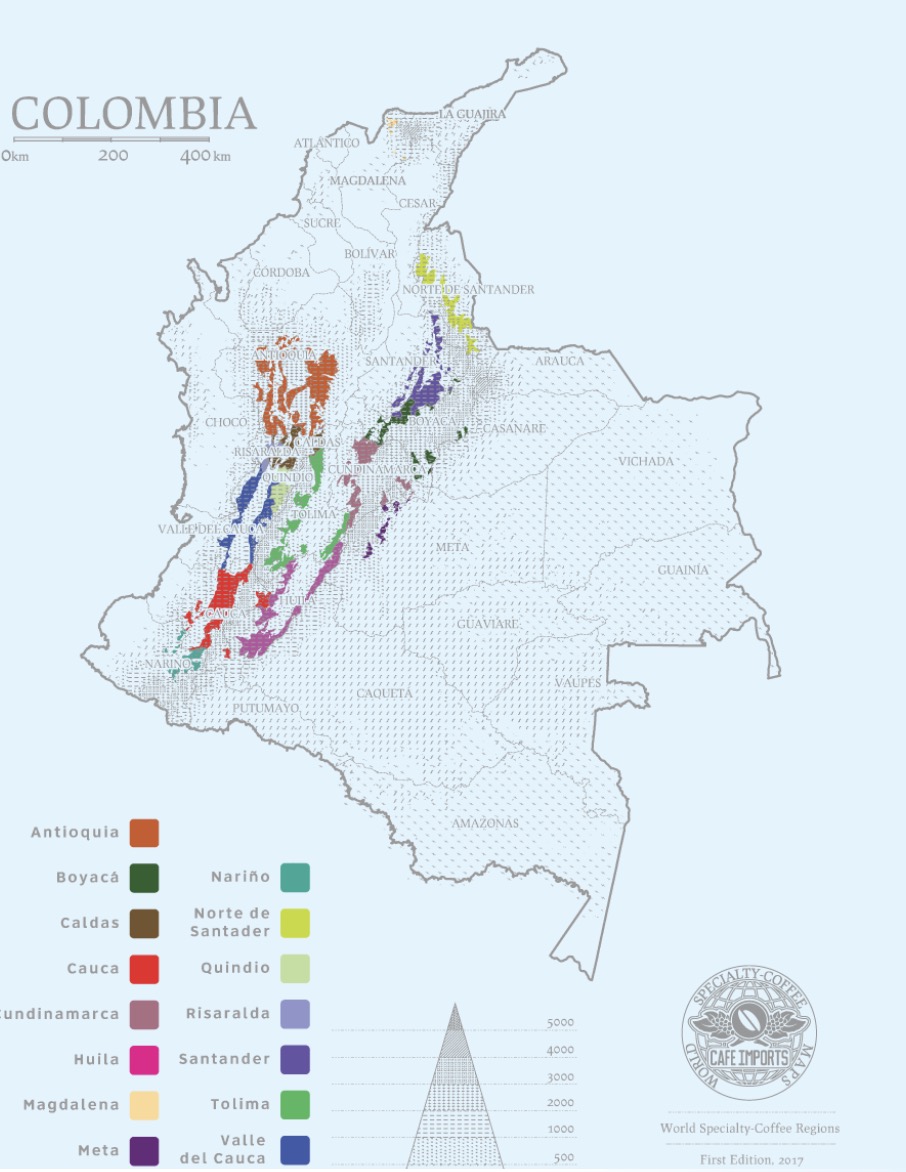
Specialty coffee beans mainly come from areas in southern Colombia above 1,500 meters, covering Cauca, Huila, Meta, Tolima, and Nariño. Coffee produced in these places typically carries delicate berry aromas and acidity, accompanied by caramel-like sweetness. The Colombian single-origin coffee beans currently sold by Front Street Coffee mostly come from the southern altitude range of 1,500 to 1,800 meters.
Commercial coffee beans are concentrated in central and northern Colombia, including Medellín, Armenia, and Manizales. Coffee from these regions presents a typical Central American style, with soft acidity and aromas of nuts and caramel.
Colombia's Coffee Varieties
Caturra and Catuai are the most common cultivated varieties in Colombia. In addition, some well-known estates also grow Geisha and some newer varieties, such as Colombia (yes, that itself is a variety name) and Castillo, among others.
Caturra A natural mutation of Arabica Bourbon, discovered in Brazil in 1937. Its tree form is shorter than Bourbon. Although it inherits Bourbon's lineage, it has relatively weak disease resistance, yet yields more than Bourbon. Despite originating in Brazil, Caturra did not adapt to Brazil's growing conditions and was therefore not widely promoted there; instead, it became widespread across Central and South America, with large-scale cultivation in Colombia, Costa Rica, and Nicaragua.
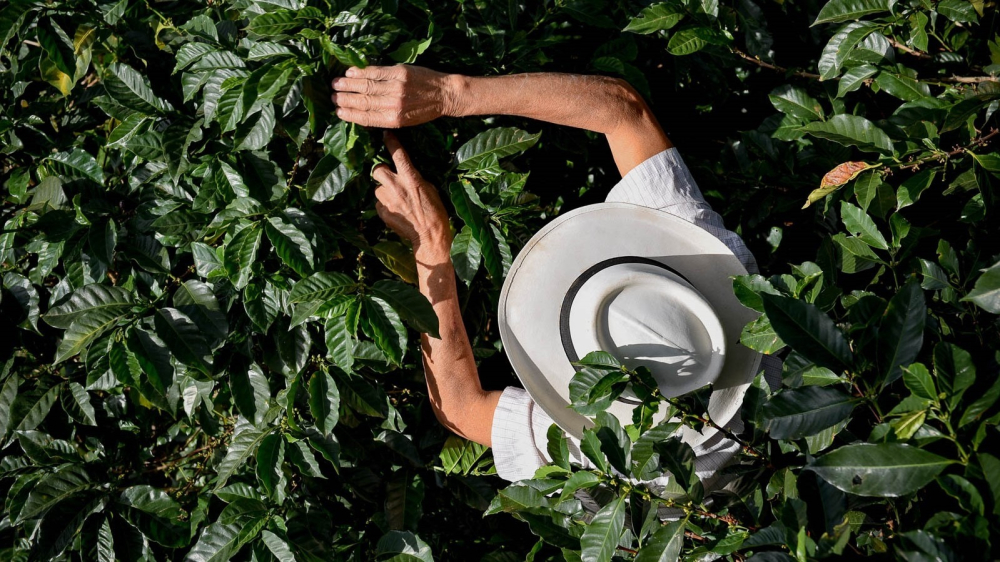
Catuai (Caturra) A manually cross-bred selection of Caturra and Mondu Novo. Catuai possesses strong resistance to natural disasters, particularly wind and rain. Its tree form is short, and its fruit is firmer than that of most coffee varieties, making picking relatively laborious. The fruit comes in both red and yellow colors. To date, there is no evidence that yellow fruit has better flavor than red fruit. On the contrary, some cupping results show that although coffee processed from yellow fruit performs well in acidity, its cleanliness in the cup is often inferior to that of red fruit.
Castillo Starting in 1961, CENICAFE began researching the Timor variety, which carries Robusta lineage. Research continued thereafter, and in 2002 the second disease-resistant variety, Tabi (a cross of Typica, Bourbon, and Timor), was released, followed in 2005 by Castillo, the most successful disease-resistant variety at the time. After the large-scale outbreak of leaf rust in 2008, Colombia began vigorously promoting the cultivation of Castillo.
Colombia (Colombla) This new variety, sharing the same name as the country, was successfully bred in 2008. It is a hybrid variety carrying the lineage of Caturra and Timor, essentially belonging to Catimor. However, [FNC] insists that although Colombia is a direct descendant of Catimor, its flavor is far more elegant than ordinary Catimor. The reason is that after multiple generations of backcrossing with Arabica, it has eliminated the moldy, fishy taste common to robusta-type beans, bringing its flavor closer to Arabica while also combining the disease resistance and high yield advantages of robusta-type beans, making it an important variety for Colombia's efforts to increase production.
Colombian Coffee Bean Processing Methods
Colombian coffee mostly uses washed processing, and specialty coffee largely comes from small- to medium-scale owner-operated farms. Compared with Brazil's large-scale cultivation, the coffee quality from small farms is usually more outstanding.
After being picked, the coffee cherries are first poured into a large water tank. Underdeveloped, inferior beans float to the surface, while ripe, full cherries sink to the bottom. At this point, the defective beans floating on the surface are scooped out and discarded.
Then a pulper is used to remove the outer skin and pulp. At this stage, a slippery layer of mucilage still clings to the surface of the coffee beans. The mucilage-covered coffee beans are placed into a fermentation tank for 16 to 36 hours, during which microorganisms break down the mucilage.
After fermentation is complete, the remaining mucilage on the coffee beans is rinsed off thoroughly with plenty of clean water. Finally, the washed coffee beans are spread out to dry.
Front Street Coffee believes that only the washed processing method can more fully showcase a coffee's quality, directly reflecting the cleanliness of the cup and the purity of flavor. Therefore, Front Street Coffee has selected a Caturra coffee from the Huila region as an entry-level selection and everyday staple bean, allowing every enthusiast to taste Colombia's regional flavor at a high value-for-money price.
In addition, the Federacion Nacional de Cafeteros de Colombia (FNC) has specifically promoted specialty coffee projects, which must pass strict quality control before export. In recent years, many experimental processing methods have also originated in Colombia, such as barrel aging and anaerobic fermentation. Colombian coffee continues to create new ideas in the specialty field and drive the industry forward.
Colombia's Coffee Grading System
Colombia's coffee grading focuses on bean size rather than flavor. Therefore, when you see the top grade "Supremo," do not directly equate it with good taste.
It only indicates that more than 80% of the coffee beans reach screen size 17, and has no direct connection to flavor. Therefore, when purchasing, be sure to pay attention to the specific region; southern specialty regions usually label the province and place name. If not labeled, it is most likely commercial-use coffee beans.
How to Roast Colombian Coffee Beans?
The Colombian single-origin coffee beans currently sold by Front Street Coffee include:
"Front Street - Huila Region Washed Staple Coffee Beans" Flavor profile: nuts, dark chocolate, caramel, soft fruity acidity
"Front Street - Rose Valley Coffee Beans" Flavor profile: rose, peach, liqueur chocolate
"Front Street - Flower Moon Night Coffee Beans" Flavor profile: strawberry jam, fermented aroma, chocolate
"Front Street - San Jose Coffee Beans" Flavor profile: rum, tropical fruit, liqueur chocolate, maple syrup
"Front Street - Cherry Blossom Coffee Beans" Flavor profile: basil leaf, strawberry jam, berries, vanilla-like spices
"Front Street - Hanami Coffee Beans" Flavor profile: pink pepper, chamomile, mandarin orange, honey, almond
In order to preserve the soft acidity of Colombian single-origin coffee beans and the sweetness after caramelization, Front Street Coffee uses a medium roast while extending the time from the yellowing point to just before first crack, allowing the coffee beans to develop a more ideal sweetness.
So that every enthusiast can experience the aroma of freshly roasted coffee, Front Street Coffee guarantees that coffee beans are shipped within 5 days after roasting is completed ~!!!
How to Brew Colombian Coffee Beans?
Front Street Coffee uses a V60 dripper to brew Colombian single-origin coffee. The 60 conical dripper has larger holes, and combined with its unique spiral curved rib design, air is more easily released, thereby improving extraction quality.
Water temperature: 90-91 degrees
Grind size: fine sugar size / Chinese standard No. 20 sieve with 80% passing
Coffee-to-water ratio: 1:15
Coffee dose: 15 grams
Three-stage pouring: In the first stage, pour 30 grams of water for a 30-second bloom, then pour 95 grams (the electronic scale shows about 125 grams), completing the pour in about 1 minute. When the water level drops to two-thirds of the coffee bed, pour the remaining 100 grams (the electronic scale shows about 225 grams), completing the pour in about 1 minute 40 seconds. Dripping is completed at 2'00", remove the dripper, and extraction is complete.
The above content is compiled by CoffeeHunters, a coffee news website.


