







Espresso is the foundation of many fancy Italian-style coffees and is known as the soul of a coffee shop. Starting from Front Street Coffee's actual store operations, this article systematically explains Espresso's two core characteristics—the golden, thick, and creamy layer of crema and its ultra-high concentration of flavor—and gradually breaks down the complete production process for both home and commercial scenarios, including key steps such as choosing the dose, extraction ratio, time control, and distribution and tamping. The article also introduces the flavor performance of Front Street Sunflower Warm Sun Blend, as well as recommendations for classic espresso blend coffee beans suitable for beginners, helping coffee lovers stably extract rich, full-bodied espresso with abundant crema at home.
For more specialty coffee knowledge, please follow: Front Street Coffee (Frontsteet Coffee)
Coffee culture is becoming increasingly popular in China, with more and more cafes opening on street corners and in alleys, and espresso, known for its efficiency and convenience, is especially favored. A cup of fragrant, rich espresso is precisely the base of all kinds of popular espresso drinks. Today, Front Street will introduce everyone to this Espresso, known as the soul in coffee shops, and take a look at what characteristics it actually has.
The main characteristics of espresso
Espresso is a coffee liquid that Italians obtain through rapid extraction using a pressurized coffee machine with high temperature and high pressure, and its surface is covered with a layer of golden foam. Different shops choose different espresso beans and extraction plans, so the flavors naturally differ, but a qualified cup of espresso usually has the following two characteristics.
Cream
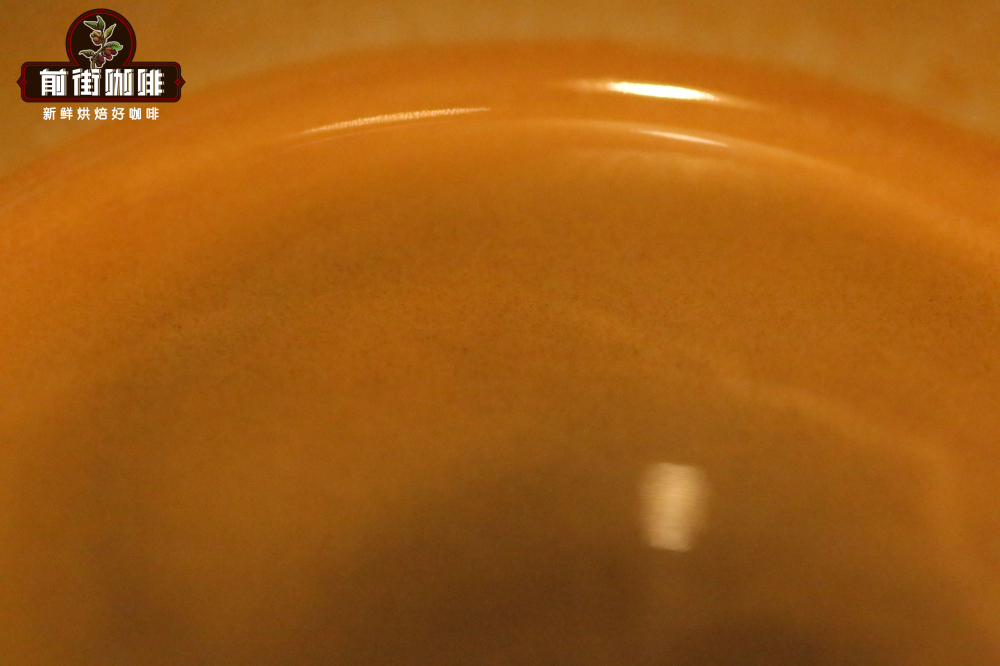
When you order an Espresso in a coffee shop and the barista brings it over immediately after extraction, you can see a thick layer of golden foam floating on top of the liquid. This is what we call crema.
Coffee beans generate a large amount of gas during roasting, and the high-pressure water flow dissolves out the carbon dioxide among it. When the coffee liquid returns to a normal-pressure environment, the liquid can no longer continue to hold all the gas, so countless tiny bubbles surge out from the liquid and remain on the coffee surface, forming a seemingly stable layer of foam. Whether the crema is rich and dense can reflect the freshness of the coffee beans used. This is because the gas inside the beans continuously escapes over time; the farther from the roast date, the less carbon dioxide remains, and the thinner the foam formed during extraction.
If a cup of Espresso has no crema on the surface, it is most likely because the coffee beans have been stored for too long, or because the espresso has been left sitting for too long after being made, causing the foam to dissipate. The darker the color of the crema, the more intense the taste often is. Coffee beans undergo the Maillard reaction during high-temperature roasting; the darker the roast level, the darker the color of the foam layer and the richer and fuller the mouthfeel.
High concentration
A single serving of Espresso needs to release a large amount of soluble substances in just a few dozen seconds, so the coffee grounds must be ground extremely fine and evenly. Under the action of near-boiling hot water and the high-intensity pressure of 9 atmospheres, the concentration of espresso is quite high, and the flavor is concentrated many times over, bringing a strong impact on the palate. After swallowing, various aromas still remain in the mouth, with a long finish. Because of this, many coffee shops serve a glass of water alongside a strong Espresso.
How to make espresso
Many coffee lovers have unknowingly accumulated a pile of equipment at home, and friends obsessed with espresso have even bought espresso machines early on, planning to extract it themselves. Here, Front Street uses store production as a reference and briefly explains how to make an Espresso.
The coffee machine used in Front Street stores is the commercial single-group "Lelit Bianca," which can adjust extraction by changing the pressure, with a maximum pressure of 11 bar. As long as a home coffee machine has 9 bar of pressure, it is enough to complete extraction and steam milk, and pairing it with an espresso grinder is all you need.
Front Street uses the capacity of a double basket, with the dose roughly between 18 and 20 grams, and for production Front Street takes 20 grams of coffee grounds. The ratio of coffee grounds to coffee liquid usually falls between 1:1.5 and 1:2.5. Front Street adopts an extraction ratio of 1:2, that is, 20 grams of grounds extract 40 grams of coffee liquid. Time is related to the flow rate of the coffee grounds. A single extraction is generally controlled at 20 to 35 seconds, because in less than 20 seconds the coffee often tastes thin, while over 35 seconds it is easy to over-extract and produce a burnt bitterness. Front Street's espresso mostly falls within the 28 to 30 second range.
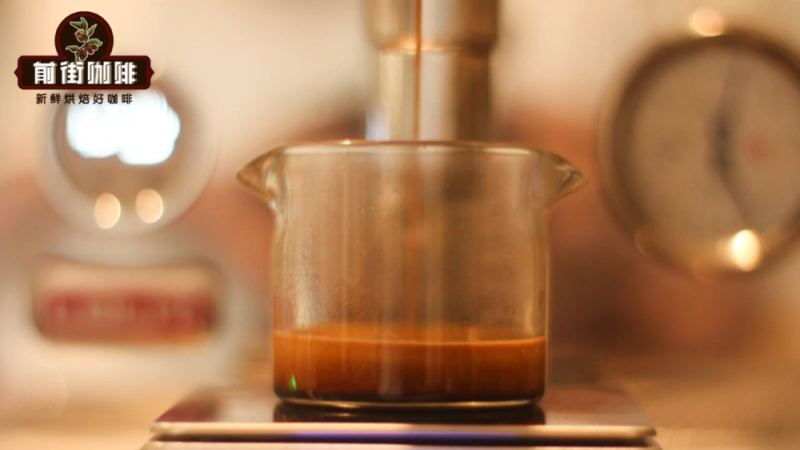
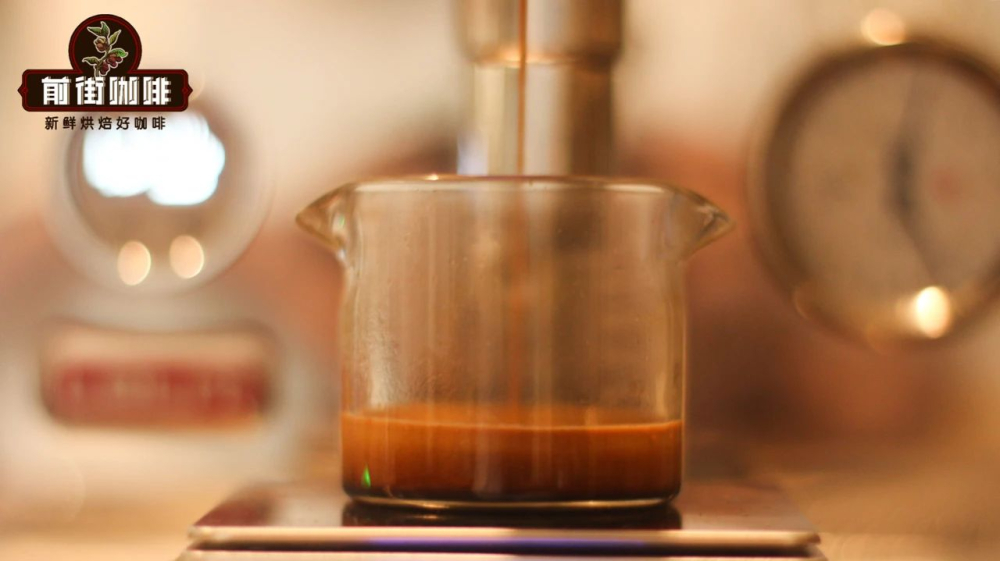
Front Street's procedure is to first wipe the basket dry, start the grinder to grind a double dose of coffee grounds, place it on an electronic scale, and increase or decrease until it reaches 20 grams. Then use a tool to evenly distribute the coffee layer and tamp the puck firmly to ensure more stable extraction. Next, turn on the extraction switch to release water, wetting the brew head while flushing away any residual coffee grounds on it, then gently lock the portafilter onto the brew head, flip the switch down, and begin extraction. When the electronic scale shows that the coffee liquid has reached 40 grams and the time is about 30 seconds, the switch can be flipped down to stop extraction. Pour the coffee liquid into an Espresso cup, and it is ready to enjoy.
The taste and mouthfeel of Espresso depend on the coffee beans used. The espresso served in Front Street stores uses Front Street Sunflower Warm Sun Blend, made from Honduras Sherry coffee and Ethiopian natural Red Cherry in a 7:3 ratio. When made into Espresso, it has rich crema, a particularly prominent whisky aroma, an acidity of vanilla cookies and berries on the palate, a solid flavor, and a mouth full of lingering fragrance after drinking.
Espresso can also be diluted with water, which is the Americano commonly seen on menus, with a refreshing aroma; adding milk turns it into a latte, presenting the sweetness of chocolate and cream.
Espresso blend coffee bean recommendations
In addition to the whisky-style Warm Sun Blend, Front Street's bean list has another three cost-effective espresso blend beans to choose from. The espresso extracted from them is mainly nutty in tone, and each one has slight differences due to different formula proportions.
For friends who have just started making coffee, because they are not yet familiar with the equipment and various parameters, it is easy to extract espresso that is bitter and hard to swallow, so Front Street believes that choosing beans is a particularly critical step. To make a standard Espresso, it is recommended to use Front Street Classic Espresso Blend Coffee. This bean is composed of three producing regions—Brazil, Indonesia, and Vietnam—and uses a dark roast, which can highlight the coffee's rich aroma to the greatest extent and also allows beginners to easily extract abundant, dense crema. It is suitable whether made into an Americano with water or a latte with milk, and can be ordered from Front Street's Taobao store or Front Street Tmall flagship store.
The above content is compiled by CoffeeHunters, a coffee news website.


