









For more information on coffee origins and coffee knowledge, please followCoffeeHuntersToutiao account
Among the many countries around the world, if we're talking about artisan-level dedication to coffee, Japan is the one that stands out. Front Street knows that Japan has always been a country with a long history and culture of coffee. They especially love coffee with a full body and rich flavor, and mostly use medium-dark roasts. Blue Mountain and Mandheling are Japan's favorite coffees! And in the hot summer of Japan, iced coffee is of course indispensable. Today, Front Street will teach you how to make a refreshing and delicious iced coffee!
The method for making Japanese-style iced coffee is very simple: first put ice cubes in the coffee cup, then brew the coffee with hot water using the usual method.

1. The advantages of Japanese-style iced coffee? Fast to make
Japanese-style iced coffee is very quick to make. If you suddenly want an iced coffee drink, you no longer have to wait a whole night or even a whole day. If made precisely, Japanese-style iced coffee has an extremely rich flavor and a bright mouthfeel. We tried making it with a washed Yirgacheffe, and the taste was better than any cold brew of the same kind. The Japanese-style iced coffee made this way is rich in flavor, and the preparation time is exactly the same as regular coffee. Isn't that amazing!
The method for Japanese-style iced coffee is similar to regular pour-over, except that the amount of water used for a normal hot pour-over is reduced by half and replaced with ice cubes.

Production process:
1. Coffee beans
You can choose medium-light roasted beans with a fresh flavor. Recommended are Front Street washed Yirgacheffe, Front Street Huakui, Front Street Kenya Little Tomato, Front Street Flower Butterfly, Front Street Strawberry Candy, and other fruit-acid aromatic beans. 15g of grounds, 100g of ice cubes (the more ice, the cooler!), rinse and drain the filter cup and filter paper in advance; for iced pour-over, there is no need to warm the cup or pot.
2. Temperature and grind size
2. For the choice of temperature and grind size, the editor chose 91°C, which is 1°C higher than the usual pour-over recommendation, with a normal grind like fine granulated sugar (Fuji Royal 3.5 setting). For iced pour-over, go half a notch finer — Fuji Royal 3 setting.

This is also why it was suggested earlier to choose beans you are familiar with. Because of the coffee-to-water ratio (1:10), iced pour-over will have a slightly lower extraction yield than a normal pour-over (but not by much). At this time, you should use water temperature and grind size to make up for the extraction yield accordingly.
In other words, increasing water temperature + finer grind = higher extraction yield.

3. Brewing technique
Bloom with 40g of water, blooming time 30 seconds.
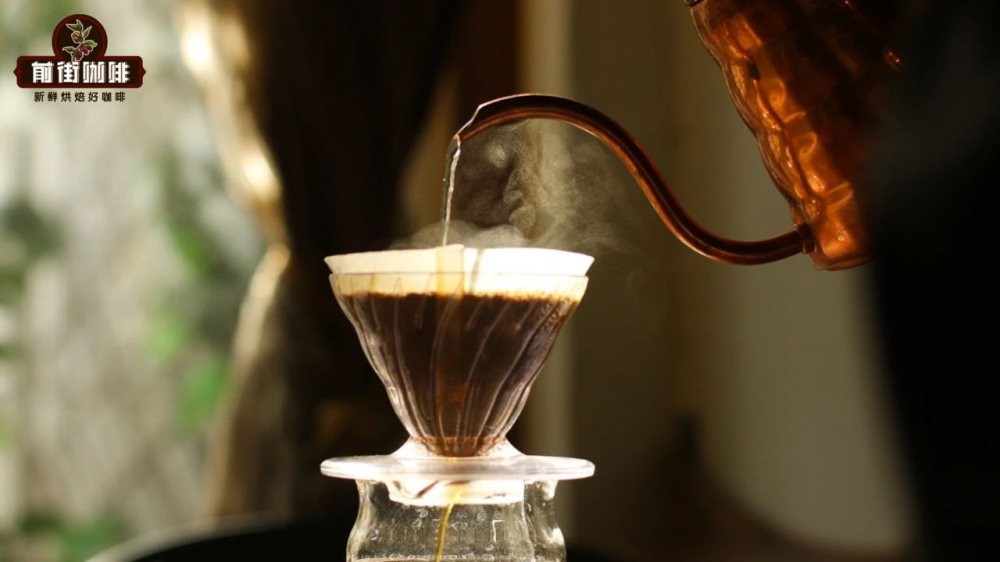
At this stage, you can also add operations such as "stirring" and "extending the blooming time" to allow the coffee grounds to absorb water more fully and release gas smoothly; pour vertically with a small stream of water, at an appropriate height, slowly circling until 160g, then you can stop pouring.

4. Staged pouring
The first pour is 60g of water, and the second pour is 40g of water. Use a relatively thin but tall stream of water, with forceful stirring and impact, so that the coffee grounds tumble fully. But be careful not to let the water level get too high, and do not pour onto the edge of the filter paper.
5. Wait
Because the grind is on the finer side, the dripping will be a little slower. That's fine. With this coffee-to-water ratio, it will not easily over-extract and produce off-flavors, so you can rest assured. This is because at the very beginning, the small-molecule flavors such as fruit acidity and floral notes are extracted first, and only then does the slight bitterness gradually emerge. With a method like iced pour-over that extracts the front and middle stages, as long as you don't keep pouring at a single point, the overall flavor will still remain relatively fresh and bright.

6. Complete
The entire extraction time is about 2 and a half minutes (close to the usual extraction time for 20g of grounds). Wait until all the coffee liquid has flowed through, then shake to mix evenly. At this point, the ice has just about half melted. The remaining ice can serve to chill and slowly dilute the coffee. If you drink until the ice has completely melted, the taste will become weaker, so it is recommended to drink it before the ice fully melts.

There are a few key points for making Japanese-style iced pour-over:
①. The ratio of ice to water is about 1:1. It does not have to be exactly 1:1, but it should not deviate too much (adjust slightly according to room temperature), otherwise either the iced coffee will not be cool enough (too little ice), or the coffee will be too weak (too much ice and too little water, resulting in under-extraction).
②. The issue of pour-over extraction yield. Sometimes you may not be able to brew a sufficiently satisfying iced pour-over in one go. At that point, you need to examine whether your brewing is too weak (extraction yield too low) or has developed off-flavors (extraction yield too high). Generally speaking, while ensuring even extraction, increasing water temperature, grinding finer, increasing stirring, and extending extraction time can all increase the extraction yield; conversely, lowering water temperature, grinding coarser, reducing stirring, and shortening extraction time can all decrease the extraction yield.
③. Do not expect too much of an explosive flavor from iced pour-over. Sometimes it is not a matter of extraction yield or whether the brewing succeeded or failed, but rather that human smell, taste, and touch naturally become duller at low temperatures. In addition, aroma molecules also react more slowly at low temperatures, making them less likely to diffuse and be detected by people. So iced pour-over can satisfy a craving, refresh you, and keep you going! But it may not necessarily amaze you!
The above content is compiled by CoffeeHunters, a coffee news website.


