








Many coffee enthusiasts focus their attention on milk foam and latte art, but what truly determines whether a cup of milk coffee tastes good is actually the extraction quality of the espresso. Drawing on the hands-on experience of Front Street Coffee, this article explains in detail why Italian blend beans are chosen, why extraction parameters must be adjusted every day, and the complete steps from locking in the portafilter, flushing, drying, grinding, distributing, tamping, to extraction. The article also provides the specific parameters of the Lelit espresso machine used at Front Street's own store, and shares how to judge whether extraction meets the standard by observing flow rate and tasting. It is suitable reading for baristas and seasoned enthusiasts who want to improve their espresso skills.
For more specialty coffee knowledge, please follow: Front Street Coffee (Frontsteet Coffee)
Front Street has found that many people new to espresso, and even some baristas, treat milk frothing and latte art as the core skills of making espresso. But in Front Street's view, the step that truly determines the quality of a cup of espresso is actually the extraction of the espresso. If the espresso itself does not taste good, then no matter how fine the milk foam or how exquisite the latte art, the cup of milk coffee still will not taste good. To meet the needs of different coffee beverage shops, Front Street has developed several espresso beans with excellent flavor, including Front Street Specialty Blend, Front Street Commercial Blend, and the espresso bean highly praised by baristas—Front Street Dark Cocoa Blend, among others. Front Street Coffee (FrontStreet Coffee) currently uses Front Street Sunflower Warm Sun Blend espresso beans at its store; this bean carries a distinct whisky aroma and a nutty finish.
Why use Italian blend coffee beans to extract espresso?
Coffee beans are an agricultural product and are affected by conditions such as weather and soil. Even if they come from the same region, different batches may differ in flavor. The idea of blending is to make up for shortcomings with strengths, so that every batch of coffee beans can present a stable and consistent flavor. This is also why Front Street chooses blend beans rather than single-origin beans to make espresso.
When making espresso, Front Street uses Front Street Ethiopia Yirgacheffe Natural Red Cherry and Front Street Honduras Sherry coffee beans, blended in a 3:7 ratio to create Front Street Sunflower Warm Sun Italian blend coffee beans. After high-pressure extraction, this bean presents a rich wine aroma, soft fruit acidity, and a nutty cocoa-like finish. When heated milk is combined with the espresso, the lactose in the milk is activated, interweaving with the berry-like acidity to create a milkshake-like sweetness, while not masking the wine aroma, making it unforgettable after just one sip. Why must espresso parameters be adjusted every day?
Front Street uses a Lelit espresso machine, and the extraction parameters are as follows:
Pressure: 9 bar
Temperature: 94°C
Time: 30 sec
Coffee-to-water ratio: 1:1.7~1:2
Dose: 20g (double espresso)
Extracted espresso yield: 40ml (double)

Why doesn't Front Street simply provide a fixed extraction parameter?
After coffee beans are roasted, they continuously release carbon dioxide every day, which changes the flavor expression of the coffee beans and also affects stability during extraction. In addition, everyone uses a different espresso machine, and the condition of the coffee beans is different, so it is naturally impossible for the parameters to be exactly the same. Therefore, the parameters provided by Front Street Coffee (FrontStreet Coffee) are for reference only, and ultimately you still need to make fine adjustments based on tasting results to find a solution that suits you. How does Front Street Coffee (FrontStreet Coffee) extract espresso?
First, remove the brew handle and knock out the coffee grounds. Two things need attention here: first, the portafilter should always be locked onto the group head to keep warm, and should not be placed on the cup warming tray or anywhere else, otherwise the low-temperature portafilter will lower the brewing water temperature and cause the coffee to taste off. Second, the coffee grounds inside should not be knocked out before brewing the next cup, because the copper group head at high temperature easily produces odors, and the coffee grounds can absorb odors.
Lock the portafilter onto the group head and press the brew button to flush the portafilter and group head. At this time, you should keep shaking the portafilter so that the coffee residue stuck to the group head can be rinsed clean. Note: if you do not flush the group head and directly load coffee, the residue stuck to the group head will be extracted a second time, making the coffee bitter and astringent. In addition, this step is also equivalent to the initial water release, preventing the brewing water temperature from being too high and causing over-extraction.
Next, use a dry towel to completely dry the filter basket inside the portafilter. The inside of the filter basket must remain dry. If there is water in the filter basket, the extraction process will begin before brewing once the coffee grounds touch the water, causing over-extraction. In addition, moisture will also cause the coffee grounds to clump, leading to uneven tamping. The spout of the portafilter should also be dried along the way to prevent coffee grounds stuck on it from flowing into the cup.
Then you can grind the coffee beans and catch the grounds. Note: do not leave grounds in the doser; grind fresh for each brew. After coffee grounds are exposed to air for a few minutes, they will completely oxidize, and the brewed coffee will become undrinkable. Some coffee shops nowadays are used to filling the doser full, which is incorrect. The correct approach is to quickly pull the doser lever while grinding, turn off the machine when the portafilter is almost full, and continue pulling the doser lever until all the coffee grounds in the doser have fallen into the brew handle.
After receiving enough coffee grounds, use a distribution tool to make the coffee grounds in the basket evenly distributed. If the coffee grounds are uneven when they fall into the basket, then during subsequent tamping part of the puck will be denser and part looser. Because of inertia, water flow will choose the place that is easier to pass through, that is, it will more easily pass through the loose areas. Those areas will be extracted more, while the dense areas will be under-extracted, resulting in uneven extraction. This is also one of the causes of channeling.
Next comes tamping! After distribution, gaps between coffee particles may still be uneven, and the loose coffee bed is easily broken apart by 9 bar of hot water during extraction, forming channeling. Tamping the coffee bed can make the coffee grounds denser, minimize the differences between coffee particle gaps as much as possible, and reduce the possibility of channeling.
Lock the portafilter onto the group head. Note: after locking it in, immediately press the brew button, and then take the coffee cup. Also, the entire process of loading grounds and tamping should be quick, because if coffee grounds stay too long in the hot portafilter, the coffee will be scorched and become bitter.
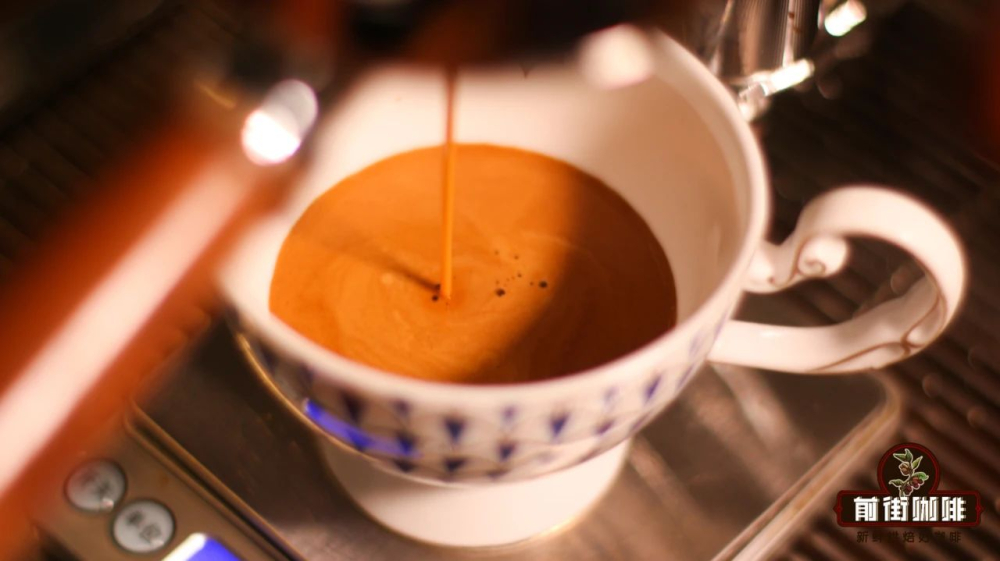
At this time, the coffee should flow out like a paste, not spray out. If the flow rate is too fast, it is very likely that the grind is too coarse or the tamping pressure is too light. Nor should it drip out drop by drop; in that case, it may be that the grind is too fine or the tamping pressure is too heavy. Also, for espresso made by the same person, under the same grind size and the same extraction yield, the espresso extraction time difference must not exceed 1 second; otherwise, the tamping pressure is unstable or the tamping is uneven, and the difference in coffee taste will be very obvious, so more practice is still needed.
Espresso after extraction is completed: after finishing, remove the coffee handle. The surface of the coffee puck should be flat and should not have any depressions; otherwise, it indicates that tamping was incorrect and more practice is needed.
After adding water to the extracted espresso to make black coffee (Americano), if there are no off-flavors and no astringency on entry, the coffee does not feel watery, and the bitterness disappears quickly after entering the mouth, then the requirements for extracting espresso are basically met. In addition, when making 5 to 10 cups continuously (with the same specification coffee handle), there must be no obvious difference in espresso extraction time and coffee taste; only then does it show that the technique is basically stable.
The above content is compiled by CoffeeHunters, a coffee news website.


