







Espresso has always polarized coffee enthusiasts: some are captivated by it, while others are put off by its intense bitterness on their first try. A tiny cup, not cheap, yet surprisingly small in quantity—what exactly are you drinking? This article draws on the practical experience of Front Street Coffee to outline the historical evolution of espresso, the principles of extraction, and the logic of parameter control, and to present the standard tasting method used at Front Street stores. It will also introduce the recipe characteristics and suitable scenarios of Front Street's classic espresso blend, helping coffee lovers gain a more comprehensive understanding of the value of this espresso base.
When espresso is mentioned, opinions tend to fall into two extremes: those who love it are addicted, while those who don't keep their distance. Many friends new to coffee walk into a café for the first time, see the fairly affordable price of espresso on the menu, and happily order it—only to find, once it arrives, that the portion is tiny and the taste is strong and bitter, making every sip a struggle. Front Street Coffee (FrontStreet Coffee) is often asked the same question: what exactly are you drinking when you drink espresso?
Watching the barista perform a smooth, flowing sequence behind the bar, a cup of espresso with rich crema and an enticing aroma is soon ready. To many beginners, this cup of coffee seems like something anyone can make. Yet years of experience at Front Street Coffee (FrontStreet Coffee) show that the more seemingly simple the action, the more it relies on rigorous underlying principles—testing not just technique, but the barista's understanding of and passion for coffee.
As the base for all kinds of espresso drinks, espresso practically supports half the coffee world. An ideal espresso should achieve a balance among acidity, sweetness, and bitterness, while possessing a distinct character, a full body, and a sweet aftertaste in the throat rather than bitterness after swallowing, with a long, lingering finish.
Interestingly, if we go back to the early twentieth century when commercial espresso machines first appeared, the equipment of that time simply could not meet the basic conditions required for today's espresso. Limited by the technology of the era, extraction pressure could not exceed 9 bar, and water temperature and time were difficult to control precisely, so the flavor was naturally far removed from contemporary espresso.
With technological advances, espresso in the truly modern sense was established with the birth of the Faema E61. The addition of more and more controllable factors significantly improved the quality of a cup of espresso. With the machine as a backing, the rest is left to the barista's knowledge and skill.
Some people are used to strictly locking down every variable, while others are better at observing conditions during extraction. Front Street Coffee (FrontStreet Coffee) has encountered friends asking for help: they stop extraction as soon as the flowing coffee liquid turns golden, only to find the resulting drink tastes thin.
The steps for making espresso may seem uncomplicated, but they conceal quite a few principles. For example, extraction pressure that is too high will break down too much coffee structure and bring out more bitter components; and in the early to middle stages of extraction, sour and sweet substances are released first, and so on.
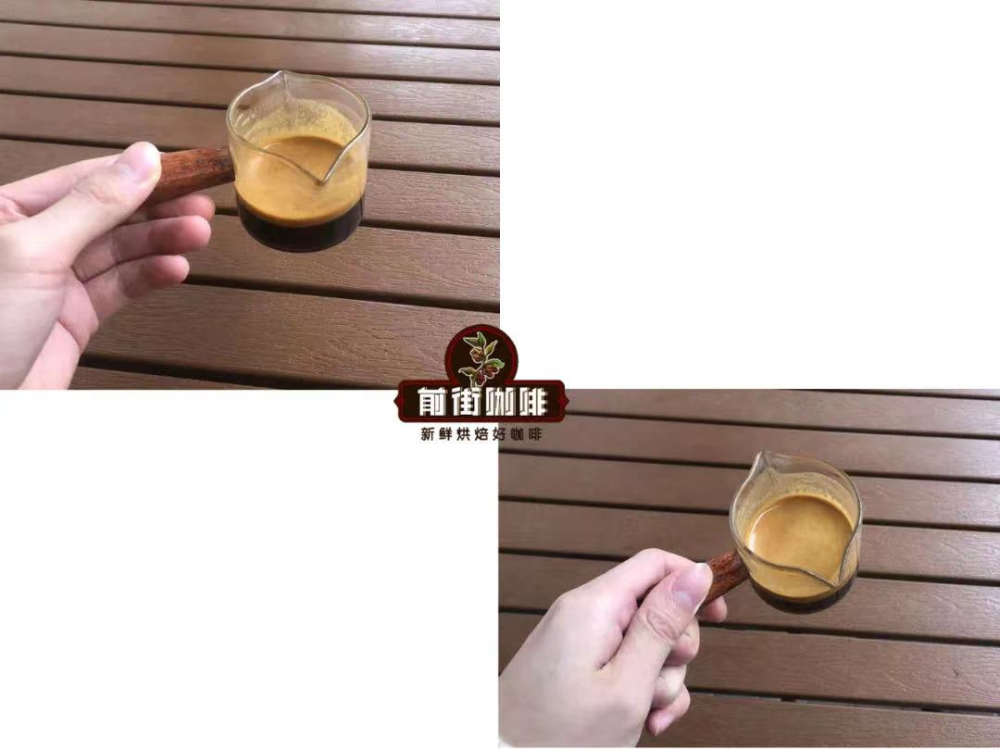
To keep output stable and ensure that the taste of each cup does not deviate too much, Front Street Coffee (FrontStreet Coffee) prefers to adjust various parameters to find a stable set of settings suitable for use that day.
Every day when opening for business, Front Street Coffee (FrontStreet Coffee) adjusts the espresso brewing parameters according to the day's temperature and humidity. Ambient temperature and humidity are uncontrollable factors, while the espresso beans selected by Front Street Coffee (FrontStreet Coffee) have the extraction temperature fixed at 94 degrees Celsius. Among the remaining controllable brewing parameters, the ones to watch are dose, grind size, time, extraction pressure, and the weight of the extracted liquid.
After adjustment, Front Street Coffee (FrontStreet Coffee) uses a Galileo Q18 espresso grinder to grind 19.7 grams of coffee at a grind setting of 1.5, and brews with a Lelit Bianca V3 espresso machine, taking 30 to 32 seconds to obtain 38 to 40 grams of espresso liquid.
In the espresso extracted according to the above parameters, Front Street Coffee (FrontStreet Coffee) tastes rich chocolate, caramel, and creamy notes, accompanied by a clear roasted nut aroma, with a very persistent dark-chocolate-like finish.
This benefits from the use of Front Street's classic espresso blend, a recipe combining coffee beans from three origins—Brazil, Indonesia, and Vietnam—and using a deep roast, which maximizes the coffee's rich aroma and makes it easier to extract abundant, dense crema. Whether diluted with water into an Americano or paired with milk as a latte, it is quite suitable; it can be ordered from the Front Street Taobao store or the Front Street Tmall flagship store.
Although espresso has a concentrated flavor, not everyone can accept it. But as the foundation of espresso drinks, some are still willing to explore its true face. Different coffees each have their own way of being enjoyed: some add sugar, some pair it with ice water. When serving espresso, Front Street Coffee (FrontStreet Coffee) usually includes a small spoon and a glass of ice water.
The purpose of the small spoon is to stir the coffee, allowing the fine coffee grounds that had settled at the bottom of the cup to redistribute evenly, thereby achieving a more consistent mouthfeel when drinking.
In fact, every café serves a glass of ice water alongside espresso. This glass of ice water is not for customers to make their own iced Americano, but rather to encourage them to take a sip before tasting, rinsing away residual tastes and odors in the mouth so they can more fully appreciate the layered expression of espresso in terms of taste, aroma, mouthfeel, and more.
Some friends have also shared with Front Street that the role of ice water goes far beyond this. When one truly cannot accept the overly strong, concentrated flavor of espresso, the leftover espresso can be poured into the ice water to make an iced Americano.
Of course, if it is truly difficult to enjoy the intense experience that espresso brings, it is better to simply order an iced Americano—much safer.
The above content is compiled by CoffeeHunters, a coffee news website.


