







For office workers who are short on time but refuse to settle for a mediocre cup of coffee, drip coffee bags are almost the ideal solution. They require no complicated equipment—just hot water and a cup to complete the extraction—but many people find in practice that the coffee comes out weak and lacking in aroma. This article will start with the origins of drip coffee bags, explain why they are called "drip bags," analyze the reasons why the flavor tends to be thin, and share the water temperature, coffee-to-water ratio, and staged pouring techniques that Front Street Coffee has summarized through practical brewing. In addition, it compiles three classic coffee beans suitable for making drip coffee bags, covering Yirgacheffe, Brazil Queen's Estate, and Sidamo Flower Queen, helping you easily enjoy a cup of layered black coffee even at the office.
For more specialty coffee knowledge, please follow: Front Street Coffee (Frontsteet Coffee)
For office workers who love drinking coffee and want a rich black coffee but don't have enough time to brew a ceremonial pour-over, drip coffee bags are our "savior."
Why is it called "drip bag"?
The earliest drip coffee bag was invented in 1990 by Yamanaka Sangyo Co., Ltd. in Japan. Its design concept originated from stringed tea bags. The inventor hoped to simulate pour-over drip coffee by pre-packaging ground coffee into non-woven filter bags, with paper tabs on both sides of the filter bag suspending the coffee bag in the center of the cup. Because they hook onto both sides of the cup like little ears, everyone calls them "drip coffee bags." Starting in 2002, Japanese companies registered drip coffee bags as a patent and promoted them to the market for sale. This convenient and efficient design quickly became mainstream in the market.
To brew a drip coffee bag, we only need to prepare a pot of hot water and a cup to easily get a cup of rich, aromatic coffee. After brewing, simply throw away the coffee grounds together with the filter bag, saving many tedious steps. With the development of the specialty coffee industry, there are diverse types of coffee beans that can all be made into drip bags, offering a great variety of choices.
Why does drip coffee taste so weak?
Although brewing a drip coffee bag is very simple, some friends still report that their drip coffee comes out with a weak flavor and less aroma than pour-over. Compared to pour-over, brewing a drip bag requires no complicated tools, and the pouring technique, timing, and ratio don't need to be as strictly controlled as with pour-over—just ensure sufficiently hot water and a suitable ratio. But precisely because of the "casual" operation, the coffee's flavor expression is often less rich and varied than pour-over coffee. Additionally, since drip bags are pre-ground and packed into bags, the aroma is not as full as freshly ground coffee. If stored for too long—more than a few months—some woody flavors may develop.
To preserve the coffee's original flavor to the greatest extent possible, the coffee grounds used in drip bags are typically ground from freshly roasted coffee beans. The coffee beans shipped by Front Street are all freshly roasted within 5 days. If made into drip coffee, by the time we receive them—usually 4 to 5 days after roasting—they are just ready to start brewing and tasting. Front Street recommends drinking them as soon as possible after receiving them, as prolonged storage can easily cause the coffee's aroma to dissipate. If you want to taste coffee with the fullest flavor, Front Street recommends buying whole beans and grinding fresh for each brew, for better flavor layering.
To get a cup of black coffee with rich aroma and full-bodied taste, Front Street recommends paying attention to the temperature of the hot water poured and the total water volume. This is because only sufficiently high water temperature can release more aromatic substances from the coffee grounds. For pour-over coffee, Front Street recommends brewing at 90–93°C. If the temperature is only around 80°C, the coffee tends to come out weak and tasteless, while boiling water can easily extract burnt, bitter flavors. Therefore, Front Street lets boiled water sit uncovered at room temperature for 1–2 minutes, allowing the temperature to drop to around 90°C.
In pour-over coffee, the coffee-to-water ratio is very important. When too much water is poured, the coffee flavor tends to be flat with insufficient aroma—the same applies to drip coffee bags. Front Street recommends starting with a 1:15 ratio—10 grams of coffee grounds to 150 grams of hot water—which extracts a more balanced flavor and provides more stable extraction. If you don't have a scale, just find a cup or kettle with measurement markings.
So how do you brew a drip coffee bag?
Before brewing, Front Street boils water first and prepares a pouring kettle, a coffee cup, and a pack of your favorite drip coffee. Front Street's drip coffee bags are made at 10 grams per bag, which can brew approximately 120–130ml of coffee liquid.
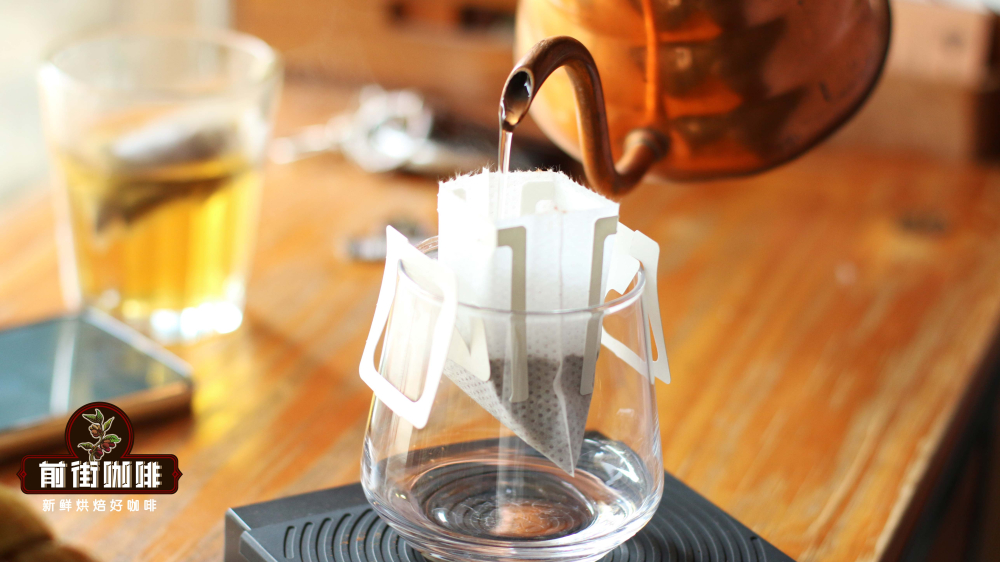
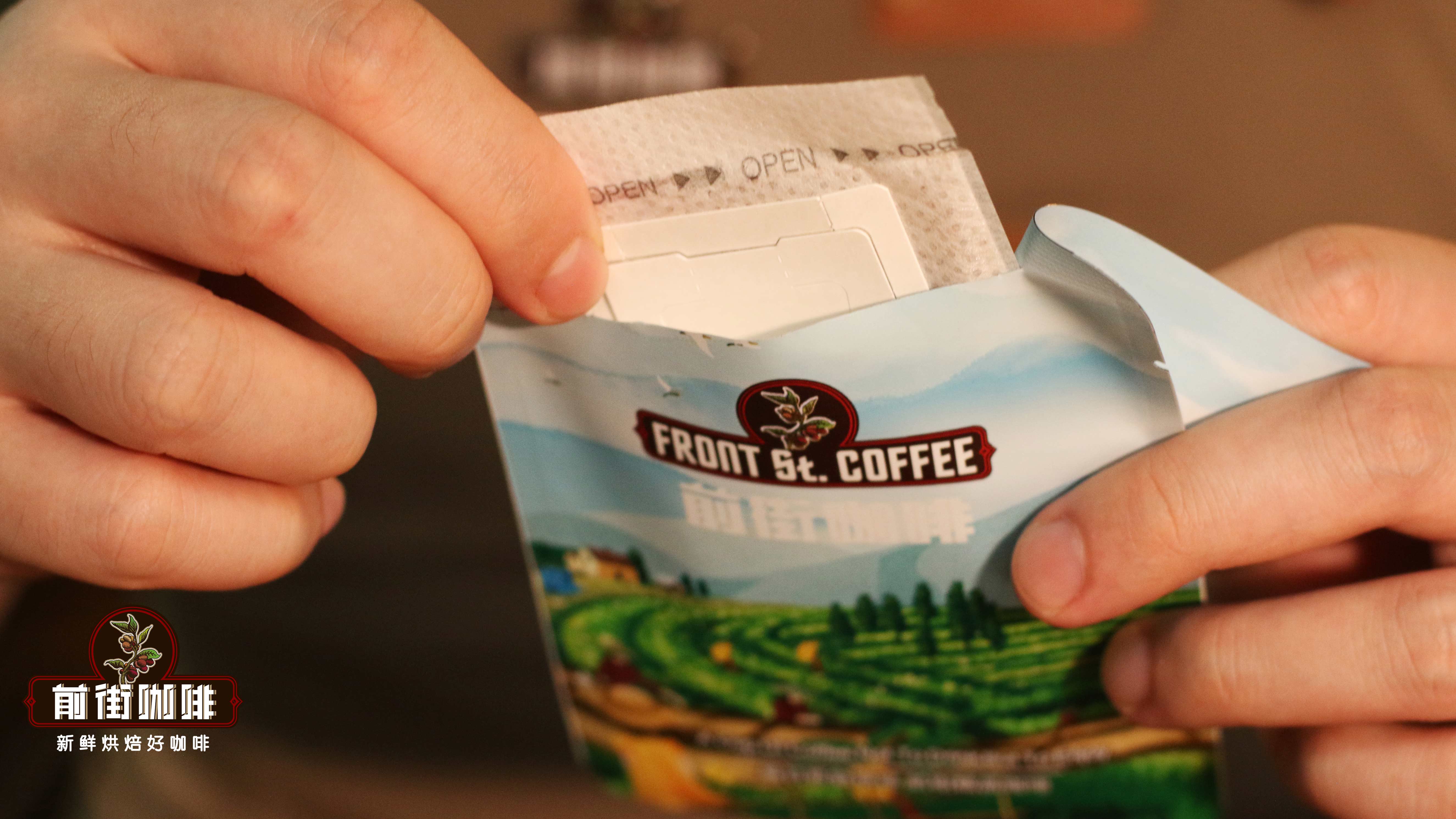
Tear open the sealed packaging, take out the drip coffee bag, and tear along the dotted line on the non-woven pouch. Then pull open the two "ears," open up the entire drip bag, and hang them on the edge of the cup or sharing pitcher.
First, pour a small amount of hot water in the first stage to completely wet all the coffee grounds, and let it bloom for about 10–20 seconds to help release gases from the coffee grounds, with the purpose of making the subsequent extraction more stable. In the second stage, pour in a steady, gentle stream until the liquid level is nearly full, then wait for the coffee liquid to drop until it has fully drained. Pour the final stage of water until full—the total water poured is about 150 grams. Once all the coffee liquid has dripped through, extraction is complete.
Before drinking, Front Street gently swirls the coffee liquid to even it out, then drinks it directly to taste the pure flavor of black coffee. You can adjust by adding an appropriate amount of sugar or milk according to your personal preference.
Recommended coffee beans suitable for making drip bags
Many office workers have asked Front Street to recommend some coffee beans suitable for making drip bags. All fifty-plus single-origin coffee beans from different regions on Front Street's bean list can be made into drip coffee bags. Below, Front Street recommends a few drip coffees with relatively classic flavors.
1. Front Street Coffee (FrontStreet Coffee) Washed Yirgacheffe Gutingding Cooperative Drip Coffee
This Gutingding Cooperative coffee bean from Front Street comes from Ethiopia's famous Yirgacheffe region, and the harvested coffee beans undergo washed processing. Traditionally, Yirgacheffe coffee used the oldest natural (sun-dried) processing method, but because early sun-dried coffee beans were mostly spread flat on the ground to dry, they inevitably picked up earthy and dusty off-flavors, and combined with a lack of proper sorting, the quality of sun-dried beans was generally average. In 1972, Ethiopia introduced washed processing technology from Central and South America to improve coffee quality, which made Yirgacheffe coffee's jasmine floral notes and bright citrus-lemon acidity clearer and more transparent, propelling it to become one of the representatives of the world's specialty coffee.
Front Street Coffee (FrontStreet Coffee): Yirgacheffe Gutingding Cooperative Coffee Region: Yirgacheffe Gedeo Zone Producer: Gutingding Cooperative Altitude: 1900-2300m Variety: Local Heirloom Processing: Washed
Grade: G1
Flavor: Citrus, berries, lemon, cane sugar, green tea
2. Front Street Coffee (FrontStreet Coffee) Brazil Queen's Estate Coffee Beans Queen's Estate is located in the Mogiana region of São Paulo State, Brazil. Unlike many large-scale regions in Brazil that prioritize quantity, this area has higher elevation, forming a relatively unique microclimate. Combined with the estate's hand-picking of coffee cherries at appropriate ripeness and small-batch, refined processing methods for each lot, the coffee beans produced are mostly of specialty quality. Queen's Estate is most proud of its Yellow Bourbon variety, which has won awards in multiple Brazil COE competitions with its refined and delicate flavors. This Queen's Estate coffee bean from Front Street uses a medium-dark roast, highlighting the classic rich aroma of Brazilian coffee while showcasing Bourbon's own sweetness. We can not only taste the intense coffee aroma but also enjoy a clear, sweet aftertaste on the palate.
Front Street Coffee (FrontStreet Coffee) Brazil Queen's Estate Coffee Beans
Region: Brazil Mogiana Region
Estate: Queen's Estate
Altitude: 1400–1950m
Variety: Yellow Bourbon
Processing: Natural (Sun-dried)
Flavor: Dark chocolate, cream, peanut, sugarcane, nuts
3. Front Street Coffee (FrontStreet Coffee) Sidamo Flower Queen Drip Coffee
This Flower Queen coffee bean introduced by Front Street Coffee (FrontStreet Coffee) was the champion of the natural group in Ethiopia's 2017 TOH coffee competition. It appeared before everyone with a unique strawberry-cream flavor, making a stunning debut. So that year, this batch of green beans was imported to China by Beijing green bean trader Hongshun, and in the same year, Li Jianfei used this bean to win second place in the 2017 World Brewers Cup China regionals. This Ethiopian bean stood out remarkably among many Geisha competition beans, hence it was crowned with the name "Flower Queen." This coffee bean uses refined natural processing, presenting a full sweet-tart palate of nuts, honey, berries, passion fruit, cream, and strawberry.
Front Street Coffee (FrontStreet Coffee): Sidamo Hambela Flower Queen 8.0 Coffee Beans
Country: Ethiopia
Region: Sidamo
Altitude: 2250-2350m
Variety: Local Heirloom
Processing: Natural (Sun-dried)
Flavor: Berries, floral tea, honey, lemon, black tea
The above content is compiled by CoffeeHunters, a coffee news website.


