







In the Asian coffee landscape, Indonesia's Mandheling and Vietnam's massive output often dominate the conversation, while the coffee story of landlocked Laos is rarely mentioned. This country, bordered by China, Vietnam, and Thailand, nurtures a mild and smooth coffee flavor thanks to the high altitude of the Bolaven Plateau, abundant rainfall, and volcanic soil. From the introduction of Typica and Bourbon during the French colonial period, to the shift toward Robusta after war and disease, and now to a diverse landscape where Arabica accounts for one-third, Lao coffee has weathered a century of ups and downs. This article will walk you through the historical threads, core producing regions, and current state of the industry of Lao coffee, along with relevant recommendations from the Front Street brand.
When Asian coffee origins are mentioned, most people first think of Indonesia and Vietnam—the former famous for Mandheling, the latter firmly holding its place as the world's second-largest coffee producer. Because of this, Laos, a coffee nation, has long remained overlooked.
Laos
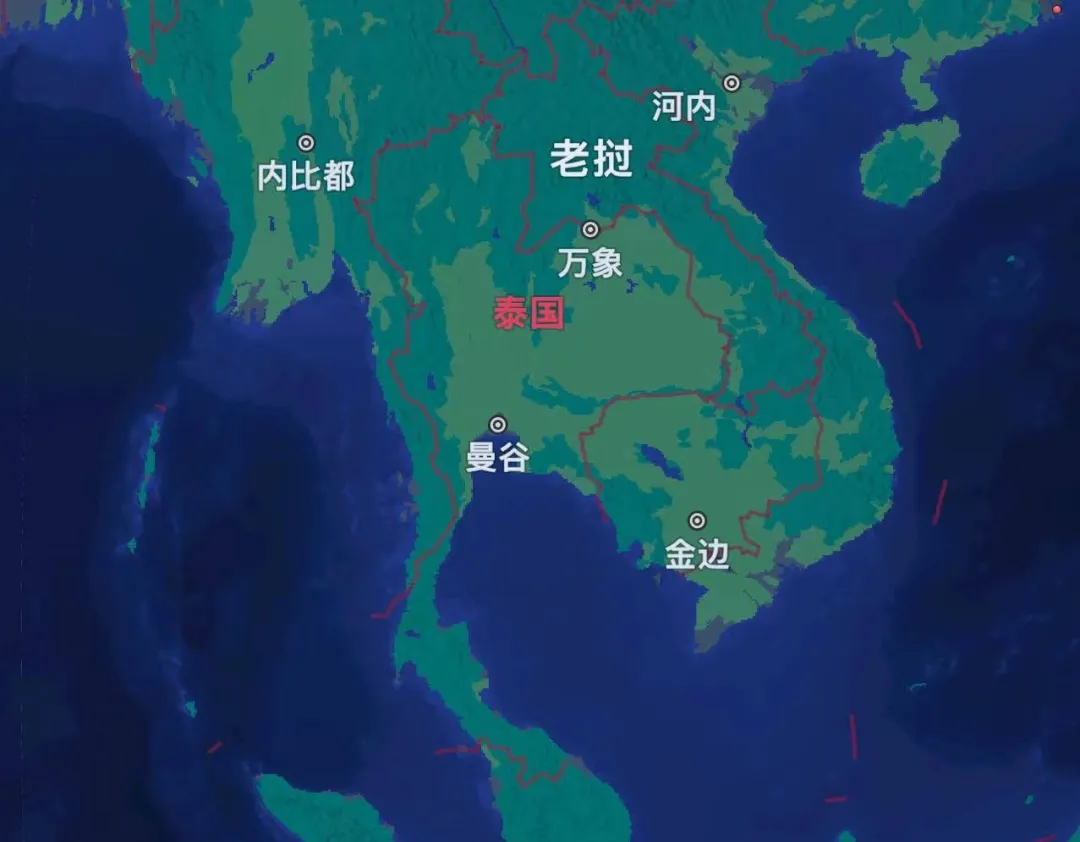
The Lao People's Democratic Republic is located in the northern part of the Indochinese Peninsula and is a landlocked country with no access to the sea. It borders Vietnam to the east, Cambodia to the south, Thailand and Myanmar to the west, and China to the north. The country covers a land area of approximately 236,800 square kilometers and is administratively divided into 17 provinces and 1 municipality.
The national flag of Laos features a rectangular design, with a blue horizontal band occupying half the flag's area across the center, red horizontal bands each taking up a quarter on the top and bottom, and a white circle painted in the center of the blue area. The blue symbolizes the country's fertile and beautiful land and the people's yearning for peace and tranquility; the red represents revolutionary spirit and the willingness to defend the nation's dignity with blood; the white circle, like a full moon, conveys the meaning of a bright moon shining over the Mekong River.
The country's topography generally slopes from high in the north to low in the south: the north connects with the Yunnan-Guizhou Plateau, the east consists of highlands formed by the Annamite Range, and the west features the Mekong River valley and basins and plains along its tributaries. According to the UN soil classification system, Laos contains 12 soil groups, among which low-activity strongly acidic soils cover the largest area, followed by high-activity strongly acidic soils, high-activity leached soils, and cambisols. These four soil types together cover more than 90% of the country and are widely distributed across the north, center, and south, providing a solid foundation for agricultural production.
In terms of climate, Laos has a tropical and subtropical monsoon type, with a rainy season from May to October and a dry season from November to April of the following year. The average annual temperature is around 26°C, with abundant rainfall reaching about 2,000 millimeters per year. The combination of high-altitude terrain, ample rain, and plateau conditions formed by volcanic eruptions makes Laos a naturally suitable area for coffee cultivation.
Coffee Producing Regions
Laos' coffee history can be traced back to the early 20th century during the French colonial period. At that time, the French introduced Typica and Bourbon varieties for cultivation on the Bolaven Plateau in the south. Later, due to factors such as war and coffee diseases, Robusta, which is more disease-resistant and higher-yielding, gradually became the mainstay and still dominates Lao coffee today; Arabica is also grown, accounting for about one-third of total production. The country's coffee harvest season is concentrated from November to March of the following year.
Bolaven Plateau
The name "Bolaven" comes from the Laven people, the largest local ethnic group, and originally means "home of the Laven." The plateau lies among the Annamite Range, with the border between Laos and Vietnam to the east and the Mekong River flowing to the west, at an elevation of about 1,000 to 1,350 meters.
In terms of coffee cultivation, the Bolaven Plateau has the longest history, largest area, and highest output in Laos. The three areas covered by the plateau—Paksong in Champasak Province, Thateng in Salavan Province, and Laongam in Sekong Province—produce about 95% of the nation's total coffee output, with a combined coffee planting area of about 70,000 hectares.
Current State of the Coffee Industry
Laos' main coffee export destinations include Vietnam, Thailand, and China, among others. The industry is currently dominated by small family-run coffee farmers, with most production supplying the domestic market and a limited share for export; coffee bean processing technology still has room for improvement, and there are relatively few large-scale coffee estates operated as enterprises. Overall, the potential of Lao coffee remains to be tapped through collaboration between the government and the private sector, but its flavor profile—mild and smooth with moderate acidity—makes it a choice well worth trying.

The above content is compiled by CoffeeHunters, a coffee news website.


