







Americano may look simple, composed only of espresso and water, yet it is precisely the drink that best tests a barista's extraction skill. This article begins with the definition and origin of Americano, sorts out the two mainstream approaches of Americano and Long Black, discusses the controversy over long-extraction weak coffee, and explains in detail the production process of hot and iced Americano, the coffee-to-water ratio, and whether removing the crema affects flavor. The article also combines the Warm Sun blend used at Front Street Coffee stores to give specific extraction parameters and ratio references, helping coffee enthusiasts reproduce a clean, balanced Americano that retains the bean's true character in daily brewing.
What exactly is Americano?
"Americano" (English: Americano, Italian: Caffe Americano), according to traditional usage, refers to black coffee brewed with a drip coffee maker. Because this method of extraction often takes four to five minutes, the flavor expression of the coffee tends to be mild and plain.
Making Americano is not complicated; it emphasizes convenience, speed, and free-and-easy flexibility. Compared with espresso, its taste is usually crisper, and it more easily brings out the original flavors of the coffee beans. However, the Americano sold in cafes today has already diverged from the traditional definition. The current method uses espresso as the base, then adds a large amount of water to dilute it, ultimately becoming a standard beverage that appears on almost every cafe menu.
Since Americano consists of nothing more than espresso and water, the mainstream methods fall into two types: one is pouring water into the espresso, and the other is pouring the extracted espresso into water. The former is usually called Americano, while the latter is mostly called long black.
The origin of Americano
Americano appeared after World War II. At that time, the U.S. military ended the war in Europe, and large numbers of soldiers came to Southern Europe. They were not used to drinking espresso, so they diluted it with warm boiled water. Only when diluted to this strength were they willing to accept it, which shows that espresso was not loved by everyone from the beginning. Because this way of drinking was mainly popular among American soldiers, people named it Americano.
At that time, most Americans were used to making milder coffee by the filter method. Even today, most American households still use drip coffee makers, which is also why drip coffee makers are called American coffee makers. The spread of the practice of diluting espresso with water to make Americano was thanks to the influence of Starbucks expanding its stores globally.
So, is it correct to use an espresso machine to run water for a long time to make a milder cup of coffee? There are two views on this. Supporters of traditional espresso believe it is not advisable, because it over-extracts the coffee. Especially in the later stage of extraction, off-flavors from the coffee grounds and excessive caffeine are brought out, and they are quite dismissive of this practice.
But in today's coffee market, for example, coffee shops in Australia operate this way, and it is quite common. Their reasoning is: if this counts as over-extraction, then aren't the extraction times of a French press and siphon longer than this? In that case, what is the problem with doing this?
Let's not first compare the taste differences between the two methods, because once taste is discussed, disagreements easily arise. But what needs to be known is that weak coffee extracted over a long time has a higher caffeine content than the method of adding water to a standard cup of espresso. Even so, there are still two production orders: making espresso first and then adding water to dilute it, and putting water first and then pouring in the espresso.
How do you make Americano?
Americano can be said to be the simplest espresso drink, because it consists of only two parts: espresso and water, while iced Americano adds ice cubes as well. But do not let its simplicity make you careless; the more basic the part, the more it tests technique, and Americano is often the best way to test a barista's level of espresso extraction.
Compared with milk coffees such as latte, Americano lacks milk's interference with the coffee's flavor, so it is the best way to taste the personality of the coffee beans themselves. Many baristas order Americano when visiting other cafes: first, because it is convenient and quick; second, because it lets them judge the other side's standard of production.
Back to the point. Earlier we said Americano is simple to make, with only water and espresso as its two parts, so you only need to pour the espresso into the water. The espresso part must be extracted according to the characteristics of the beans, and different beans correspond to different extraction parameters. For example, Front Street Coffee stores use a Warm Sun blend—60% Sherry barrel coffee beans mixed with 40% sun-dried Yirgacheffe. Baristas adjust it every day according to the condition of the beans. To highlight the Sherry barrel flavor, they chose a plan of 20 grams of coffee beans, extracting 40 grams of coffee liquid, with the time controlled at 27 to 28 seconds.
When making hot Americano, first warm the cup with hot water, then pour in hot water, and finally pour in the extracted espresso. The coffee-to-water ratio of Americano is generally between 1:6 and 1:8. After repeated testing, Front Street Coffee chose 1:6, that is, 40 grams of coffee liquid mixed with 240 grams of hot water.
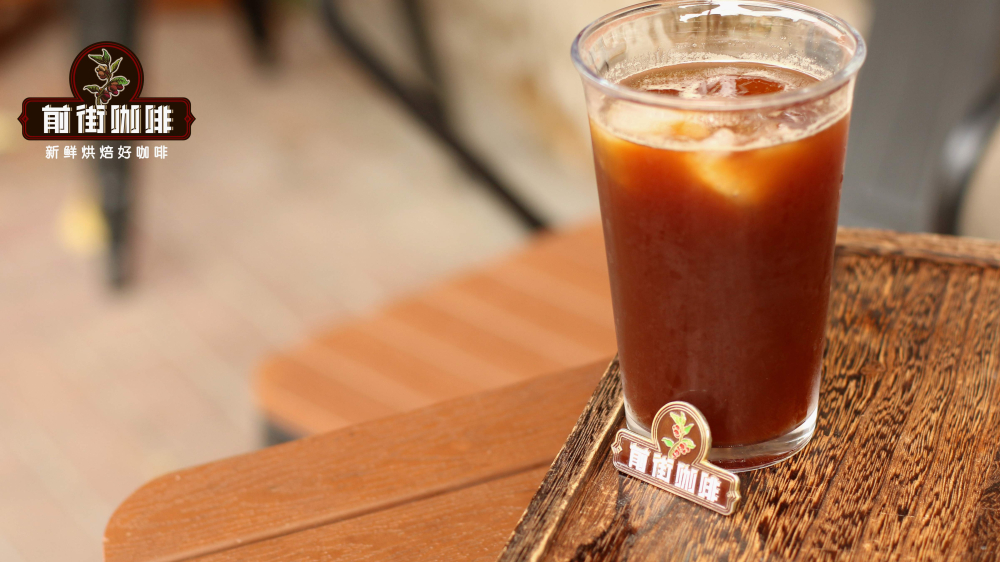
Similarly, when making iced Americano, first pre-chill the cup with ice cubes, then pour in water, and finally pour in the espresso. Because ice cubes are added, Front Street Coffee's iced Americano uses a 1:7 ratio, namely 40 grams of coffee liquid mixed with 280 grams of ice-water mixture, of which 180 grams is ice and 100 grams is water.
Does Americano taste better with the crema removed?
When making hot Americano, you will see a layer of foam floating on the surface of the coffee, which is what is commonly called crema. This layer of crema comes from the crema produced when making espresso. We know espresso consists of three parts: the core, the body, and the crema. Espresso crema is produced like this: under the high pressure of the coffee machine, carbon dioxide in the coffee grounds is dissolved into the liquid. After extraction ends and the pressure returns to normal, the carbon dioxide in the coffee liquid begins to be released into the air, and at the same time meets and is wrapped by the fats in the coffee, and crema is thus produced.
What happens if you scrape off this layer of crema? Front Street Coffee once did an experiment, making two cups of Americano, one of which had the crema scraped off as a comparison. Taking Front Street Coffee stores' Warm Sun blend coffee beans as an example, the cup with the crema scraped off was cleaner and had a smoother mouthfeel; the cup that retained the crema had a thicker mouthfeel. Both cups had obvious dark chocolate flavor and a slight whiskey oak barrel aroma, with soft acidity, and the difference was actually not great. If you prefer a clean taste, it is recommended to scrape off the crema; if you need continuous production, it is more recommended to retain the crema.
The above content is compiled by CoffeeHunters, a coffee news website.


