








On the African continent, beyond Ethiopia, Kenya is likewise a presence that cannot be overlooked on the specialty coffee map. Anyone who has come into contact with specialty coffee, after discovering that coffee can possess such a vivid acidity, will almost invariably ask the same question: where does the coffee with the most prominent acidity come from? The brewers at Front Street Coffee usually point to Kenya. Kenyan coffee is renowned for its clean and translucent cup, its full and rounded body, and its highly recognizable fruit acidity, conquering the palates of countless coffee lovers. This article will systematically review Kenya's coffee-growing terroir, historical evolution, characteristics of the ten major producing regions, official grading standards, and, using the washed fermentation process as an entry point, explain the reasons behind the formation of its signature flavors. Finally, a specific brewing recipe for Front Street Kenya Asaliya is attached for reference.
For more specialty coffee knowledge, please follow: Front Street Coffee (Frontsteet Coffee)
Many friends who have just stepped into the world of specialty coffee, after realizing for the first time that coffee can actually have a sour taste, often can't help but ask: "Which coffee has the highest acidity?" Faced with this question, the baristas at Front Street almost invariably think of Kenya. Front Street Kenyan coffee features a clean and refreshing taste, a thick mouthfeel, and bright fruit acidity. Everyone who has tried Kenyan coffee has fallen under its spell.
Coffee Growing Conditions
Kenya is located in East Africa, with the equator passing through the center of the country and the East African Rift Valley running north to south. The terrain is dominated by plateaus, with an average altitude of about 1,500 meters. The second-highest peak in Africa, Mount Kirinyaga (i.e., Mount Kenya), stands at 5,199 meters and is covered in snow year-round.
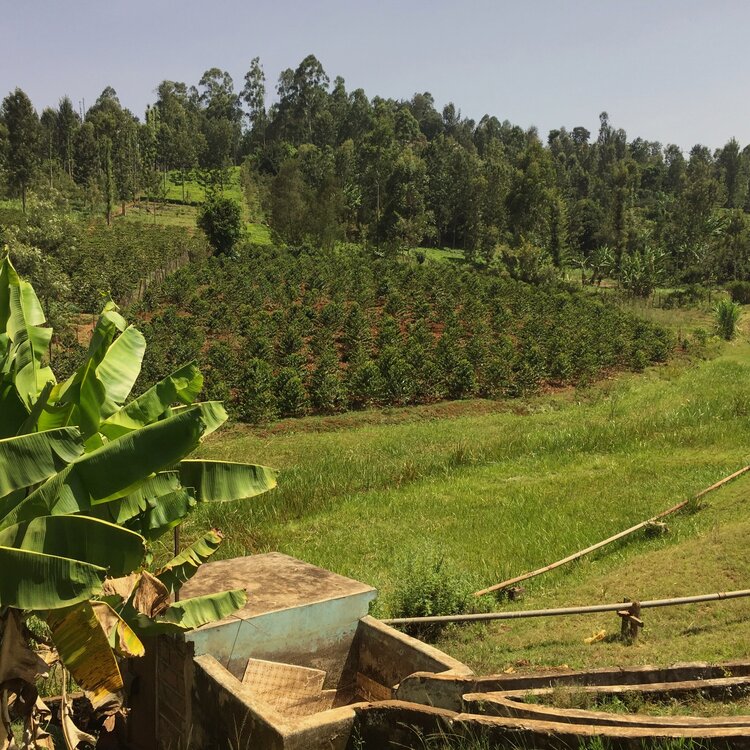
Kenya is a tropical producing region, experiencing two rainy seasons a year, with the corresponding harvest periods concentrated from October to December and from June to August. The coffee-growing belt is mainly located in volcanic soil areas at altitudes of 1,600 to 2,100 meters. Thanks to the suitable high-altitude conditions, the ripening cycle of coffee cherries is extended, aromatic substances within the beans are fully accumulated, the fruit acidity is prominent, and the beans are also harder.
Coffee Growing History
Although neighboring Ethiopia is recognized as the birthplace of coffee, Kenya's coffee-growing history did not begin until the late 19th century. In 1893, missionaries introduced the Bourbon variety from Brazil into Kenya. In 1895, Britain colonized Kenya, designating it as the "East Africa Protectorate" and taking control of all crops, including coffee.
Between 1900 and 1933, the colonial authorities established the Coffee Board (CB), responsible for licensing, inspection, and promotion of coffee. From 1934 onward, auctions gradually became a sales channel for Kenyan coffee, while the first coffee auction was not formally held until September 1935. In 1946, the Coffee Marketing Board (CMB) was established and became fully operational on July 1, 1947, but the body was abolished in 1971.
Introduction to Kenyan Coffee Producing Regions
There are mainly 10 coffee-producing regions in Kenya: Nyeri, Murang'a, Kirinyaga, Embu, Meru, Kiambu, Machakos, Nakuru, and Kisii.
[Nyeri]
The Nyeri producing region is located in central Kenya and is home to Mount Kenya, an extinct volcano. The area is covered with fertile volcanic red soil, creating unique conditions for producing Kenya's top coffee. In this producing region, the number of cooperatives formed by smallholder farmers far exceeds that of large estates. The growing altitude ranges between 1,200 and 2,300 meters.
[Murang'a]
The Murang'a producing region falls under the administration of Central Province, with approximately 100,000 coffee growers in the area. This was one of the earliest areas where missionaries chose to settle. Murang'a also possesses fertile volcanic soil, and the number of smallholder coffee farmers exceeds that of estates. The growing altitude ranges between 1,350 and 1,940 meters.
[Kirinyaga]
The Kirinyaga producing region is located east of Nyeri and also has fertile volcanic soil. The coffee in this area is mainly produced by smallholder farmers, and the processing plants also produce quite a lot of excellent-quality coffee. The growing altitude ranges from 1,300 to 1,900 meters.
[Embu]
The Embu producing region is adjacent to Mount Kenya, and its name is taken from Embu town. About 70% of the local population is engaged in small-scale agriculture, and the coffee beans almost all come from smallholder farmers, with overall output relatively low. The growing altitude ranges between 1,300 and 1,900 meters.
[Meru]
Most of the coffee in the Meru producing region is grown by smallholder farmers on the slopes of Mount Kenya and the Nyambene Hills. The name Meru originates from the local ethnic group—the Meru people. In the 1930s, they became the earliest Kenyans to engage in coffee production, thanks to the Devonshire White Paper signed in 1923, which clarified the importance of safeguarding the rights and interests of Kenya's African population. The growing altitude ranges between 1,300 and 1,950 meters.
[Kiambu]
The Kiambu producing region is located in central Kenya, with large coffee estates as the main form of production. However, with the advancement of urbanization, the number of estates has continuously shrunk. Coffee from Kiambu is usually sold under sub-region names, such as Thika, Ruiru, and Limuru. There are also a considerable number of smallholder farmers in the area. The growing altitude ranges between 1,500 and 2,200 meters.
[Machakos]
The Machakos producing region is a relatively small county in central Kenya, and its name comes from Machako town. Coffee production in this region is composed of both estates and smallholder farmers. The growing altitude ranges between 1,400 and 1,850 meters.
[Nakuru]
The Nakuru producing region is located in central Kenya and has the highest-altitude coffee-growing zone among the central producing regions. Some coffee plants grown at high altitudes will stop growing due to Dieback. The region's name originates from Nakuru town. The growing altitude ranges between 1,850 and 2,200 meters.
[Kisii]
The Kisii producing region is located to the southwest of Kenya's coffee-producing regions, adjacent to Lake Victoria, and is relatively limited in area. Most of the coffee in the area comes from common cooperatives formed by free small-scale producers. The growing altitude ranges between 1,450 and 1,800 meters.
Kenya's Coffee Grading System
Friends who have browsed Front Street's content on Kenyan coffee will easily notice the presence of Kenya AA. Kenya developed its coffee economy during the colonial period, and the entire industry system leaned toward refined management. In terms of selection and breeding, grading, and processing methods, Kenya's level at the time far exceeded that of many coffee-producing countries. It was not until decades later, when other countries also gradually recognized the value of refined management and began to learn from it, that Kenya's unique dominance gradually faded.
1. Distinguished by size, shape, and weight
E: Elephant bean, 18 mesh and above (including peaberry), includes large peaberry; like PB, it is relatively scarce
AA: 17-18 mesh
AB: 15-16 mesh, a blend of Grade A and Grade B; 17 mesh (6.8mm) and above is Grade A, 16 mesh (6.3mm) and above is Grade B
TT: Light beans sorted out from AA and AB by an air separator
PB: 15 mesh and above, peaberry, accounting for about 10% of Kenyan coffee
C: 12-14 mesh, as well as light beans sorted out from PB by an air separator
T: Below 12 mesh, with more defective beans, broken beans, and light beans
HE: Grades outside the above are classified as HE (Hulled Ears)
2. Green beans that have not undergone official standard grading are UG (ungrade)
E, AA, AB, PB→UG1
C, TT, T, HE→UG2
3. MBUNI (natural sun-dried beans, not washed processing)
All green beans undergo gravity separator sorting
MH: heavy mbuni, heavy beans, yellow, free of black beans, fragments, dried fruit, or other defects; the cup shows typical natural-process flavors with no flavor defects
ML: light mbuni, yellow-green, with a small number of insect-damaged beans or black beans, free of stinky beans or fragments, and no earthy taste or other bad flavors in the cup
The above is Kenya's official national grading system. In addition, Kenyan exporters or green bean traders have introduced special grading for AA and AB grade green coffee beans (not officially recognized by the Kenyan government), in order: TOP, PLUS (+), FAQ
Reasons Behind the Taste Characteristics of Kenyan Coffee
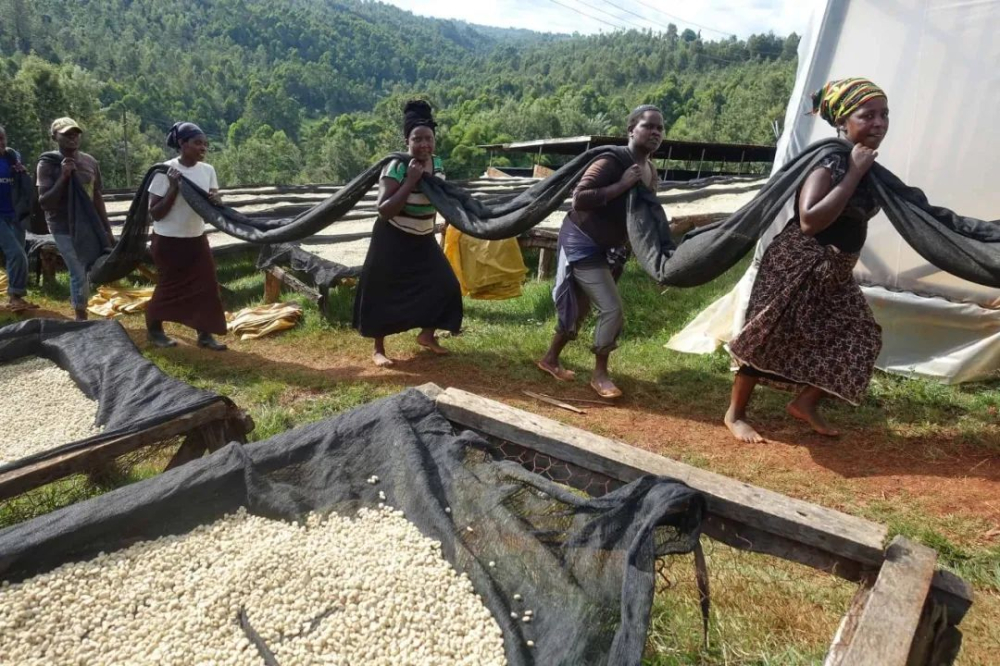
The fermentation time of beans from Central and South America in washing tanks usually does not exceed 36 hours, while Kenya's washing time can be as long as 72 hours. After 30 to 48 hours of fermentation, the parchment beans are removed from the tank. At this point, the mucilage on the bean surface has been completely removed, but they still need to undergo 24 hours of soaking in clean water. After cupping multiple beans, Front Street noted that this additional fermentation step should be closely related to the bright and clean flavor performance in the characteristics of Kenyan AA coffee.
How to Drink Kenyan Coffee?
Taking Front Street Coffee (FrontStreet Coffee) Kenya Asaliya as an example:
Front Street Coffee (FrontStreet Coffee): Kenya · Asaliya coffee beans
Producing region: Asali processing plant, Thika producing region, Kenya
Altitude: 1,550 meters—1,750 meters
Variety: SL28, SL34
Processing method: K72 washed processing
Flavor description: smoked plum, cherry tomato, snow pear, yellow sugar, plum
Front Street Coffee (FrontStreet Coffee) pour-over parameter sharing
Dripper: Hario V60
Dose: 15 grams
Coffee-to-water ratio: 1:15
Water temperature: 90℃
Grind size: EK43s#10 (80% passing rate on No. 20 standard sieve)
In the first stage, pour 30 grams of water for a 30-second bloom, then in the second stage pour water to 125 grams for staging. When the water level drops to the point where the coffee bed is about to be exposed, begin the third stage of pouring until 225 grams, then stop pouring. Wait for the water in the dripper to completely drip into the server, then remove the dripper. Total extraction time: 2'00".
The above content is compiled by CoffeeHunters, a coffee news website.


