







Blue Mountain coffee is hailed as the "Emperor of Coffee," but the market is full of mixed quality and it is hard to tell the real from the fake. This article, from the perspective of Front Street Coffee, systematically sorts out the historical origins of Jamaican Blue Mountain coffee, the certified authentic production areas, the green bean grading standards, the characteristics of the Typica variety, and the differences between washed and natural processing methods. It also explains in detail how to identify authentic Blue Mountain through features such as CIB certificates and wooden barrel packaging, and includes Front Street washed Blue Mountain's roasting curve, cupping report, and brewing parameters, helping coffee lovers gain a comprehensive understanding of the true appearance and value of this top-tier coffee.
For more specialty coffee knowledge, please follow the WeChat public account: Front Street Coffee (FrontStreet Coffee)
After more and more people become obsessed with coffee, they want to brew a cup themselves, and the starting point for choosing beans often falls on those famous classic production areas. When it comes to the world's most famous coffee, Jamaican Blue Mountain is almost inevitably
That being the case, today Front Street will walk with you into the world of Jamaican Blue Mountain coffee and see what this "Emperor of Coffee" actually looks like.
The Historical Thread of Jamaican Blue Mountain Coffee
Jamaica's coffee heritage can be traced back to the 18th century. In 1717, King Louis XV of France ordered the establishment of coffee plantations in Jamaica. By the mid-1720s, Sir Nicholas Lawes, then Governor of Jamaica, introduced Arabica seeds from Martinique and gradually promoted their cultivation in the St. Andrew region. Coffee trees thus took root in the Blue Mountains, and later differentiated by altitude into three grades: Jamaican Blue Mountain Coffee, High Mountain Coffee, and Jamaican Coffee—different grades, naturally different prices.
Where Is the Officially Certified Authentic Blue Mountain Production Area?
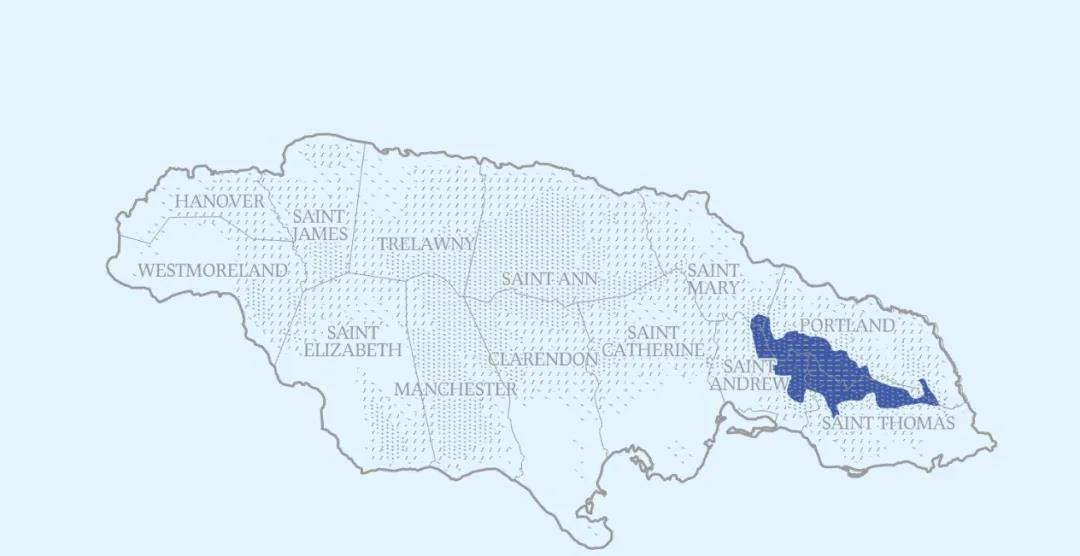
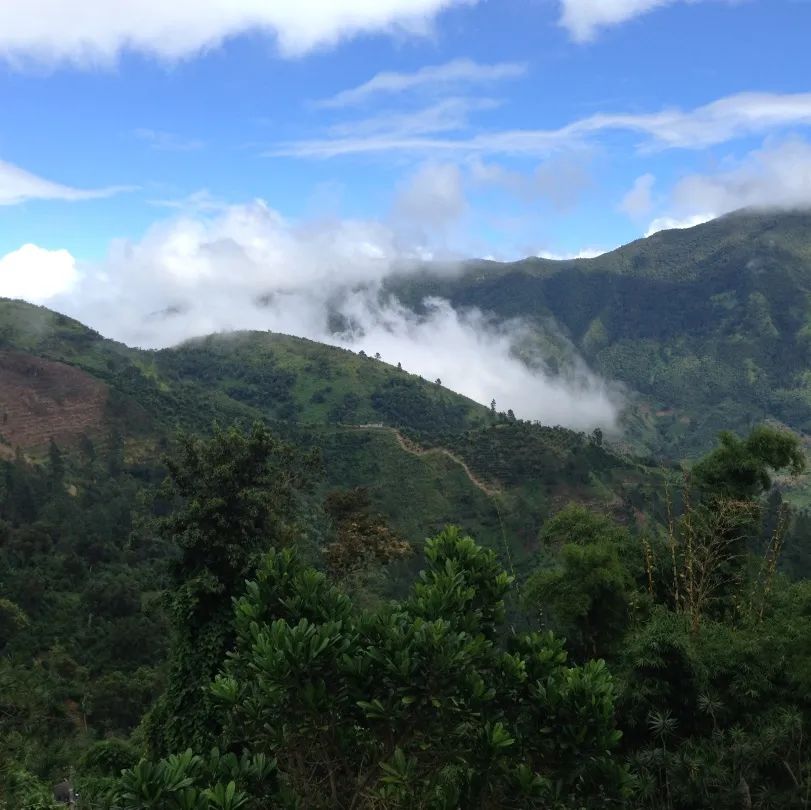
The Blue Mountains sit in the eastern part of Jamaica, at elevations between 1,000 and 1,700 meters. Only coffee grown within this range qualifies to bear the name of authentic Blue Mountain. The mountains are embraced by the Caribbean Sea. On clear days, sunlight strikes the azure sea, and the peaks reflect the shimmering blue radiance of the water—hence the name Blue Mountain.
The Blue Mountains lie right in the coffee belt, with fertile volcanic soil, clean and pollution-free air, a humid climate, and year-round fog and rain. Annual rainfall averages about 1,980 mm, and temperatures hold around 27°C. It is precisely these terroir conditions that have made Jamaican Blue Mountain coffee world-famous. The authentic Blue Mountain production area designated by the Jamaican government covers four eastern administrative parishes: St. Andrew, St. Thomas, St. Mary, and Portland. Front Street's Washed Blue Mountain and Sun-Dried Blue Mountain both come from Clifton Mount Estate within Jamaica's certified Blue Mountain production area. This estate is also the only one in the Blue Mountain growing region to hold Rainforest Alliance certification. Rainforest certification refers to the traditional cultivation method of growing under native forest shade, an ecologically beneficial farming system. A portion of the alliance's proceeds is also invested in wildlife conservation in tropical rainforest reserves and improving laborers' living conditions.
Altitude Requirements for Blue Mountain Coffee Cultivation
The main peak of the Blue Mountains rises 2,256 meters, the highest point in the Caribbean. This is coffee belt territory, with fertile volcanic soil, fresh and pollution-free air, a humid climate, year-round fog and rain, annual rainfall of about 1,980 mm, and temperatures around 27°C. Such an environment has produced both the world-renowned Front Street Jamaican Blue Mountain coffee and the world's most expensive coffee. Only coffee planted in designated areas at elevations of 1,000 to 1,700 meters can bear the official certified Blue Mountain mark.
Why Did Japan Once Hold Priority Purchasing Rights for Blue Mountain Coffee?
In 1950, the Jamaican government established the Jamaica Coffee Industry Board to set coffee quality standards and oversee their enforcement, ensuring the quality of Jamaican coffee. The Board issues special official seals for exported green beans and roasted beans. Because Japan provided loans to help Jamaica improve production quality, the market for Blue Mountain coffee was secured. This priority purchasing right lasted until 2009, when it finally came to an end. In April 2011, the first batch of Jamaican Blue Mountain No. 1 coffee arrived in mainland China.
Jamaica Coffee Industry Board (CIB)
Jamaica is the only country in the world with a government-level coffee management agency—the Jamaica Coffee Industry Board (CIB), under the Ministry of Agriculture and Fisheries. CIB's responsibilities include cultivation technical guidance, processing training, fair trade, and quality supervision, covering all aspects of Jamaican Blue Mountain quality and branding. CIB board members are all estate owners with plantations of a certain scale or larger in Jamaica. Due to changes in the industry landscape, newly certified Jamaican Blue Mountain estates must now be at least 50 hectares in size.
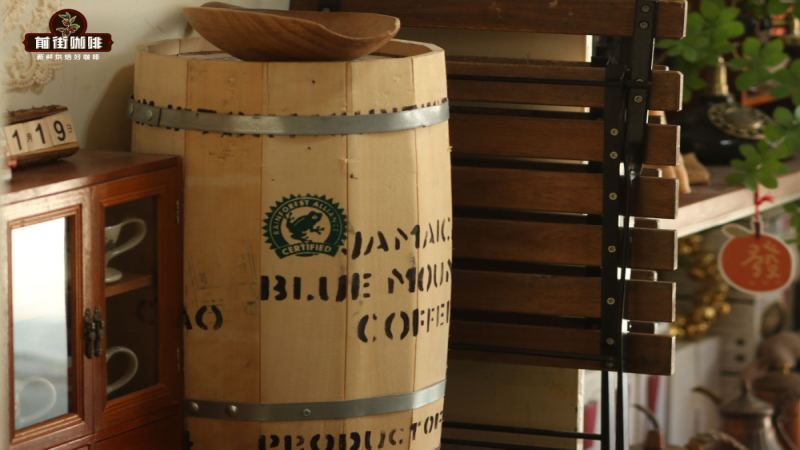
CIB explicitly stipulates that only coffee beans grown above 2,200 feet in Jamaica's Blue Mountains may be called Jamaican Blue Mountain. Grades are classified by bean size as NO.1, NO.2, NO.3, and hand-selected PB. The basic standards for NO.1 Front Street Blue Mountain green beans are: 17 screen or above, defect rate below 3%, moisture content around 13%, etc. All Blue Mountain coffee currently exported on the market must hold a certificate issued by CIB.
Grading of Jamaican Blue Mountain Coffee Green Beans
From highest to lowest quality: NO.1, NO.2, NO.3, and PB—PB being peaberry. According to CIB standards, only coffee grown at elevations of 1,000 to 1,700 meters deserves to be called Jamaican Front Street Blue Mountain coffee. Its output is scarce, the beans are large, quality is outstanding, and the flavor is harmonious—with moderate acidity, bitterness, aroma, body, and sweetness. It is recognized worldwide as a supreme delicacy, and thus the national treasure Blue Mountain No.1 commands the highest price among all Blue Mountain coffees.
(1) No.1 - 17/18 screen, defect bean ratio no more than 2%. (2) No.2 - 16/17 screen, defect bean ratio no more than 2%. (3) No.3 - 15/16 screen, defect bean ratio no more than 2%. (4) Peaberry - 10MS, defect bean ratio no more than 2%.
Varietal Characteristics of Jamaican Blue Mountain Coffee
The variety of Front Street Jamaican Blue Mountain coffee is Typica. In the 1720s, Typica was transplanted from Martinique to the Jamaica Blue Mountains. Over more than two centuries, Blue Mountain Typica has evolved stronger disease resistance, particularly better resistance to coffee berry disease than ordinary Typica. However, once Blue Mountain Typica leaves Jamaica, it cannot reproduce its clear, sweet, delicate aroma. Typica's top leaves are bronze-colored, the beans are oval or slender-pointed, the tree is tall with slightly slanting branches at about 50 to 70 degrees. The flavor is elegant, but the plant is somewhat weak, with poor disease resistance and extremely low yield per tree, bearing few cherries.
How to Identify Genuine Front Street Jamaican Blue Mountain Coffee
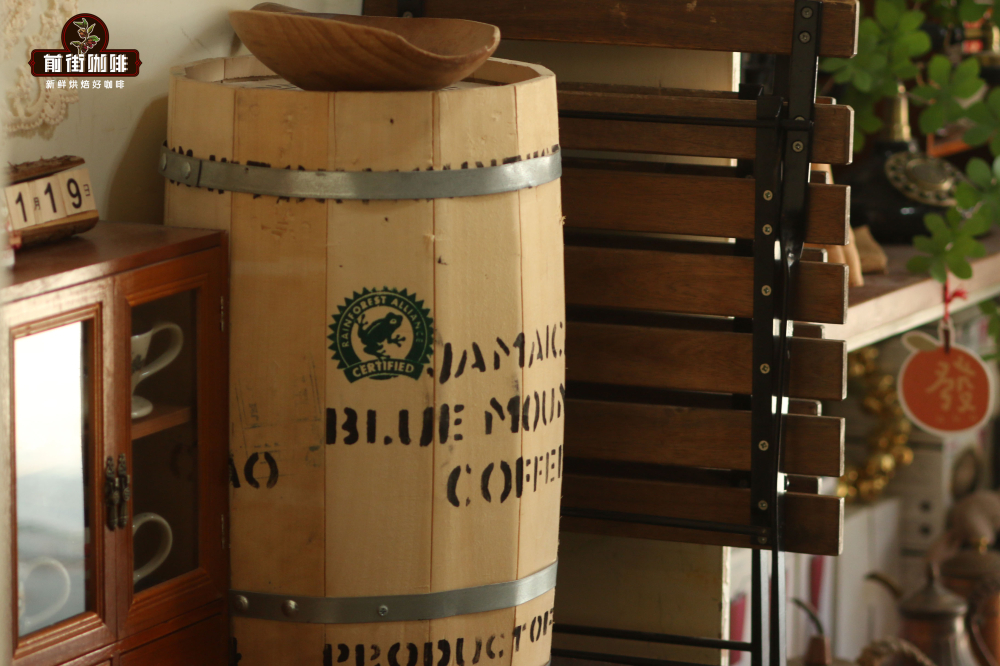
1. Export companies designated by the national coffee board. 2. The only production area that uses wooden barrels for green beans. Front Street reminds you here that when buying Jamaican Blue Mountain, beware of two misconceptions:
First, many merchants roast beans from other regions or blends slightly darker to strip away their flavor characteristics and approximate the taste of Blue Mountain coffee. Such merchants play word games, labeling beans that are not Blue Mountain as "Blue Mountain Flavor Coffee." Because Jamaican Blue Mountain coffee is so famous, a flood of imitation products has appeared on the market—such as Blue Mountain Style Coffee, Blue Mountain Blend Coffee, or simply "Blue Mountain Coffee." But these are merely blends that operators create by mixing various coffee beans to imitate Jamaican Blue Mountain's flavor—there may not be a single genuine Jamaican Blue Mountain bean in them.
Second, some industry players' understanding of Blue Mountain remains stuck more than a decade ago, believing that all authentic Jamaican Blue Mountain was bought up by Japan and that what's sold in China is not genuine Jamaican Blue Mountain No.1. In fact, China's market demand is huge, normal imports of Blue Mountain have been ongoing for years, and Blue Mountain coffee estate owners have frequently visited China in recent years to deepen Chinese consumers' understanding of Blue Mountain coffee beans. Blue Mountain on the Chinese market is far from being so rare that fakes are everywhere. Today, Jamaica's Blue Mountain coffee production area is larger than before, and with Japan's weakening purchasing power, genuine Jamaican Blue Mountain coffee is also sold in China—as long as you know how to identify it, you can buy the real thing.
Processing Methods of Jamaican Blue Mountain Coffee Beans
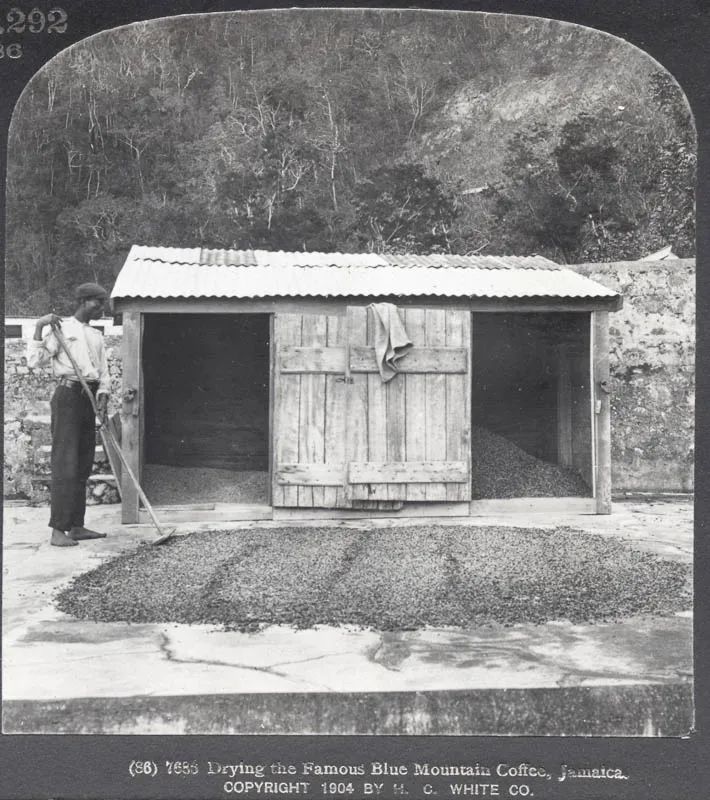
Before 2019, Clifton Farm's Blue Mountain coffee uniformly used the washed method for green bean processing. The process begins by removing the skin and pulp, then fermenting for 12 to 18 hours. After fermentation, the beans are moved into water tanks and pushed back and forth, using the friction between beans and the force of flowing water to wash the coffee beans until smooth and clean. After washing, the beans are still wrapped in parchment, with moisture content as high as 50%. They must be dried to bring moisture down to 12% to 14%, otherwise fermentation continues, leading to mold and spoilage. The beans are then sorted and stored in dedicated warehouses.
In the 2020 new harvest season, Clifton Farm introduced sun-dried Blue Mountain coffee beans for the first time—quite a novelty. Jamaica has a tropical rainforest climate, with rainy seasons from May to June and September to November each year, and the most frequent showers in January and May. The harvest and processing season for Jamaican Blue Mountain coffee runs from February to June each year, half of which falls in the rainy season, making sun-drying clearly impractical. In addition, traditional sun-drying produces unstable quality—coffee quality depends entirely on the heavens. To obtain better-quality sun-dried beans, labor costs exceed those of washed methods. During drying on the patio, coffee cherries must be manually turned every few hours to maintain ventilation, reducing mold while ensuring even drying. Such a thankless processing method was naturally even harder to promote in Jamaica at the time.
Front Street Blue Mountain Coffee Green Bean Analysis
First, observe Front Street Blue Mountain coffee green beans: the beans are extremely plump, uniform in screen size, with both ends slightly upturned and an oval shape. Viewed from the side, the bean body is flat and thin—a pure-blooded Typica variety. Washed Front Street Blue Mountain coffee beans are overall blue-green with little silver skin. This is because washed beans undergo prolonged soaking during processing, which separates the silver skin from the beans; when the parchment is finally removed, the outer silver skin is scraped off along with it, leaving very little silver skin on the surface of washed green beans.
FrontStreet Coffee Roasting Notes
Front Street Washed Blue Mountain Coffee: charge when drum temperature reaches 170°C, set airflow to 3. After 1 minute, reduce heat to 140°C with airflow unchanged. Roast until 5 minutes 10 seconds at 153°C, when the bean surface turns yellow, the grassy smell fully dissipates, and dehydration is complete. Adjust heat to 115°C, airflow to 4. At the 8th minute, wrinkles and dark streaks appear on the bean surface, and the toast aroma clearly shifts to coffee fragrance—this can be seen as the prelude to first crack. At this point, listen carefully for the sound of first crack. First crack begins at 8 minutes 12 seconds. Reduce heat to 90°C, open airflow fully (adjust heat very carefully—not so low that cracking sounds disappear), and drop at 201.3°C.
FrontStreet Coffee Cupping Report
FrontStreet Coffee conducts cupping within 8 to 24 hours after roasting sample coffee beans. FrontStreet Coffee roasters typically use 200ml ceramic cupping bowls with 150ml and 200ml graduation lines. According to SCAA standards, water TDS is around 150ppm—too low causes over-extraction, too high affects mouthfeel and tends toward under-extraction. Cupping water temperature is 94°C. Cupping grind follows SCAA standards, controlled to 70% to 75% passing through a No. 20 standard sieve (0.85mm). The ratio is 11g coffee grounds to 200ml hot water, i.e., 1:18.18. The resulting extraction concentration falls right within the golden cup range of 1.15% to 1.35%, with a 4-minute steep time. Front Street Washed Blue Mountain Coffee Cupping
Dry aroma: roasted peanut, hazelnut, melon, chocolate Wet aroma: oolong tea, caramel, honey, chocolate, almond Flavor: roasted nuts, chocolate, almond, melon, honey, balanced sweet-acidic-bitter
FrontStreet Coffee Brewing Notes Dripper: Kono Dose: 15g Coffee-to-water ratio: 1:15 Grind: medium-coarse (75% passing No. 20 standard sieve)
Front Street segmented pouring method: bloom with 30g water for 30 seconds, then slowly pour 100g water in circular motions from center outward at a slow flow rate, bringing the scale to 130g. When the bed drops to the halfway point, pour 65g water at a fast flow rate, reaching a total of 195g. Once all coffee liquid in the dripper has flowed into the server, remove the dripper to end extraction. Total brew time is 1 minute 50 seconds.
[Front Street Washed Jamaican Blue Mountain] On the palate, it presents black chocolate and nutty flavors, with high cleanliness, very bright, good body, and balanced acidity, sweetness, and bitterness.
The above content is compiled by CoffeeHunters, a coffee news website.


