







How Does Golden Mandheling Compare in Dark Roast Coffee Aroma?
Golden Mandheling and Jamaica Blue Mountain No. 1 differ mainly in aroma and body once roasted dark. Golden Mandheling, an Indonesian coffee, tends to show earthy, herbal, and dark chocolate notes with a heavy body, while Blue Mountain No. 1 stays cleaner and more balanced, with mild sweetness and low bitterness even at a deep roast. Dark roast does not taste only bitter.
Prolonged high-temperature roasting drives Maillard and caramelization reactions, creating the chocolate, caramel, nut, and cream notes that define classic coffee aroma. The same process raises the expansion rate and water loss rate, so the brew feels fuller and richer. Bitterness still appears, but it carries sweetness and a lasting sweet aftertaste that light roasts rarely produce.
In today's world where light roasts dominate the specialty coffee scene, dark roasted coffee still retains a loyal following. This article analyzes the unique charm of dark roast coffee from three dimensions: aroma, mouthfeel, and sweetness. Using Jamaica Blue Mountain No. 1 and Indonesian Golden Mandheling as examples, it explains the aroma differences that different origins and varieties exhibit under dark roasting; and from the perspectives of expansion rate, water loss rate, and bitter compounds, it explains why dark roasted coffee is more full-bodied and rich. It also explores the layered taste of bitterness with sweetness in dark roast coffee, as well as the sweet aftertaste—a characteristic that is difficult to replicate with light roasts— guiding you to rediscover the rich facets of dark roast coffee.
Before 2000, dark roast was the absolute mainstream of the coffee market. As a result, many people who encountered coffee in those early years often had a first impression of coffee that could be summed up in one word—bitter. If you wanted to drink coffee that wasn't bitter, the options at the time were simply to add milk and sugar, or go for Nescafe 2-in-1.
After the specialty coffee wave emerged, light roasts with rich floral and fruity notes gradually became mainstream, also attracting many new friends who previously didn't drink coffee. For this "new generation" of coffee lovers who have had less exposure to dark roast coffee, they often feel puzzled: "Dark roast coffee is so bitter, how can anyone like it?"
However, if you ask those who prefer dark roast coffee for their reasons, you'll find that the merits of dark roast coffee they mention are far richer than imagined.
Rich Coffee Aroma
The alluring aroma of coffee originally referred to the fragrance given off by strong, bitter dark roast coffee, and this is also the coffee scent you can smell in most coffee shops today.
This type of aroma is different from the floral and fruity notes of light roasts. It is the roasted fragrance transformed from coffee beans through prolonged high-temperature roasting, under the effects of the Maillard reaction and caramelization reaction. The complex aromas of chocolate, caramel, nuts, and cream are steady and comforting, fascinating as soon as you smell them. The best-selling coffee beans include Front Street Classic Blend, Front Street Dark Cocoa Blend, Front Street Commercial Blend, and Front Street Specialty Blend.
The aroma of dark roast coffee is not monotonous either; it varies depending on variety, origin, and roast level. For example, Front Street Indonesia·Golden Mandheling from the Front Street bean list carries, in addition to roasted notes, hints of spice and smokiness; Front Street Jamaica·Blue Mountain No. 1 coffee, besides roasted notes, also has an indescribable yet very unique elegant fresh fragrance, soft and pleasing; Front Street Brazil·Queen's Estate, on the other hand, carries a more intense hazelnut flavor...
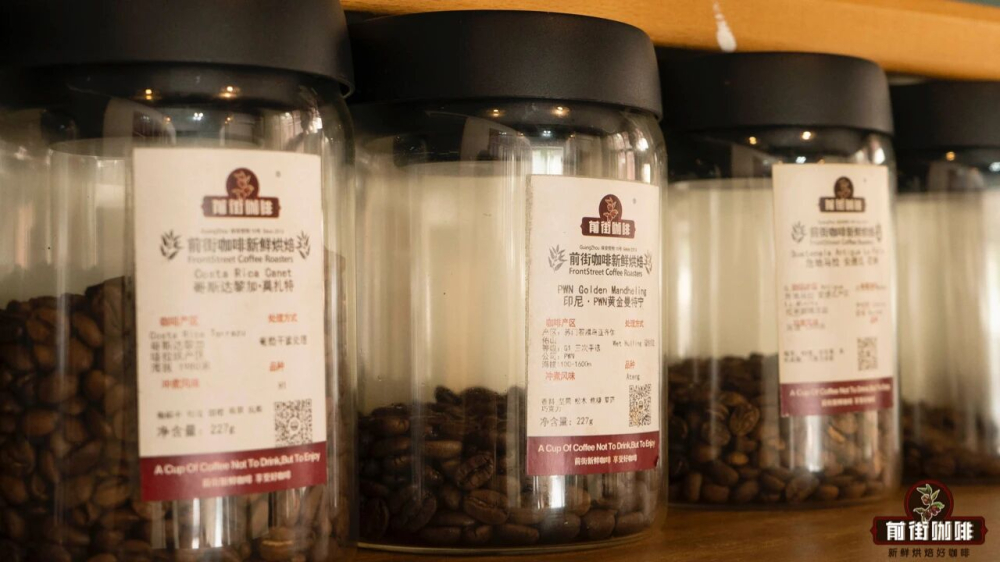
From this we can see that, like light roast coffee, the aroma of dark roast coffee can also be "a colorful spectrum of black."
Full-bodied Mouthfeel
Have you ever noticed that even with the same dose of grounds, brewed dark roast coffee always tastes much fuller-bodied than light roast coffee? This is not an illusion—with the same dose, dark roast coffee indeed has a fuller mouthfeel.
There are multiple reasons for this difference. Dark roasting causes coffee beans to have a higher expansion rate and looser structure, making internal substances easier to extract; at the same time, dark roasting increases the beans' water loss rate and reduces weight, so for the same 15g of grounds, dark roast beans have more particles than light roast beans, and with the same parameters, the concentration is naturally higher.
Not only that, deep roasting also brings substances to the coffee that increase body, and activates the bitter characteristics of caffeine and trigonelline, all of which can enhance the coffee's body.
For this reason, the dark roast coffee we brew always has a full-bodied mouthfeel that light roast cannot match. Many friends are devoted to dark roast coffee precisely because of its outstanding body and volume, which gives the palate tremendous satisfaction.
High Sweetness and Sweet Aftertaste
Finally, there is the sweetness unique to dark roast coffee. That's right—even dark roast coffee has a distinctive sweetness, and that is sweetness within bitterness. Front Street has shared before that we usually cannot taste the full picture of dark roast coffee on the first sip, because for the senses, the sudden bitterness is a relatively strong stimulus. On the first sip, attention tends to focus on the stronger bitter stimulus.
But after the first sip, when you take a second sip, you'll find the coffee becomes much more approachable. Not only is it less bitter than the first sip, but you can also taste many nuanced flavors, such as the sweetness in the coffee.
Here we still take Jamaica·Blue Mountain coffee from the Front Street bean list as an example. Many people can only perceive roasted aromas like chocolate and nuts on the first sip, but from the second sip onward, if you taste carefully, you can sense a sweetness similar to caramel and maltose, which is very pleasing.
In addition, after swallowing the coffee, the bitterness dissipates immediately, and soon you can taste a strong and contrasting sweet aftertaste. This is the sweet aftertaste that Front Street shared recently, and it is also one of the important reasons many friends prefer bitter coffee, and moreover a characteristic that is difficult to replicate with light roast coffee.
Rich aroma, full-bodied mouthfeel, and high sweetness with sweet aftertaste—these factors are the main reasons dark roast coffee still attracts countless fans. Of course, some friends choose dark roast coffee because they dislike acidity but still want coffee's energizing effect. But regardless of the reason, dark roast coffee has its unique charm and is by no means uniformly bitter. As Front Street says, bitterness can also be a colorful spectrum.
The above content is compiled by CoffeeHunters, a coffee news website.


