








How Does the SCAA Coffee Flavor Wheel Work?
The SCAA coffee flavor wheel is a sensory reference tool, not a direct answer key. The version released in 2016 by the Specialty Coffee Association of America organizes descriptors across an inner, middle, and outer ring, moving from broad categories to specific notes. It helps tasters narrow a vague impression into a named flavor, but it cannot make anyone taste something the palate has not yet learned to notice.
The wheel came out of work with the World Coffee Research Institute, the German Agricultural University, Kansas State University, and coffee industry representatives, who pooled sensory data to build shared vocabulary. Because its sample set is limited, some real flavors, such as lychee, may not appear. Comparing two coffees side by side, like a Yirgacheffe and a Boquete Geisha, shows how to move outward through the rings and build sensory memory step by step.
The Coffee Flavor Wheel is an authoritative sensory tool recognized by the industry, but it cannot make you directly taste a certain flavor; rather, it is an auxiliary guide that helps you organize and identify flavors. This article will use the new version of the flavor wheel released by the SCAA in 2016 as the blueprint, starting from its research background, and disassemble one by one the correspondence among the three-layer structure of the inner ring, middle ring, and outer ring. It will also use a comparison between Front Street Yirgacheffe Gudingding and Front Street Boquete Geisha to explain how to use the flavor wheel to gradually narrow the scope of judgment and build sensory memory. At the same time, it also reminds enthusiasts that they do not need to blindly follow the flavor wheel, because the samples it includes are limited, and real flavors such as lychee may not necessarily appear on the wheel. At the end, it also shares the ingenious design between the flavor wheel's color scheme and flavor associations, helping you more efficiently improve your ability to distinguish the flavors of pour-over coffee.
Objectively speaking, a flavor wheel alone cannot directly let you taste the specific flavors in coffee. Front Street has also repeatedly mentioned before that users need to have a certain foundation, understanding how flavor is composed and how to perceive it, because the core role of the flavor wheel is to assist identification, not to directly provide answers.
As a relatively authoritative coffee flavor guide in the industry, when used properly, the flavor wheel can indeed help us grasp methods for identifying flavors more quickly. Therefore, Front Street still recommends that friends who are just starting out and cannot yet quickly distinguish flavors first understand and digest the flavor wheel, so as to accelerate the improvement of flavor identification ability. Of course, truly "reading" the flavor wheel also requires some skill, so today Front Street will talk with everyone about how to "correctly use" the coffee flavor wheel.
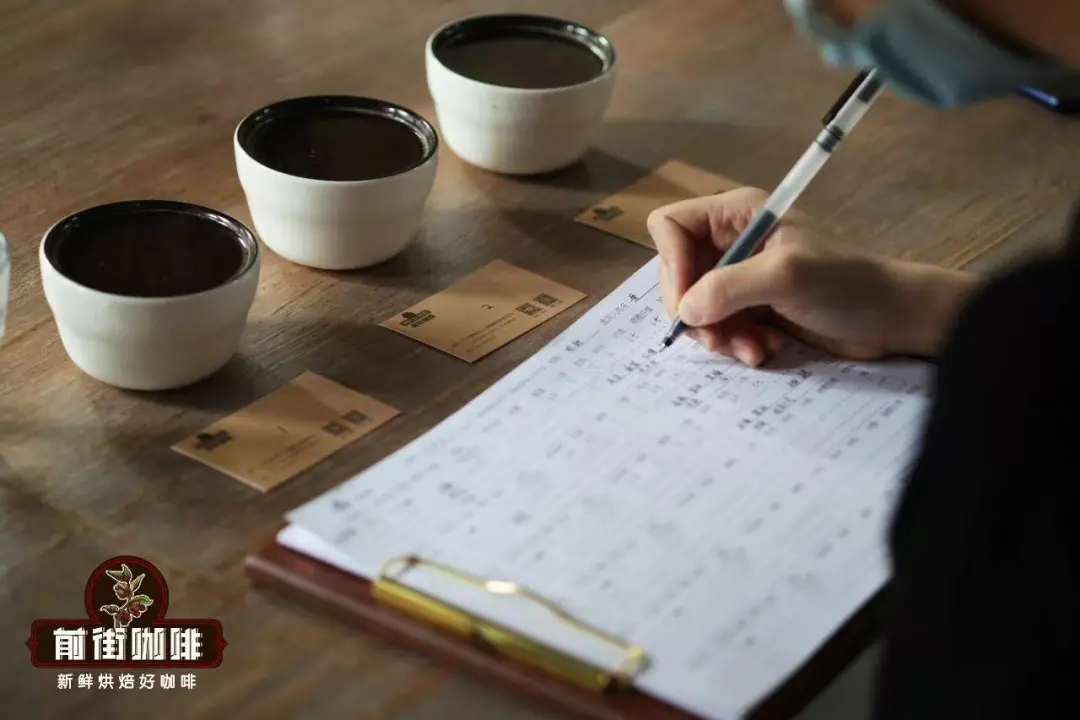
At present, the most widely used is the new version of the coffee flavor wheel released by the SCAA in 2016. The vast majority of coffee training institutions use it as teaching material, so today's sharing by Front Street is also based on this version of the flavor wheel.
First, a brief introduction to the origin of this version of the flavor wheel: the SCAA first joined forces with the World Coffee Research Institute, the German Agricultural University, Kansas State University, and coffee industry representatives to conduct flavor analysis and testing on 105 different samples from 13 coffee-producing countries, compiling the "World Coffee Research Sensory Lexicon," which formed the basis of the new version of the flavor wheel. Afterward, a team from the University of California, Davis made innovative adaptations, with 72 experts ranking the flavor attributes in the lexicon, and ultimately combining the data to compile and arrange the flavors into a wheel. It can be seen that this version of the flavor wheel is quite authoritative. To understand it, we must first understand one thing: do not blindly follow the flavor wheel.

1. Do not blindly follow the flavor wheel Many friends may wonder: wasn't it said to be very authoritative? Why then do you say not to follow it blindly? The reason is simple. Although it is very authoritative, there are hundreds of flavors in coffee, while the samples collected by the flavor wheel are quite limited. Not all flavors that may appear in coffee have been included. For example, Front Street Ethiopia Hamashu, sold in Front Street Coffee's Tmall Taobao store, gives us a lychee-like sweetness, but there is no lychee item in the flavor wheel. The reason is exactly what Front Street said: the samples included in the flavor wheel are still limited.
Therefore, when we taste a flavor in coffee that is not on the flavor wheel, we do not need to doubt ourselves. It is not that there is a problem with our senses; it is simply that the flavors included in the flavor wheel are not complete enough. 2. Understanding the flavor wheel As can be seen, this version of the flavor wheel is divided into three rings: inner, middle, and outer. What we need to understand next is how to find the correspondence between coffee flavors from the flavor wheel.
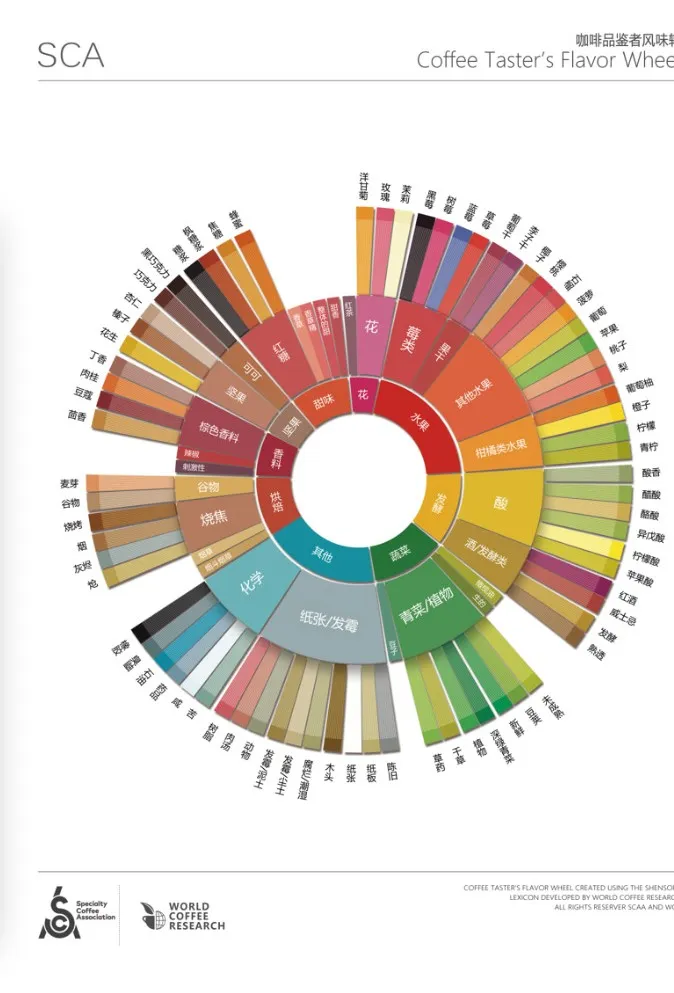
The inner ring is the category, which can be understood as a broad class; the middle ring is the secondary detail under each category of the inner ring, that is, a further subdivision of the broad class. For example, the fruit category in the inner ring can be subdivided into citrus, other fruits, dried fruit, and berries; the outer ring is a further subdivision under the middle-ring categories, directly reaching specific concrete food flavors! For example, citrus is subdivided into lime, lemon, orange, grapefruit, and other fruits rich in citric acid.
After understanding the relationship among these three rings, we can try to use the flavor wheel while tasting food and coffee to train our senses and identify flavors. How exactly do we do it? Very simple. When drinking coffee, if you perceive a flavor that you cannot identify for the moment, you can first judge which broad category in the inner ring this aroma belongs to: fruity, floral, roasted, or other... If it leans toward fruity, you can further savor it to see which subcategory under the fruit category it belongs to.
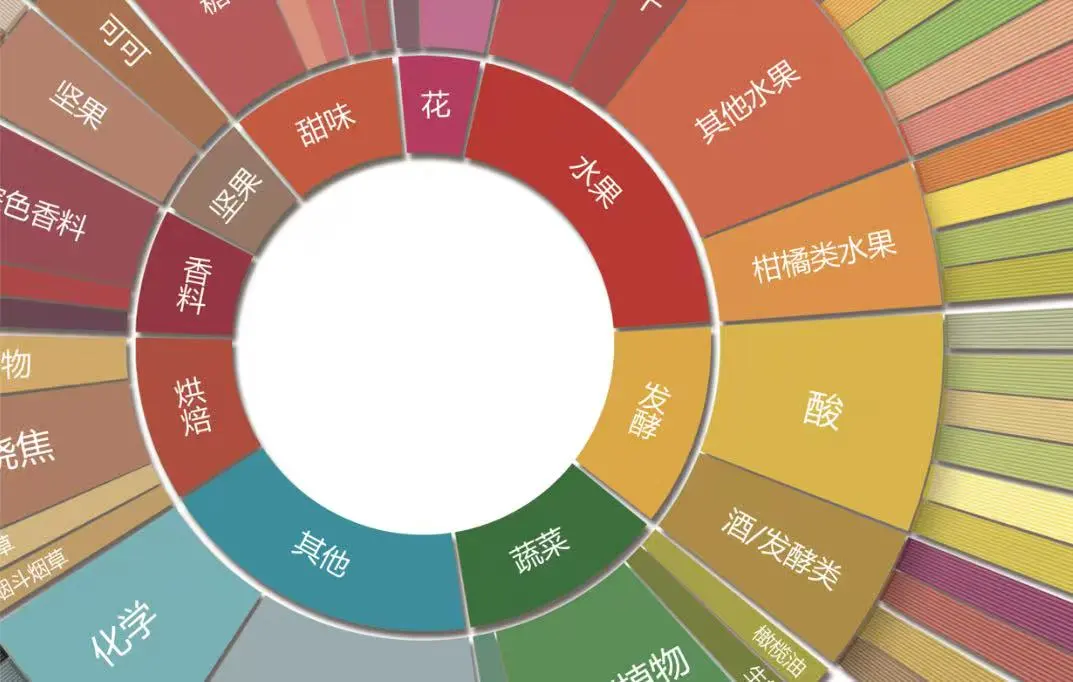
If the aroma is relatively fresh and the taste is relatively sour, then it is very likely citrus; if the aroma is richer and the taste is sour with sweetness, then it may be berries. After identifying the second category, the last thing to do is determine which specific flavor under that category it belongs to. For example, under citrus, is it lemon? Grapefruit? Or orange? The sour aromas of different fruits each differ, and they are not hard to distinguish. If you really cannot tell them apart, Front Street suggests first drinking coffees in comparison, which will help you distinguish different aroma types more quickly.
For example, Front Street Yirgacheffe Gudingding and Front Street Boquete Geisha from Front Street's Tmall Taobao flagship store both carry rich citrus aromas, but their tonal qualities are clearly different.
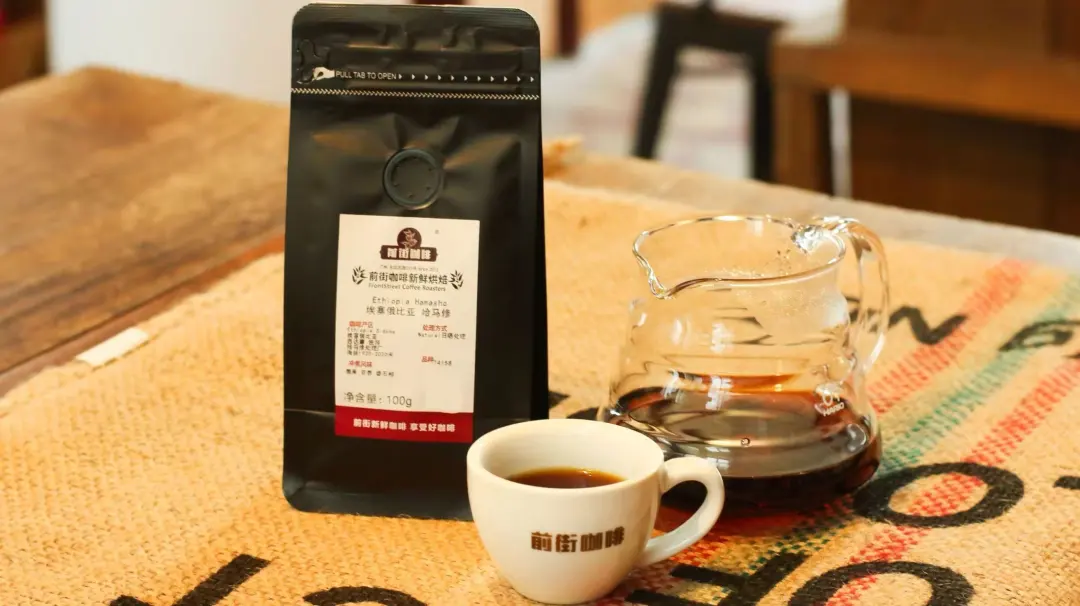
The citrus aroma of Front Street Yirgacheffe Gudingding is fresher, the overall texture is light, and the acidity is bright, belonging to the lemon flavor within citrus; while the citrus aroma of Front Street Boquete Geisha is richer, the texture is heavier, and the taste is mainly sweet and sour, belonging to the citrus or sweet orange flavor within citrus. If you cannot distinguish the specific differences, you can drink these two beans in comparison, and you will understand that the differences between the aromas are actually very obvious. Of course, if at first you cannot subdivide all the way to a concrete flavor, you can also use this three-level relationship to first determine the detailed classification. For example, if you taste a floral note but cannot say what flower it is, you can use "floral" as a general description. This is also progress, and afterward you can gradually enrich your flavor library through more drinking, more smelling, and more memorizing.
3. Associations in the details The last thing Front Street wants to share is some details on the flavor wheel. The color scheme of this version of the flavor wheel was handled by the London creative agency One Darnley Road. Each color and shade was carefully selected to match the corresponding flavor. For example, jasmine is matched with creamy white, blueberry with blue, orange with orange, lemon with golden yellow... There is a good association between colors and flavors. What we often call white floral notes actually refers to fresh and elegant floral aromas like jasmine.
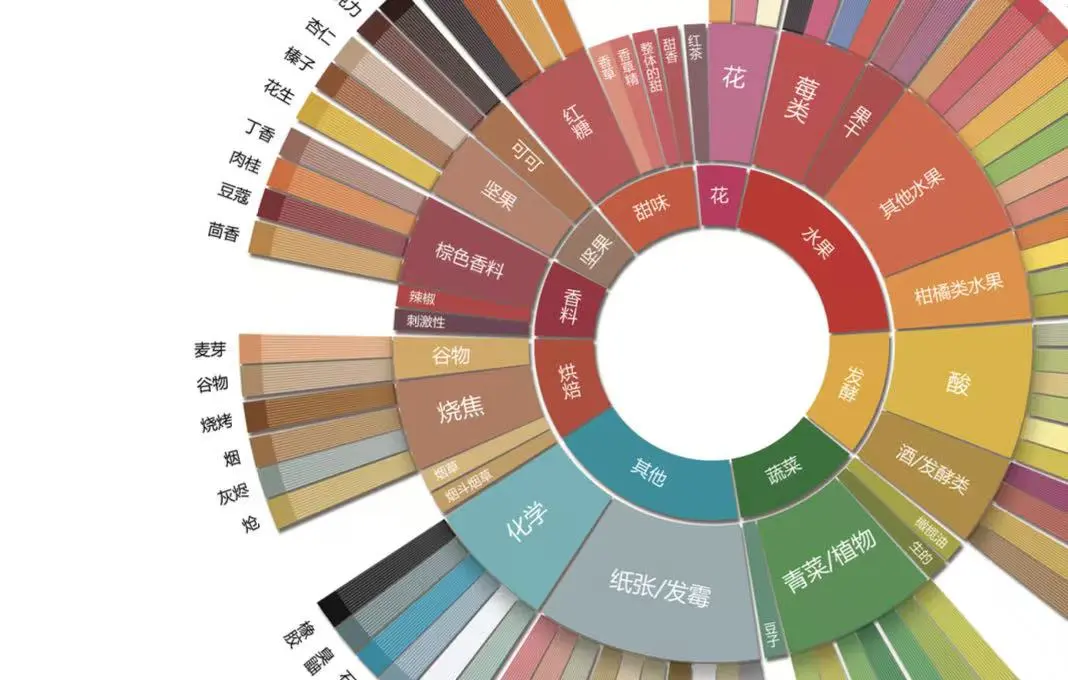
That is what you need to understand to read the flavor wheel! But as Front Street said at the beginning, understanding the flavor wheel can only help you better distinguish detailed flavors and systematically organize the connections between coffee flavors. It cannot make you immediately taste coffee flavors. If you want to taste coffee flavors, you still need to drink more, smell more, and feel more, and then combine that with the assistance of the flavor wheel. Only in this way can you quickly master the ability to identify coffee flavors.
- END -
The above content is compiled by CoffeeHunters, a coffee news website.


