








What Is Starbucks Coffee Doing With Full-Time Roles?
Starbucks is cutting full-time barista positions in first- and second-tier cities and hiring more social and student part-timers instead. On January 14 its Join Starbucks recruitment account listed 269 regions: student part-time roles were 61.7%, social part-time 17.8%, and full-time only 20.4%. Full-time postings now cluster in third-tier cities and below.
Some store managers also oversee two to three stores at once, a change tied to the earlier Project Elevate and a digital system overhaul. Starbucks China has not responded. Global financial reports show employee salaries and benefits account for nearly 58% of total store operating expenses, which frames the labor-cost pressure behind the shift. Whether this affects service quality and staff loyalty is the open question.
Starbucks was recently reported to be cutting full-time barista positions in first- and second-tier cities, shifting instead to large-scale recruitment of social part-timers and student part-timers. Data shows that full-time positions posted by its recruitment account are mostly concentrated in third-tier cities and below, while full-time demand in first-tier cities such as Beijing, Shanghai, Guangzhou and Shenzhen has shrunk noticeably. At the same time, some store managers now have to oversee 2 to 3 stores simultaneously — a change linked to Starbucks' earlier-launched "Project Elevate" and its digital system overhaul. Although Starbucks China has not responded to this, its global financial reports show that employee salaries and benefits account for nearly 58% of total store operating expenses, making labor cost pressure an important backdrop. Whether this shift in employment strategy will affect service quality and employee loyalty deserves continued attention.
▲
Click to follow | Daily specialty coffee culture magazine Coffee Workshop
According to Jiemian News, coffee chain giant Starbucks is reducing full-time positions in first- and second-tier cities, filling them instead with social part-timers and student part-timers.
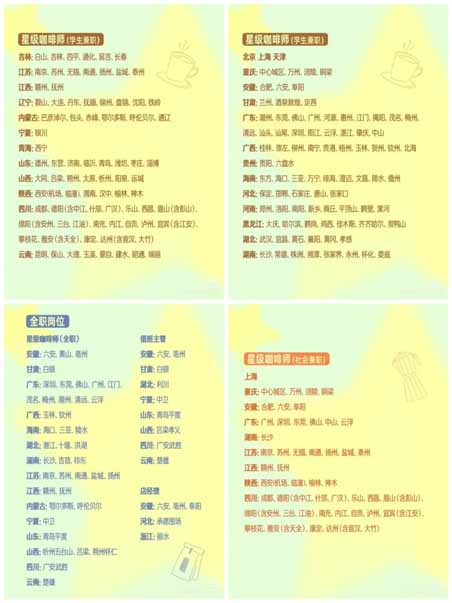
Data from the brand's official recruitment account "Join Starbucks" shows that on January 14, it posted recruitment information covering 269 regions (with overlaps between regions), of which student part-time positions accounted for 61.7%, social part-time positions 17.8%, and full-time positions only 20.4%.
Based on the account's month-by-month national recruitment statistics for the whole of last year, cumulative full-time positions involved 343 cities (counted only by the number of city appearances, with overlaps), but among the four first-tier cities of Beijing, Shanghai, Guangzhou and Shenzhen, Shenzhen appeared only 4 times and Shanghai only 2 times; the remaining full-time demand was mainly distributed in third-tier cities and below.
However, public information shows that as of the end of the last fiscal year, Starbucks opened 415 new stores for the year, including stores such as Shanghai Xujiahui Center, Beijing Zhongguancun Darong City, and Shenzhen Huaide MixC, all of which opened in 2025. Judging by the pace of store openings, Starbucks' demand for staff in first- and second-tier cities has not weakened but is instead continuing to grow.
In addition, since last year, multiple Starbucks employees from Shanghai, Beijing, Yunnan and Henan have revealed that some stores have stopped recruiting full-time staff and prefer to hire part-timers. Some also say that Starbucks stores currently recruiting full-time staff are mostly located in newly expanded areas or third-tier cities and below, while the reduction in full-time positions is mainly concentrated in first- and second-tier high-tier cities.
In response to the above reports, the media sent inquiries to Starbucks China, but as of press time no reply had been received, and it is currently impossible to confirm whether the reduction in full-time positions is a systematic, long-term adjustment by the company.
In addition to the contraction of full-time positions, multiple Starbucks employees also told the media that Starbucks' internal staffing has changed, with some full-time store managers now required to manage 2 to 3 stores simultaneously.
It is understood that these changes reported by employees already emerged as early as the beginning of 2025. At that time, Starbucks announced the launch of "Project Elevate," planning to integrate some stores into multi-store communities, meaning one store manager would be responsible for multiple stores. However, considering multiple factors such as commercial districts and customer traffic, Starbucks only piloted this model in some stores. But with the upgrade of its digital system, Starbucks has completed the adaptation of the multi-store community model across all operating systems.
In China's coffee market, Starbucks was once regarded as a benchmark employer. It paid bonuses, helped store employees find work back in their hometowns, and bought insurance for employees' parents — these measures made it an ideal employer in many people's minds and also attracted a large number of job seekers to join Starbucks stores.
Although Starbucks China has never disclosed specific figures for labor costs, the burden of labor costs has been mentioned repeatedly in Starbucks' global financial reports. According to Jiemian News statistics, in fiscal year 2025 (ending at the end of September 2025), employee salaries and benefits accounted for nearly 58% of Starbucks' total store operating expenses and about 26.5% of Starbucks' global net revenue.
It can thus be seen that replacing full-time baristas with part-timers can indeed cut employee salary and benefit expenditures in store operations, while the "one manager overseeing multiple stores" model can also use existing human resources more efficiently. For the brand, such adjustments should help ease the economic pressure brought by labor costs.
But at the same time, the outside world has expressed concern about Starbucks' practice of replacing full-time staff with gig workers, believing that this model may lower store service quality and product quality control standards, and some also feel that this move may weaken employee loyalty.
As Boyu Capital takes control and is about to complete the transfer of a 60% stake in Starbucks China, whether Starbucks China will further tilt its operating strategy toward cost control in the future due to market changes and performance pressure remains to be seen.
Image source: Internet
Disclaimer: Some images in this article are from the Internet. For some content on the website, such as images, we will respect the original author's copyright and indicate the source. However, due to the large quantity, some images and texts may not have been credited in time; please forgive us. If the original author has any dispute, they may contact the website for handling, and once verified we will correct it immediately. Compiled and edited by "Coffee Workshop"; please indicate the source when reposting. If there is any infringement, please inform us for deletion. Thank you ~ !
The above content is compiled by CoffeeHunters, a coffee news website.


