







Shelf life questions for coffee enthusiasts and tea buyers
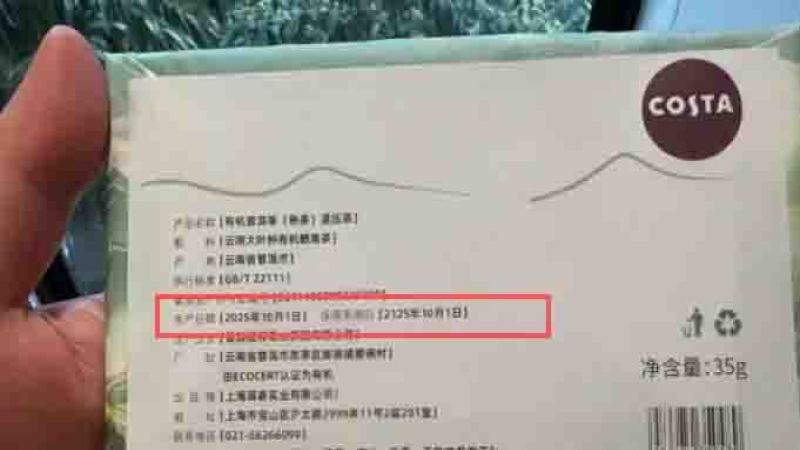
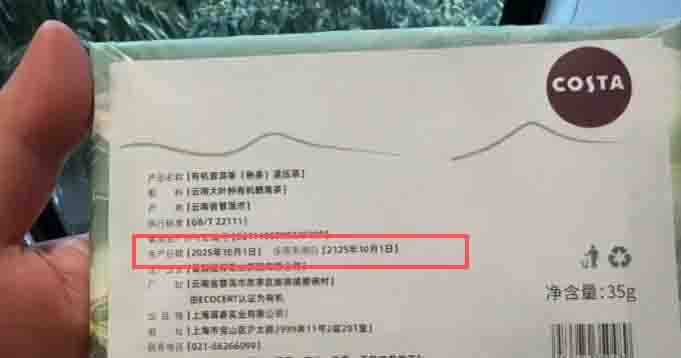
A consumer found that a Costa organic ripe Pu'er tea cake carried a 100-year shelf life on its packaging, with a production date of October 1, 2025 and an expiration date of October 1, 2125. Costa customer service cited the saying that tea improves with age, but experts and lawyers note the national standard only says Pu'er is suitable for long-term storage, with no fixed number of years.
The labeling raises food safety concerns such as mold, since a century-long shelf life cannot be scientifically verified. Some e-commerce listings show Costa Pu'er tea with a shelf life of 9,999 days, over 27 years. For any coffee enthusiast watching beverage labels, the case highlights how compliance and scientific validity matter when brands print storage claims.
Recently, a consumer discovered that a Costa organic ripe Pu'er compressed tea product had a shelf life of 100 years printed prominently on its packaging box, with a production date of October 1, 2025, and an expiration date of October 1, 2125. This bizarre labeling quickly sparked questions: was it a printing error, or can tea cakes really be stored for a century? Customer service responded that "the older the tea, the more fragrant," but experts and lawyers both pointed out that the national standard for Pu'er tea only states "suitable for long-term storage," with no fixed number of years. A 100-year shelf life can neither be scientifically verified nor does it hide food safety risks such as mold. Meanwhile, some e-commerce platforms still sell Costa Pu'er tea with a shelf life listed as 9,999 days, equivalent to over 27 years. As coffee enthusiasts, Front Street also reminds you to pay attention to the compliance and scientific validity of beverage shelf lives.
▲
Click to follow | Daily specialty coffee culture magazine Coffee Workshop
Recently, a consumer tipped off China News Service's Jiwei that a Costa organic Pu'er tea (ripe tea) compressed tea they purchased on an e-commerce platform had a shelf life of 100 years printed on its outer packaging box.
According to photos provided by the person involved, the production date of this tea is written as October 1, 2025, while the expiration date is marked as October 1, 2125—spanning a full century, leaving consumers baffled: is this a packaging printing error, or can this tea really be stored for that long?
In response to netizens' questions, the reporter contacted the customer service of the Costa Coffee flagship store on the e-commerce platform as a buyer. The representative stated that the product is a tea cake, and "the older the tea, the more fragrant." As for whether it can really last 100 years, the customer service responded that as long as it is stored properly (away from light, at room temperature), it can be kept for a very long time.
When asked how the tea's shelf life was determined and whether there was relevant experimental certification, the customer service only emphasized that the specific date on the packaging should be taken as authoritative, and that tea cakes can be stored long-term. When the reporter further asked whether it was a printing error, the customer service still said the packaging label as received should be taken as authoritative. In addition, the reporter repeatedly called the contact phone number on the tea packaging box, but each time was prompted with "the user is busy."
Interestingly, a 21 Express reporter also inquired with the brand's official flagship store as a consumer, but the customer service claimed that the Pu'er tea product reported by the consumer had already been taken off the shelves. However, on a certain e-commerce platform, a Costa specialty store was still selling Pu'er tea, with its shelf life displayed as 9,999 days, equivalent to over 27 years.
The reporter then asked the customer service of that store, who initially only said, "Pu'er tea undergoes aging when stored for a long time, and the older it gets, the more fragrant it becomes," without directly giving a specific storage period. Under repeated questioning from the reporter, the customer service finally said, "It can be stored for about 3 to 5 years, depending on the storage environment, and can also be kept longer."
After the reporter's investigation, most Pu'er tea products on the market generally label their shelf life as "long-term storage," with some noting "suitable for long-term storage under compliant storage conditions," and rarely writing a specific date. Industry insiders explained that "suitable for long-term storage" means the tea can be stored indefinitely under appropriate conditions, and as long as it does not mold or deteriorate, it can be brewed and consumed.
Experts pointed out in interviews that there is currently no unified national regulation on tea shelf life, and different tea categories follow different standards, with special teas like Pu'er having relatively longer shelf lives. "The public's perception of Pu'er tea is that 'the older, the more fragrant,' but from a scientific perspective, if Pu'er tea ferments for too long or is stored improperly, it is prone to mold, posing certain food safety hazards."
Therefore, experts believe that a "100-year shelf life" is more like a marketing gimmick, which can neither be verified nor comes without high food safety risks. "Not to mention storing it for 100 years—some teas turn into tea paste after just a few decades."
In addition, lawyers also stated that the national standard GB/T 22111—2008 "Geographical Indication Products—Pu'er Tea" clearly states "suitable for long-term storage under the storage conditions specified in this standard," rather than a fixed number of years. 100 years is a specific time limit, which conflicts with the qualitative expression "long-term storage" and does not comply with the standard's labeling requirements.
At the same time, a "100-year shelf life" far exceeds the safety and quality control period generally recognized in the food industry, and cannot be scientifically verified to consistently meet food safety and quality requirements over 100 years. Moreover, according to regulations, the premise of long-term storage is "meeting storage conditions," and long-term storage makes it difficult to guarantee compliance with those conditions. Labeling a fixed number of years ignores this premise, so it should not be labeled as such.
Image source: Internet
Disclaimer: Some images in this article are from the Internet. For some content on the website, such as images, we will respect the original author's copyright and indicate the source. However, due to the large volume, some images and texts may not have been credited in time. Please understand. If the original author has any disputes, they can contact the website for handling. Once verified, we will promptly correct it. Compiled and edited by "Coffee Workshop." Please indicate the source when reprinting. If there is any infringement, please inform us for deletion. Thank you ~ !
The above content is compiled by CoffeeHunters, a coffee news website.


