








How moka pot pressure shapes crema and milk drinks
A moka pot extracts at roughly 3 to 4 bar with a dual-valve model, while an espresso machine runs near 9 bar. That lower pressure is why moka pot crema thins out quickly, and why the brew cannot fully match espresso body. It can still work as a base for lattes and similar drinks.
Front Street Coffee tested its classic blend to compare the two methods. The company's answer is that moka pots are a practical option for milk drinks, but reproducing espresso texture is very difficult, mainly because the pressure gap changes how much crema forms and how long it lasts. Price is the other factor: a moka pot costs far less.
Many coffee enthusiasts wonder whether the affordable moka pot can truly replace the espresso extracted by an espresso machine. This article will delve into the essential differences between moka pot coffee and espresso in terms of extraction pressure, concentration, and crema persistence, and, combined with actual test data from Front Street Coffee's classic blend, explain the performance and limitations of moka pot coffee when making lattes, Dirty, and other fancy coffee drinks. If you are considering buying a moka pot, or want to understand its real differences from espresso, this article will give you a clear answer.

Espresso is extremely concentrated and is often used as a base for making all kinds of fancy coffee drinks. Classic drinks such as lattes, cappuccinos, and flat whites are all made with espresso as the core. However, espresso machines are expensive, and for many people they are not a necessary expense. As a result, people who want rich coffee often turn their attention to the moka pot. Like espresso machines, moka pots use pressure extraction, and they can also brew coffee with a relatively high concentration and golden crema floating on the surface. Their price is usually only a few hundred yuan, which is obviously much more affordable than espresso machines that often cost tens of thousands of yuan. For this reason, the moka pot is often called a "budget replacement for the espresso machine."
But then the question arises: with such a huge price gap, can coffee brewed with a moka pot really replace espresso extracted by an espresso machine? This is a question Front Street Coffee has received frequently recently.
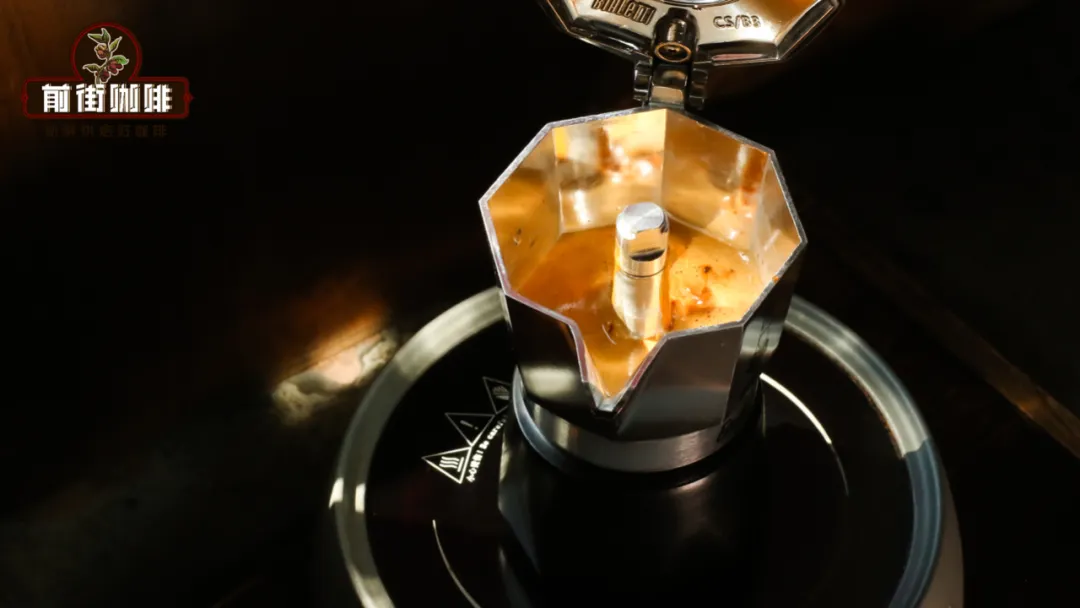
Let's give the conclusion first: if you simply want moka pot coffee to serve as a base like espresso for making various fancy coffee drinks, then it is entirely feasible. But if you want to use moka pot coffee to completely replicate the mouthfeel and taste of espresso, it is not absolutely impossible, but at the very least extremely difficult. The reason is that the extraction pressure of a moka pot is far lower than that of an espresso machine. Although both use pressure extraction, the pressure used by a moka pot during extraction is much lower. The extraction pressure of an espresso machine is usually around 9 bar, while that of a dual-valve moka pot is only 3-4 bar, a difference of two to three times. The fundamental reason for this difference lies in the different design principles of the two.
The pressure of an espresso machine is provided by an independent pressure pump inside the machine. Once extraction begins, the pressure pump starts operating and applies strong pressure to the water flow, thereby extracting coffee quickly and efficiently; while a moka pot relies on the steam pressure generated by heating water to push the water flow and complete extraction. However, because the pressure is limited by the heat source and the structure of the pot, the extraction pressure of a moka pot cannot reach such a high level. Insufficient pressure means that a moka pot cannot extract high-concentration coffee as quickly as an espresso machine can. Front Street Coffee often gives an example: using the same dose and grind size, extract the same liquid weight with a moka pot and an espresso machine respectively. When using the moka pot, Front Street Coffee deliberately lowers the heat during the outflow to extend the extraction time. Even so, the resulting coffee concentration is still much lower than that of espresso.

The coffee beans selected by Front Street Coffee are the Front Street classic blend from the bean list, with a dose of 20 g, a grind size of 1.0 on the Galileo Q18, and a yield of 40 ml. Measurement shows that the concentration of moka pot coffee is much lower than that of espresso. In terms of taste, the two are broadly similar; after all, both use the same Front Street classic blend, full-bodied with no acidity, carrying flavors of chocolate, caramel, nuts, cream, and cookies. But the difference in concentration makes them significantly different when making fancy coffee drinks and in the final results. (The left is moka pot coffee, and the right is espresso.)
In the article "How to Make a Delicious 'Latte' with Moka Pot Coffee," Front Street Coffee once shared: when making a latte with espresso, the ratio of coffee to milk is about 1:5. Because espresso is concentrated enough, even if more milk is added, the coffee flavor will not be easily masked, and the mouthfeel will not be thin; while when making a "latte" with moka pot coffee, the ratio needs to be adjusted to 1:4. Because moka pot coffee is lower in concentration, the amount of milk should be appropriately reduced to avoid the coffee flavor being covered by the milk. But even so, a "latte" made with moka pot coffee will still be somewhat inferior in mouthfeel and taste to one made with espresso.
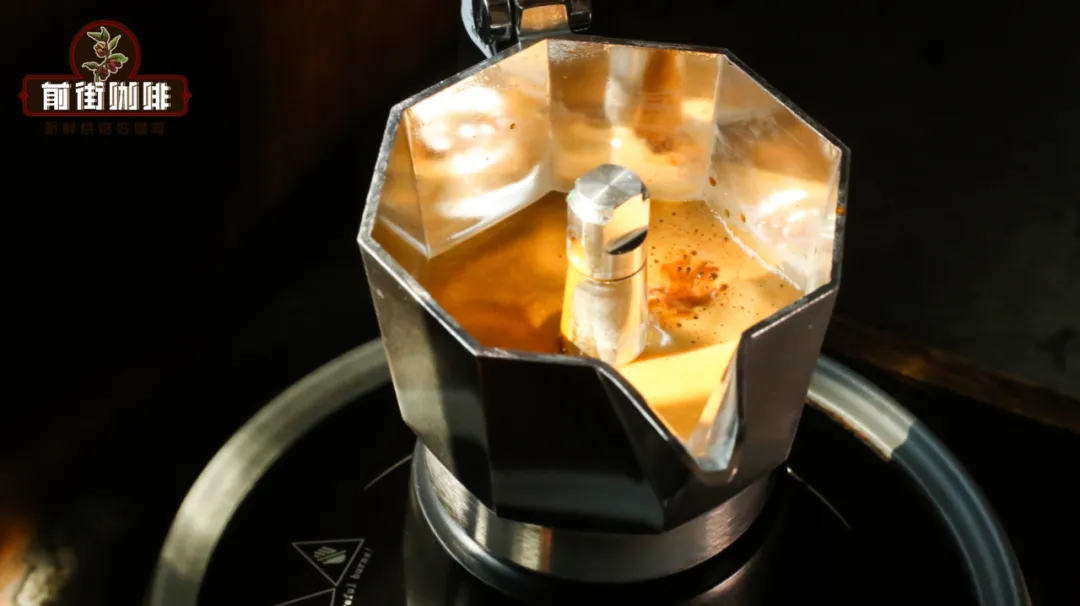
Not only that, when making drinks like Dirty that require high-concentration coffee, moka pot coffee simply cannot handle the job. Because the concentration is insufficient, when making Dirty with moka pot coffee, the layering effect quickly disappears. It is not just concentration; from the comparison image above, you can also see that the "crema" of moka pot coffee is thinner than that of espresso. Likewise, this is also caused by insufficient pressure. Although a rich "crema" can be seen when moka pot coffee flows out, in reality most of it is foam produced by the valve squeezing. Their stability is far inferior to the bubbles (crema) of espresso, so they dissipate quickly not long after the coffee is made.
It can be seen from this that moka pot coffee can be used as a base like espresso to make most fancy coffee drinks, but it cannot completely replace it. In the final analysis, the birth of the moka pot and its coffee was never meant to replace the espresso machine or espresso (and it cannot replace them), but to provide everyone with a more convenient coffee-making tool. Simply add water, fill with grounds, and heat, and you can easily get a cup of high-concentration coffee.

In addition, the extremely affordable price also lowers the threshold for buying one. Without "breaking the bank," you can purchase a quite convenient tool for making strong coffee. So, if you are just looking for a device to make coffee and satisfy your daily coffee craving, as long as the amount is not particularly large, a moka pot is completely sufficient for your needs~
- END -
The above content is compiled by CoffeeHunters, a coffee news website.


