







What counts as black coffee, and why is cold brew pricier?
Black coffee is pure coffee with nothing added except water, which includes Americano, pour-over, and cold drip. Cold drip is often the priciest of these. Two reasons explain the gap: the brew takes several hours or more of low-temperature extraction and maturation, and each cup uses far more coffee grounds than a pour-over.
Water acts as the solvent that dissolves flavor compounds, and its temperature sets how fast that happens, so a long cold extraction is inherently slower than a hot one. Because cold drip needs more grounds per serving and more time and steps, cafes such as Front Street Coffee price it above Americano and pour-over even when the same beans are used.
Black coffee refers to pure coffee with no added ingredients other than water. Americano, pour-over, and cold drip all fall into this category. Among the many types of black coffee, cold drip coffee is often noticeably more expensive than Americano and pour-over, even when the same coffee beans are used. Taking Front Street Coffee's stores as an example, cold drip is always priced higher than other black coffee categories. There are two main reasons behind this: first, cold drip coffee takes longer to make and involves more complicated steps, requiring several hours or even a dozen-plus hours of low-temperature extraction and fermentation/maturation; second, the material cost is higher, as making a cup of cold drip requires far more coffee grounds than pour-over. This article will explain in detail the specific reasons why cold drip coffee is priced higher, and introduce Front Street Coffee's parameters and bean selection recommendations for cold drip production.
Black coffee usually refers to a pure coffee beverage with no added ingredients other than water. Americano, pour-over, cold drip, and others all belong to the category of black coffee. Because there are no additives such as milk, cream, or sugar that would affect the coffee's flavor, black coffee can present the taste of the coffee itself more purely.
It is not hard to notice that among the many types of black coffee, cold drip coffee is often priced on the higher side. If a café sells cold drip, its price is very likely to be higher than Americano and pour-over. Taking Front Street Coffee's stores as an example, even when made with the same beans, cold drip is simply priced higher than Americano and pour-over.
This makes many customers curious: "Why is cold drip, made from the same coffee beans, priced higher than other categories?" There are two reasons: first, compared with other black coffees, cold drip coffee takes longer to make and involves more complicated steps.
A longer production time and more complicated production steps
No matter which type of black coffee it is, water is needed during production as a solvent to dissolve the flavor substances in the coffee. The temperature of the water determines the speed of dissolution. In the article "What Water Temperature Makes the Best Coffee," Front Street Coffee mentioned that the kinetic energy of water molecules is affected by temperature; the higher the water temperature, the faster water dissolves flavor substances, and vice versa.
The vast majority of black coffees, such as pour-over and Americano, use hot water for extraction, so the production time is not long and can be completed in just a few minutes at most. Cold drip coffee, however, is completely different. It belongs to cold brew coffee and uses very low-temperature ice water for extraction. Because the water temperature is too low, the extraction efficiency is very low, so the required extraction time often reaches several hours.
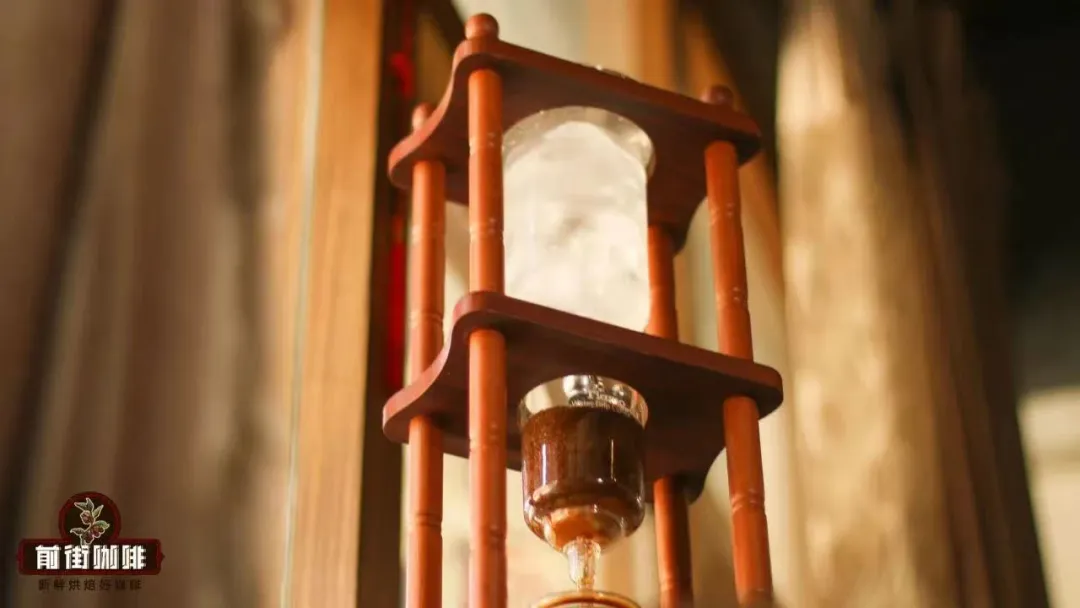
At this point, a professional cold drip tower is generally used. Through the control of the drip rate valve, ice water is made to fall slowly in the form of droplets, thereby extending the overall extraction time and allowing the coffee to achieve complete extraction.
Taking Front Street Coffee's cold drip production as an example: when making cold drip coffee, Front Street Coffee generally uses 60g of coffee grounds, with a coffee-to-water ratio of 1:10, and the drip frequency of the ice water is about 7–8 drops per 10 seconds. Under such parameters, the entire extraction process usually takes about 5–8 hours.

After extraction is complete, the cold drip coffee cannot be drunk immediately, because at this point it still needs to develop flavor through fermentation. Therefore, the dripped cold drip coffee needs to be poured into a sealed bottle and placed in the refrigerator for "low-temperature maturation." Front Street Coffee usually refrigerates and ferments it for more than 8 hours to ensure that the cold drip can ferment out a unique vinous aroma or fermented note. Only after fermentation is complete can one officially begin to enjoy the deliciousness of cold drip coffee.
From the cold drip production shared by Front Street Coffee, it can be seen that the process of making cold drip coffee is very complicated and extremely time-consuming. A rough calculation shows that making a 600ml pot of cold drip coffee takes about 13 hours or more, and this is still considered relatively fast.
Front Street Coffee's cold drip serving standard is 200ml of cold drip coffee plus 1–2 ice cubes. In other words, the 600ml of coffee produced through "countless hardships" can only yield 3 cups. Whether it is pour-over coffee or Americano, the time to serve 3 cups is at most around ten minutes. By comparison, the time cost of making cold drip coffee is already dozens of times greater.
Higher material costs
But more often, cold drip coffee is expensive mainly because of the cost of materials.
When making cold drip, Front Street Coffee specifically chooses aromatic single-origin beans, because only in this way can it provide the coffee with a more complex taste: for example, for floral flavors, choose Front Street Coffee Butterfly and Front Street Coffee Huakui; to make cold drip coffee with an obvious juicy feel, Front Street Coffee Little Tomato is the first choice; if the focus is on a rich fruity aroma, buying Front Street Coffee Strawberry Candy, Front Street Coffee Sidra, or Front Street Coffee Blackberry is the right choice.
Using the same example above, Front Street Coffee used 60g of coffee grounds to make 600ml of cold drip coffee liquid, but the final number of servings is only 3 cups. If these 60g of coffee grounds were used for pour-over coffee, they could yield 4 cups, because the serving standard for pour-over coffee is 15g of grounds to brew one pot.
Because one cup of cold drip coffee uses more grounds and has a higher cost, its price is usually higher than other black coffees. In summary, everyone can now understand why cold drip coffee is sold at a relatively high price most of the time. It is both because its material cost is higher and because the time required to make it is longer.
The above content is compiled by CoffeeHunters, a coffee news website.


