Origins & Estates · In-Depth Visits
Coffee cultivation in Rwanda began in 1904, when German missionaries introduced the crop. But before the 1994 genocide, Rwanda's coffee industry was dominated by low-quality commodity beans and had barely entered the specialty market. After the genocide, driven by international aid, Rwanda began systematically rebuilding its coffee industry. In 2008, the first Cup of Excellence was held in Rwanda, marking the country's formal entry into the specialty coffee world.
II. The Nyungwe Region
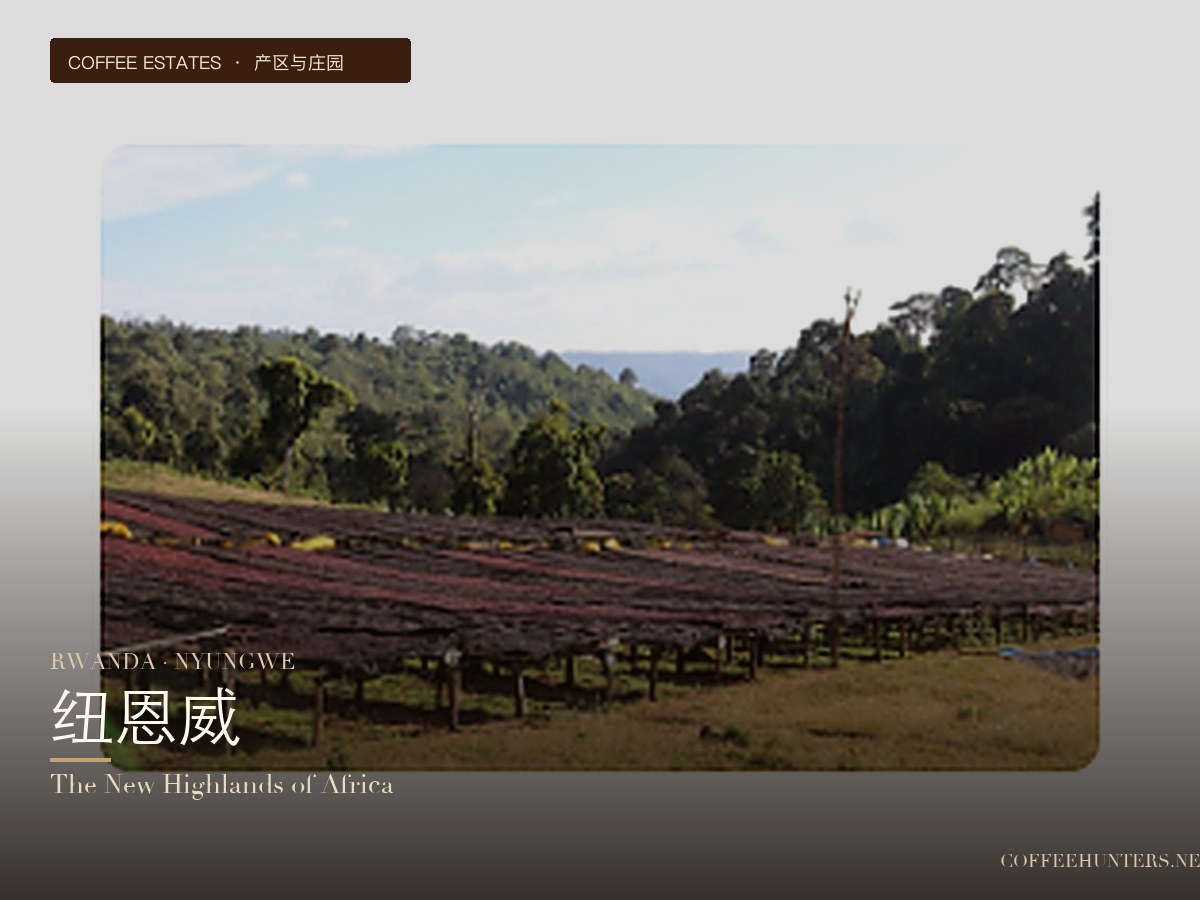
Nyungwe is located in southwestern Rwanda, close to the border with Burundi, and is Rwanda's most important specialty coffee region. The core growing area of Nyungwe lies in the mountains surrounding Nyungwe Forest National Park, at an altitude of 1,500–2,000 meters, making it one of the highest-altitude coffee regions in Africa. Nyungwe Forest is one of Africa's largest mountain rainforests, providing a unique microclimate for the surrounding coffee-growing areas—humid, cool, and shrouded in mist.
III. Variety: Predominantly Red Bourbon
Rwanda's main variety is Red Bourbon, accounting for about 95% of the planted area. This single-variety structure gives Rwandan coffee a very consistent cup profile—bright acidity, full body, and pronounced sweetness. Rare varieties such as Mayaguez (a locally selected Bourbon cultivar) and Jackson are often found in specialty lots.
IV. Washed Processing: A Standardized Craft
Nearly all coffee in Rwanda is washed. The newly built local CWS (Central Washing Station) is key to specialty coffee production. A CWS centrally collects coffee cherries from surrounding smallholder farmers and carries out depulping, fermentation, washing, and drying in a unified way, ensuring consistent processing for every lot. This "central washing station + smallholders" model is the key to Rwanda's specialty coffee success.
V. Typical Flavors
A high-quality Rwandan coffee has a very distinctive cup profile: the aroma shows clear floral and fruity notes, similar to Ethiopian jasmine and orange blossom; on the palate, it has medium-high acidity reminiscent of Kenyan tartaric acid; the mid-palate is a combination of blackcurrant, grape, and citrus; and the finish carries distinct notes of black tea and honey. The whole cup is bright, solidly sweet, and richly layered—often called "Africa's Bourbon benchmark."
VI. Representative Cooperatives and Washing Stations
Rwanda's representative cooperatives include Dukunde Kawa, Abakundakawa, Koakaka, and others. Among them, Dukunde Kawa is one of Rwanda's most famous cooperatives and has won multiple awards at the Cup of Excellence. Representative washing stations include Muraho Trading, Long Miles Coffee, and others. The specialty lots from these washing stations enjoy a very high reputation in the international market.
VII. Representative Estates
Rwanda's coffee industry is dominated by smallholders, and there are almost no large estates. The best-known "estate-level" coffees are Bumbogo Estate, Kanzu Washing Station, and others. The specialty lots from these washing stations/estates are labeled by "single plot" and command higher prices on the international market.
VIII. Brewing Suggestions
Rwandan coffee is very well suited to pour-over brewers such as the V60, Origami, and Kalita Wave, which highlight acidity and layering. Use a water temperature of 90–92°C, a coffee-to-water ratio of 1:15–1:16, and a medium-fine grind. If you want to highlight Rwanda's floral and fruity notes, a single-pour V60 works well; if you want to emphasize sweetness and body, a three-pour Kalita Wave is more suitable.
IX. Sustainability in Nyungwe
Rwanda's coffee industry places great emphasis on sustainability. Many cooperatives have obtained international certifications such as Rainforest Alliance and Fair Trade. In the Nyungwe region, coffee cultivation is combined with forest conservation, allowing coffee production and ecological protection to advance together.
Conclusion: Africa's Latecomer
On the global specialty coffee map, Rwanda is a relatively young origin, but its growth rate is astonishing. From rising out of the ruins of the 1994 genocide, to first entering the Cup of Excellence in 2008, to becoming a "rising star" of African specialty coffee today, Rwanda's coffee story is one of the most inspiring chapters in the specialty coffee world. To understand Rwanda is to understand the possibilities of the specialty coffee world.
— CoffeeHunters Editorial Team
The above content is compiled by CoffeeHunters, a coffee news website.