Origins & Estates · In-Depth Visits
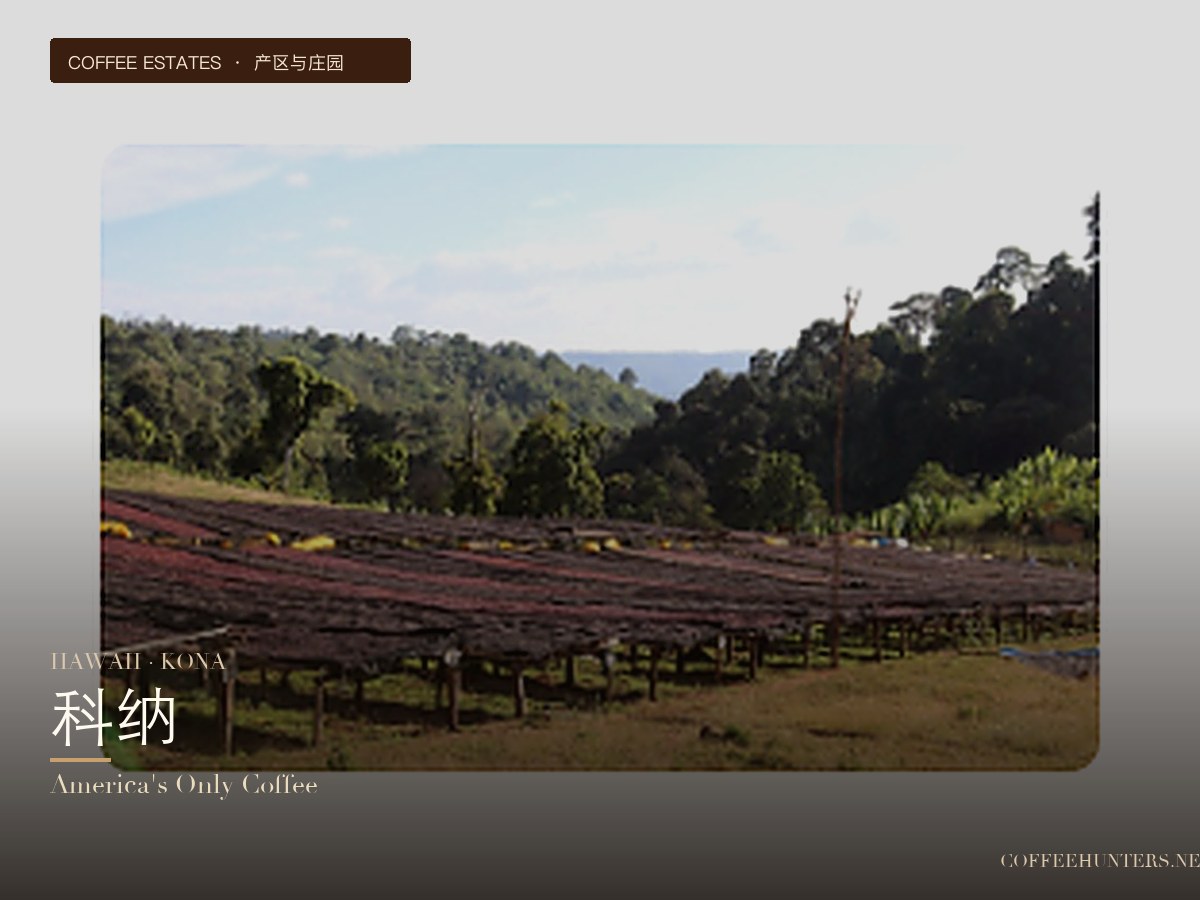
Coffee cultivation in Hawaii's Kona region began in 1828, when American missionaries brought Bourbon variety from Brazil to Hawaii. By the mid-19th century, coffee had become an important cash crop in Hawaii. Today, Kona coffee's annual output is about 2,000-3,000 tons, almost entirely produced in the Kona district on the west coast of the Big Island of Hawaii—a narrow strip roughly 50 kilometers long from north to south and about 3 kilometers wide.
II. The Geography of Kona
The Kona district lies on the west coast of the Big Island of Hawaii, backed by Mauna Kea (elevation 4,207 meters) and Mauna Loa (elevation 4,169 meters), facing the Pacific Ocean. Coffee is grown at elevations between 100 and 900 meters, much lower than other of the world's top coffee regions. But because it is located in the tropics, with ample sunshine, fertile volcanic soil, and moist sea breezes brought by the warm Pacific currents, Kona coffee possesses a unique "low altitude, high sugar content" character.
III. Variety: A Typica Variant
Kona's main variety is a Hawaiian variant of Typica, known as "Kona Typica." After this variety was introduced to Hawaii in the 19th century, it adapted to the local volcanic soil and maritime climate, evolving unique flavor characteristics—low acidity, pronounced nutty and chocolate notes, and solid sweetness.
IV. A Strict Grading System
Kona coffee has the world's strictest origin grading system—only coffee from within the "Kona Coffee Belt" can be labeled "Kona." The Kona district is further divided into multiple grades including "Kona Extra Fancy," "Kona Fancy," "Kona Number 1," "Kona Select," and "Kona Prime," and all grades must be certified by the Hawaii Department of Agriculture.
V. Processing Methods
Kona coffee is almost entirely washed. Local small processing stations use the standard depulping-fermentation-washing-drying process, with fermentation typically lasting 18-24 hours. Drying is mainly sun-drying, and patio drying usually lasts 7-14 days. A small number of specialty lots also use honey processing and natural processing.
VI. Typical Flavor Profile
A cup of high-quality Kona coffee shows a very distinctive cup profile: the aroma has pronounced notes of nuts, roasted malt, and light chocolate; on entry, there is mild citric and green apple acidity; the mid-palate is a combination of praline, brown sugar, and honey; the finish carries distinct floral and tea-like notes. The overall mouthfeel is very balanced, clean, and mild—somewhat similar to Jamaican Blue Mountain, but with more prominent sweetness.
VII. Representative Estates
Representative Kona estates include Greenwell Farms, Royal Kona Coffee, Hawaiian Queen Coffee, and others. Among them, Greenwell Farms is one of Kona's oldest estates, founded in 1850. Other well-known estates include Hula Daddy, Kona Coffee & Tea Company, and Mountain Thunder Coffee Plantation.
VIII. Price and Market
Kona coffee prices have long remained high. Green bean prices typically range between $20-40 per pound, and retail prices after roasting are even more astonishingly high. Behind these high prices are multiple factors: relatively small output (about 2,000-3,000 tons per year), extremely high labor costs (U.S. labor law), a strict grading system, and the scarcity of "Made in USA."
IX. Brewing Recommendations
Brewing Kona requires respecting its mild character. Use a V60 or Chemex dripper, water temperature 88-90°C (slightly lower than for most coffee), a coffee-to-water ratio of 1:16-1:18, and a medium-fine grind. Use a three-pour method: bloom for 30 seconds, pour to half in the second stage, and finish with a slow thin stream in the third stage. If you want to highlight Kona's nutty and chocolate notes, the Kalita Wave with three pours is more suitable; if you want to highlight acidity and floral notes, the V60 single-pour is more suitable.
Conclusion: America's Only Coffee
On the global coffee map, Hawaii is the only coffee-producing region that appears under an "American" identity. This "American identity" gives Kona unique brand value—it represents the coffee tradition on American soil, and also represents the other side of "island coffee" in the world of specialty coffee. To understand Kona is to understand the diversity of the specialty coffee world.
—— CoffeeHunters Editorial Team
The above content is compiled by CoffeeHunters, a coffee news website.