Origins & Estates · In-Depth Visits
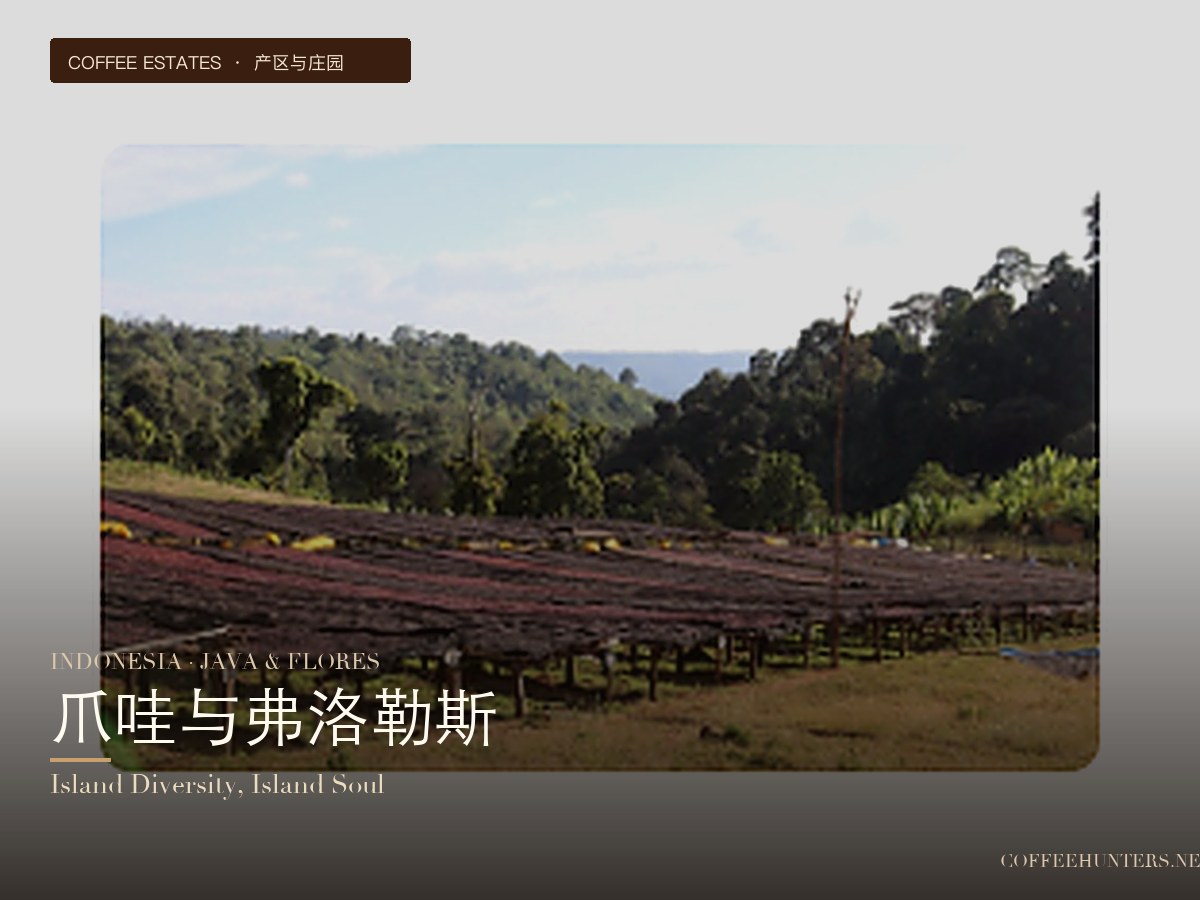
Java's coffee history is as long as Sumatra's. When coffee was first introduced to Indonesia in 1696, it was first planted on the island of Java. In the mid-19th century, Java was once one of the world's largest coffee-producing regions. Today, Java's core producing areas are concentrated around the Ijen Plateau, at elevations of 900-1500 meters. Java coffee was once the most important trade good of the Dutch East India Company, and today Java Estate still centers its brand on "Old Java."
II. Java's Varieties and Processing
Java's main varieties are Typica and its variants, S795, Abyssinia, and others. In terms of processing, Java is similar to Sumatra, mostly using the wet-hulled method. But Java's wet-hulled method is more traditional than Sumatra's—longer drying time, lower bean moisture, and a cleaner cup than Mandheling.
III. Java's Typical Flavors
Java's typical flavor falls between Mandheling and other Indonesian islands: low acidity, full body, dark chocolate, tobacco, a slight spiciness. Overall it is somewhat "lighter" than Mandheling, without Mandheling's heavy earthy taste, but it still retains the rich, full mouthfeel characteristic of Indonesian wet-hulled coffee.
IV. The Flores Producing Region
Flores is an island in Indonesia's East Nusa Tenggara province, named after the Portuguese word for "flower" (Flores). Coffee was introduced to Flores by Portuguese colonists in the 19th century, and today specialty coffee cultivation is mainly distributed in the Bajawa area, at elevations of 1200-1800 meters. The Bajawa area is located near the active volcano Inerie and has fertile volcanic soil.
V. Flores' Climate and Varieties
Flores is located near the equator, but has a cool climate due to its high elevation. Annual rainfall is 1500-2000 mm, distributed across the rainy season from October to April. Flores' main varieties are Typica, S795, and Abyssinia, with a small amount of Caturra and Catuai as well. In terms of processing, wet-hulled is dominant, but in recent years there have also been more and more washed, honey, and natural lots.
VI. Flores' Typical Flavors
Flores' typical flavor is "brighter" than Sumatra Mandheling—medium-low acidity, pronounced nut, chocolate, and citrus notes, with an overall cleaner mouthfeel than Mandheling and without such a heavy earthy taste. Specialty lots often carry distinct floral, honey, and orange peel notes, making them a rising star in Indonesia's specialty coffee world.
VII. Representative Estates
Flores' representative estates include Flores Bajawa Cooperative, Watujaji Estate, Mata Air Estate, and others. The specialty lots from these estates are becoming increasingly popular in the international market. Java's representative estates include Ijen Plateau Estate, Java Estate Blawan, and others.
VIII. Brewing Recommendations
Both Java and Flores coffees are suitable for brewing at medium-low water temperatures (88-91°C), with a coffee-to-water ratio of 1:15-1:16. For equipment, a Kalita Wave or French press is recommended—the Kalita Wave is suited to highlighting cleanliness and sweetness, while the French press is suited to highlighting body and herbal notes.
Conclusion: An Island Is a Flavor
Indonesia is a country made up of more than 17,000 islands, each with its own unique geography and climate, creating coffees of different flavors. Java represents the classic, Flores represents the trendy, and Mandheling represents the heavy—to understand these three islands is to understand the complete map of Indonesian coffee.
— CoffeeHunters Editorial Team
The above content is compiled by CoffeeHunters, a coffee news website.