Origins & Estates · In-Depth Visits
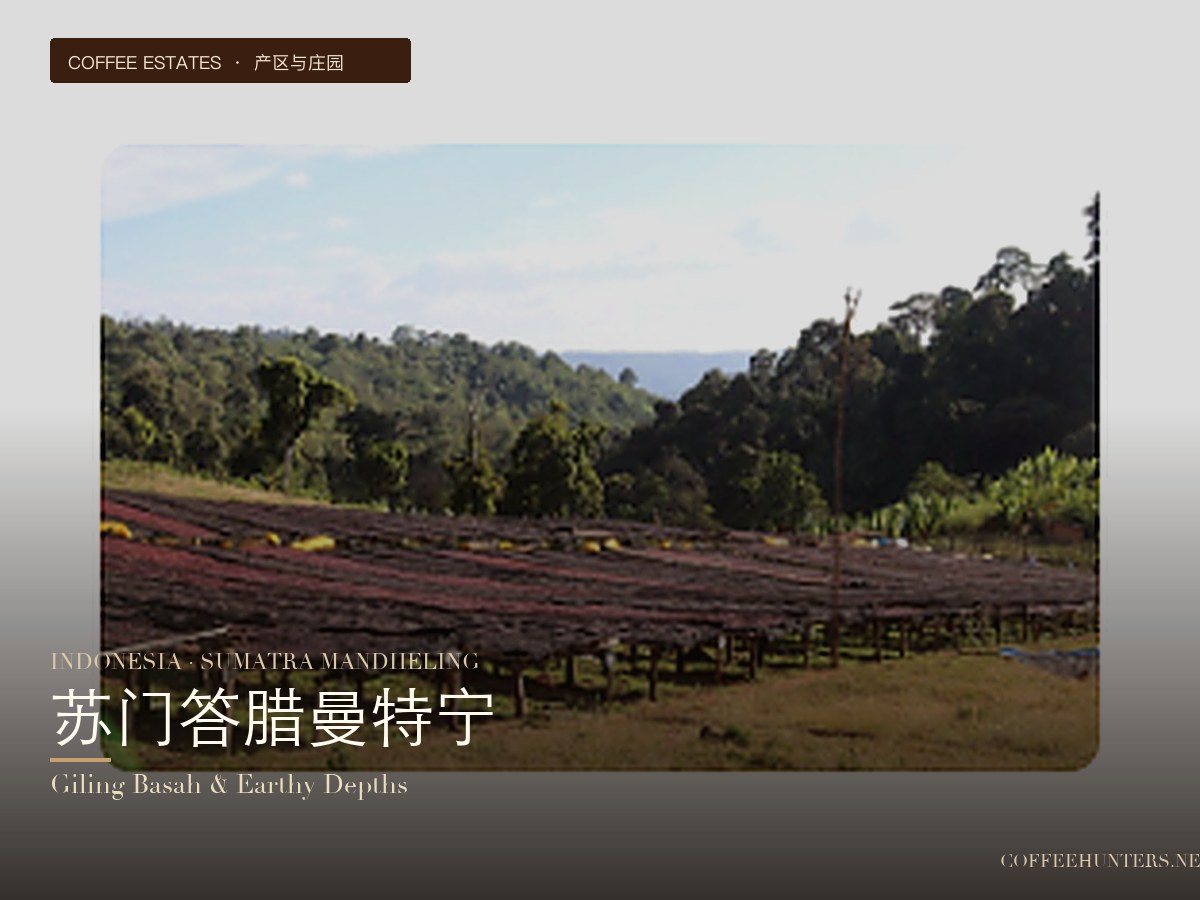
Coffee cultivation in Sumatra began in 1696, when the Dutch East India Company introduced coffee to Indonesia. The area around Lake Toba on the island of Sumatra is Indonesia's most important coffee-producing region. Mandheling is a transliteration of the local Mandailing people, and Mandailing was historically a kingdom in northern Sumatra known for its coffee trade. Today "Mandheling" has become a general term for coffee from northern Sumatra, with core producing areas around Lintong, Tapanuli, and Lake Toba.
II. Wet-Hulling: Giling Basah
Mandheling's distinctive flavor comes from its unique "wet-hulling" process (Giling Basah, also known as Semi-Washed). This method differs from traditional washing—after depulping, the beans are not directly sun-dried; instead, the parchment beans with about 30-35% moisture content have the mucilage layer (parchment) removed by machine, and only then are they dried. This process gives the beans their distinctive blue-green or jade-green appearance, and also brings out a unique earthy, spicy, herbal note in the cup.
III. The Origins of Wet-Hulling
The birth of wet-hulling had practical reasons—Sumatra has a tropical rainforest climate with extremely high humidity (annual rainfall of over 2,000 millimeters), and traditional washing followed by drying takes 14-21 days. Wet-hulling shortens the drying time to 5-7 days, allowing the coffee to finish drying before the rainy season. At the same time, some mucilage remains on the beans during wet-hulling, bringing a unique sweetness and body to the cup.
IV. Varieties: Typica and Its Mutations
The main variety of Mandheling is Typica and its mutations, including Bergendal and Sidikalang. Specialty lots often feature rare varieties such as S795 (a Java variety, a hybrid of Kenyan and Indian types), Abyssinia (an Ethiopian mutation), and Tim-Tim. These varieties give specialty Mandheling lots a more three-dimensional flavor than traditional Mandheling.
V. Typical Flavor Profile
A cup of traditional Mandheling has a very distinctive cupping profile: the aroma shows obvious notes of earth, tobacco, and baking spices; on the palate it is low in acidity with a thick mouthfeel; the mid-palate is a combination of dark chocolate, herbs, spices, and soil; the finish carries obvious cedar, tobacco, and a slight herbal note. The overall cup is thick, solidly sweet, and almost without acidity—this is the biggest difference between Mandheling and other specialty coffees.
VI. The Shift Toward Specialty
Over the past decade, Mandheling's shift toward specialty coffee has accelerated. Local processing stations have begun experimenting with new methods such as double wet-hulling, organic processing, and anaerobic fermentation. Single-estate lots from the Lintong region and organic lots from the Sidikalang region have both earned high scores in the international specialty market.
VII. Representative Estates
Representative estates of Sumatra Mandheling include Lintong Estate, Sidikalang Estate, and Sumatra Organic Estate. Also worth mentioning is Koperasi Permata Gayo, Indonesia's largest coffee cooperative, whose organic Mandheling is widely praised in the international market.
VIII. Brewing Recommendations
Mandheling's thick mouthfeel is very well suited to brewers that retain oils and body, such as the French press, Clever Cup, and Kalita Wave. Water temperature 88-90°C (slightly lower than for regular coffee), coffee-to-water ratio 1:15-1:16, medium-coarse grind (slightly coarser than usual). If you want to highlight Mandheling's herbal and spicy notes, a 4-minute immersion in a French press is recommended; if you want to highlight the sweetness and chocolate notes, the three-pour method with a Kalita Wave is more suitable.
Conclusion: The Other Side of Low Acidity
In the global specialty coffee world, Mandheling may not be the most popular flavor—its earthy and herbal notes deter many enthusiasts. But Mandheling represents the specialty coffee world's ultimate pursuit of the "low-acid" style, and is a "backbone" in espresso blends. To understand Mandheling is to understand the diversity of the specialty coffee world.
— CoffeeHunters Editorial Team
The above content is compiled by CoffeeHunters, a coffee news website.