Origins & Estates · In-Depth Visits
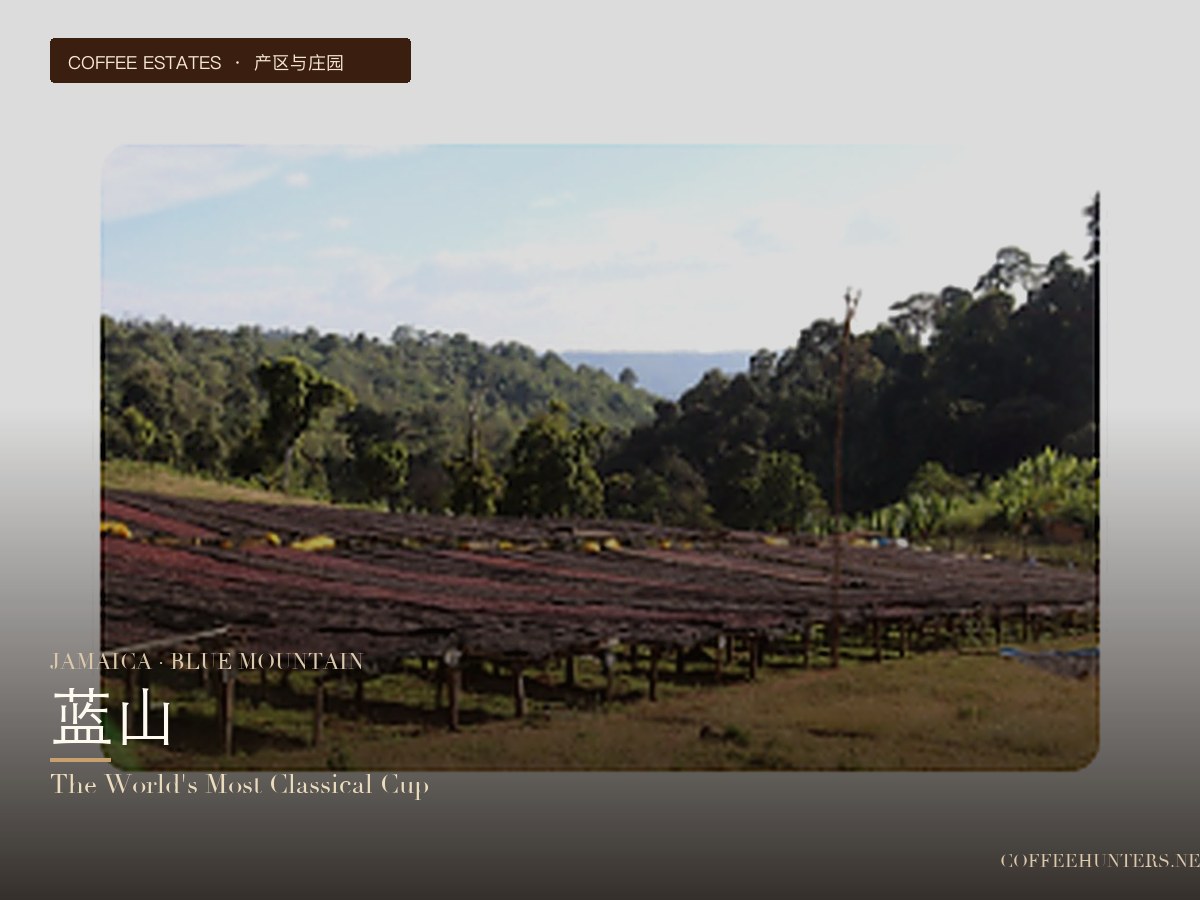
The cultivation history of Jamaican Blue Mountain coffee can be traced back to 1728, when the then Governor of Jamaica, Nicholas Lawes, introduced coffee to Jamaica from Martinique. By the mid-19th century, Jamaica was already one of the world's major coffee-producing countries. But the true "Blue Mountain" brand took shape in the 1840s—the British Governor registered a trademark for Blue Mountain coffee, and from then on Blue Mountain coffee became Jamaica's most important export product. Today, Blue Mountain coffee is almost entirely exported to the Japanese market, with roughly 80% or more of it ultimately consumed in Japan.
II. The Geography of Blue Mountain
The Blue Mountains are located in eastern Jamaica, with the highest peak reaching 2,256 meters, making it one of the tallest mountains in the Caribbean. The core production area for Blue Mountain coffee lies within a specific zone between 900 and 1,700 meters above sea level in the Blue Mountains—this zone is strictly defined as "Blue Mountain," and coffee from other areas may not use the name even if it comes from Jamaica. The volcanic soil, cool and humid climate, and regular mist and clouds of the production area together create the unique climatic conditions of Blue Mountain coffee.
III. Variety and Cultivation
The main variety of Blue Mountain is Typica, one of the earliest Arabica varieties to be commercially cultivated in the world. Blue Mountain coffee cultivation is dominated by small family farms, with an average planting area of only 2-3 hectares per household. This small-scale, refined approach to cultivation is an important reason for Blue Mountain's consistent quality.
IV. Processing Method
Blue Mountain coffee is almost entirely processed using the traditional washed method. Local processing stations use the standard流程 of depulping-fermentation-washing-drying. The fermentation time for Blue Mountain coffee typically ranges from 18 to 30 hours, making it one of the processing methods with longer fermentation times in the world. This long fermentation gives Blue Mountain coffee its unique "effervescence" and soft acidity.
V. A Strict Grading System
Blue Mountain coffee has the world's most rigorous product grading system: Blue Mountain No. 1 (largest and most uniform beans), Blue Mountain No. 2, No. 3, PB (peaberry), Blue Mountain 1-3, and several other grades. All Blue Mountain coffee must be packaged in official wooden barrels issued by the Jamaica Coffee Industry Board (CIB), with the CIB steel stamp and a unique serial number printed on each barrel.
VI. Typical Flavor Profile
A high-quality cup of Blue Mountain coffee presents a very distinctive cupping profile: the aroma carries faint notes of nuts, toasted malt, and light chocolate; on the palate there is mild lemon and green apple acidity; the mid-palate is a combination of almond candy, brown sugar, and honey; and the finish carries distinct floral and tea-like notes. The overall mouthfeel is very balanced, clean, and gentle, lacking the intense acidity or heavy body found in other production areas—this is the unique charm of Blue Mountain's "moderate" style.
VII. The Price of Blue Mountain
The price of Blue Mountain coffee has always remained high. Green bean prices typically range between $30 and $50 per pound, and the retail price after roasting is even more astonishingly high. Behind this high price are multiple factors: strict production-area designation, a rigorous grading system, stringent packaging requirements, a relatively small output (about 200-400 tons per year), and stable demand from the Japanese market.
VIII. Brewing Recommendations
Brewing Blue Mountain coffee requires respecting its gentle character. Use a V60 or Chemex dripper, water temperature of 88-90°C (slightly lower than for general coffee), a coffee-to-water ratio of 1:16-1:18, and a medium-fine grind. Pour in three stages, with a 30-second bloom, the second pour filling to halfway, and the third pour finishing with a thin stream. If you want to highlight Blue Mountain's effervescence and tea-like notes, an Origami dripper is recommended.
Conclusion: The Definition of a Classic
In the global specialty coffee landscape, Blue Mountain may not be the production area with the most unique flavors, the richest varieties, or the largest output, but it is one of the production areas with the greatest brand value, the strictest controls, and the most classic status. To understand Blue Mountain is to understand the true meaning of the word "classic" in the world of specialty coffee.
— CoffeeHunters Editorial Team
The above content is compiled by CoffeeHunters, a coffee news website.