Origins & Estates · In-Depth Visits
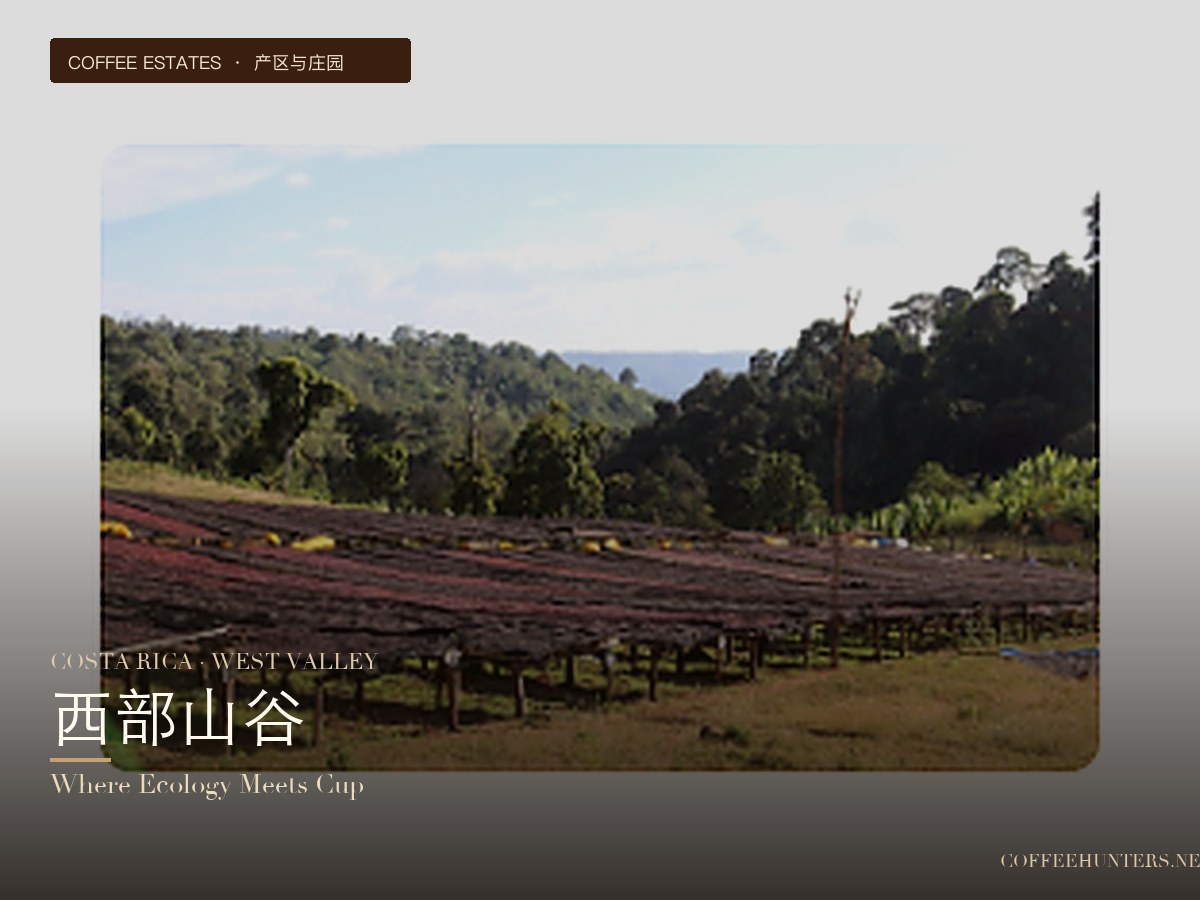
The West Valley is located in the province of Alajuela, west of Costa Rica's capital San José, and is one of Costa Rica's four major specialty regions (Tarrazú, West Valley, Guanacaste, and Brunca). The core growing area of the West Valley sits at an altitude of 1,200–1,700 meters, making it a region with a moderate growing elevation for Costa Rica.
2. Climate and Micro-Differences
The West Valley's climate is warmer than Tarrazú's, with an average annual temperature of 19–22°C and rainfall of 1,500–2,000 mm. Because of terrain differences, the region contains multiple microclimates—sub-regions such as Pérez Zeledón, San Ramón, and Naranjo each have their own distinct microclimate. This microclimate diversity makes the West Valley's coffee styles more varied than Tarrazú's.
3. Variety Structure
The main varieties of the West Valley are similar to those of Tarrazú—Caturra and Catuai dominate, while Villa Sarchí, Yellow Bourbon, and Geisha are common specialty varieties. Worth mentioning is Costa Rica's unique variety Villa Sarchí—a Bourbon mutation discovered in the village of Villa Sarchí in the West Valley, with a delicate cup profile and prominent sweetness.
4. Ecological Farming
The West Valley is Costa Rica's flagship region for ecological coffee farming. Many local estates adopt eco-friendly growing methods such as shade-grown cultivation, organic composting, and biodiversity conservation. Many estates have obtained international certifications such as Rainforest Alliance and Organic Certification.
5. Processing Methods: A Diverse Experimental Ground
The West Valley is the most active region in Costa Rica for processing experiments. In addition to traditional washed and natural methods, West Valley estates extensively try new processes such as honey processing, anaerobic fermentation, and carbonic maceration. Don Mayo processing station and La Pastora processing station are pioneers of honey processing and anaerobic fermentation.
6. Typical Flavors
The West Valley's typical flavors: "medium acidity, full sweetness, rounded mouthfeel"—the acidity of lemon and green apple, the sweetness of caramel and brown sugar, and a finish of almond and chocolate. Honey-processed lots carry distinct notes of dried apricot, peach, and black tea; anaerobic lots carry a complex fermented character—red wine, fruit juice, and a slight spiciness.
7. Representative Estates
Don Mayo processing station is one of the most famous processing stations in the West Valley, and its honey-processed lots are sold at internationally renowned shops such as Sasa Sestic and Tim Wendelboe. Finca La Pastora is a representative estate of the Naranjo area, known for its single-plot Yellow Bourbon lots. Other representative estates include Helsar de Zarcero and Coopetarrazú.
8. Brewing Suggestions
West Valley washed coffees suit a single-pour V60, with a water temperature of 90–92°C and a coffee-to-water ratio of 1:15. For honey-processed coffees, we recommend a Kalita Wave, with a water temperature of 89–91°C and a ratio of 1:16. For anaerobic lots, we recommend an Origami dripper, with a water temperature of 90°C and a ratio of 1:15, which allows the complex fermented character to fully unfold.
Conclusion: Ecology Is the Future
Today, as the global coffee industry faces climate change, ecological degradation, and the loss of varieties, the West Valley's ecological farming philosophy offers a possible answer for the future of specialty coffee. To understand the West Valley is to understand the specialty coffee world's concern for ecological sustainability.
— CoffeeHunters Editorial Team
The above content is compiled by CoffeeHunters, a coffee news website.