







What does the bring-your-own-cup coffee policy actually require?
A customer who asked McDonald's to fill her own cup received the drink in a disposable paper cup first, which staff then poured into her container. The store manager explained that company rules bar customer cups from the preparation area because they do not meet hygiene requirements, so the extra cup served as a transfer vessel. The episode drew attention to how bring-your-own-cup coffee orders are handled in fast food settings.
Reactions split along two lines. Some customers argued that the extra disposable cup cancels the environmental benefit of carrying a reusable one, especially when chains promote bring-your-own-cup discounts as part of coffee culture. Others sided with the store, noting that health codes and cross-contamination concerns make outside containers difficult to accept behind the counter. No company-wide policy change has been announced following the discussion.
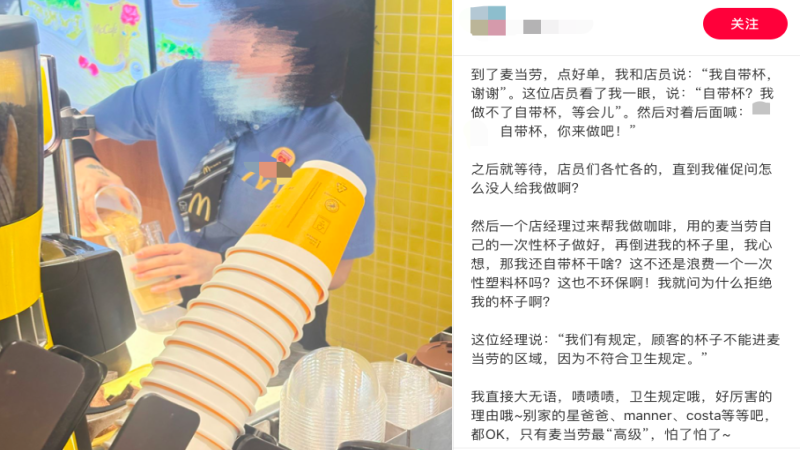
Bringing your own cup to buy coffee is inherently an eco-friendly gesture, but one consumer encountered an unexpected situation at McDonald's: the staff first poured the drink into a disposable cup, then poured it into the customer's cup. The store explained that customer containers cannot enter the preparation area due to hygiene regulations. This incident sparked heated discussion—some people understand McDonald's food safety considerations, while others believe that using an extra plastic cup defeats the original eco-friendly purpose. So how exactly should bring-your-own-cup work at fast food restaurants? Front Street Coffee takes you to find out.
▲
Click to follow | Daily specialty coffee culture magazine Coffee Workshop
Bringing your own cup to a nearby café to buy coffee has become a daily habit for many coffee lovers. However, one consumer's bring-your-own-cup experience at McDonald's hit a snag.
According to the consumer's account, when she went to the McDonald's downstairs to order coffee and asked to use her own cup, the staff initially said it couldn't be done and that she needed to wait for someone else to handle it. The store manager then came out to make the coffee, but first prepared the drink and poured it into a McDonald's disposable paper cup, then poured it into the customer's own cup.
This operation left the customer confused, as she felt the store manager had unnecessarily used an extra disposable cup, which was neither eco-friendly nor economical. She then asked why an extra takeaway cup was used. The manager responded: "The company has regulations—customer cups cannot enter McDonald's preparation areas because they don't meet hygiene requirements."
For bring-your-own-cup users, the whole point of carrying a cup to buy coffee is to reduce the use of disposable plastic cups. But McDonald's employees, citing "bring-your-own-cups aren't hygienic" as the reason, used a disposable cup as a transfer container for the drink—in the consumer's view, this completely betrays the eco-friendly meaning of bringing your own cup, so she believes McDonald's is indirectly rejecting customers' own cups.
After the post was published, many netizens agreed with the poster, believing that McDonald's, while promoting "bring-your-own-cup discounts," engaging in such behavior indeed contradicts the brand's environmental philosophy, and they said the store manager's approach was an unnecessary extra step that wasted a plastic cup.
However, more netizens believed the store manager's approach was entirely reasonable, with some even openly supporting it. In their view, McDonald's is different from professional coffee shops like Starbucks and Manner—its stores focus on burgers and other food items, so it may have stricter hygiene requirements for utensils entering and leaving food preparation areas.
Even if the customer's own cup had been cleaned beforehand, non-restaurant utensils entering the food preparation area do pose food safety risks. Therefore, many netizens believe that the store manager, instead of directly using the customer's cup to catch the drink, used a disposable cup as a "transfer"—though it may seem troublesome and not eco-friendly, it actually prevents foreign items from contaminating food, and is also a responsible approach to consumer food safety.
Additionally, some McDonald's employees came forward to confirm that the situation the poster encountered actually complies with store regulations. They revealed that headquarters indeed does not allow customer items to enter or leave the food area, and if employees bring customers' own cups into the preparation area, it would be considered a violation.
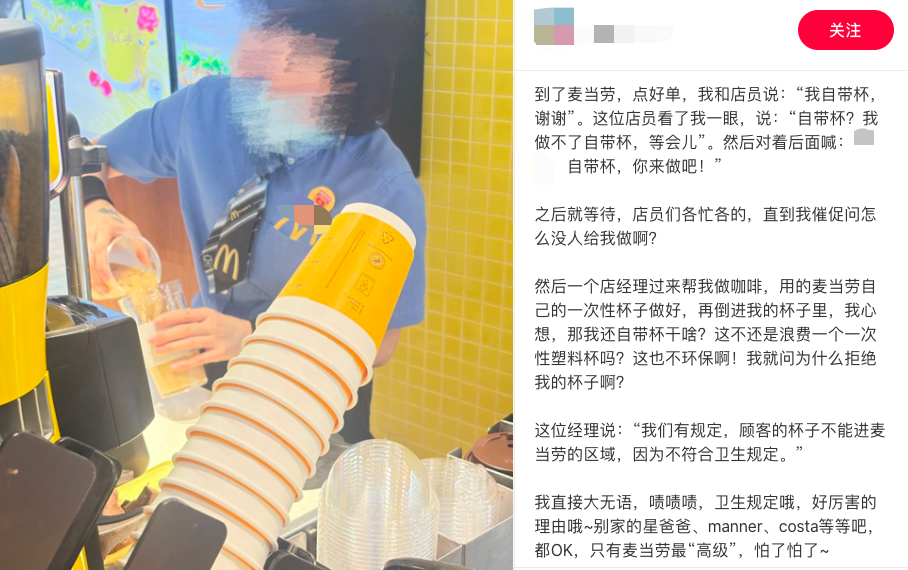
Currently, McDonald's has not explicitly prohibited customers from using their own cups, so when faced with such requests, staff mostly prepare the drink in the store's serving cup first, then pour it into the customer's container. When the brand previously held bring-your-own-cup events, employees could also be seen pouring drinks into customers' cups via disposable cups on-site, rather than directly taking them to the preparation area to dispense coffee.
Image source: Xiaohongshu
Disclaimer: Some images in this article are from the internet. For some content on the website such as images, we will respect the original author's copyright and indicate the source. However, due to the large volume, some images and text may not have been credited in time. We apologize for this. If the original author has any disputes, please contact the website to handle it. Once verified, we will correct it immediately. Compiled and edited by "Coffee Workshop." Please indicate the source when reposting. If there is any infringement, please inform us for deletion. Thank you~!
The above content is compiled by CoffeeHunters, a coffee news website.


