







Is brewing coffee on a high-speed train safe?
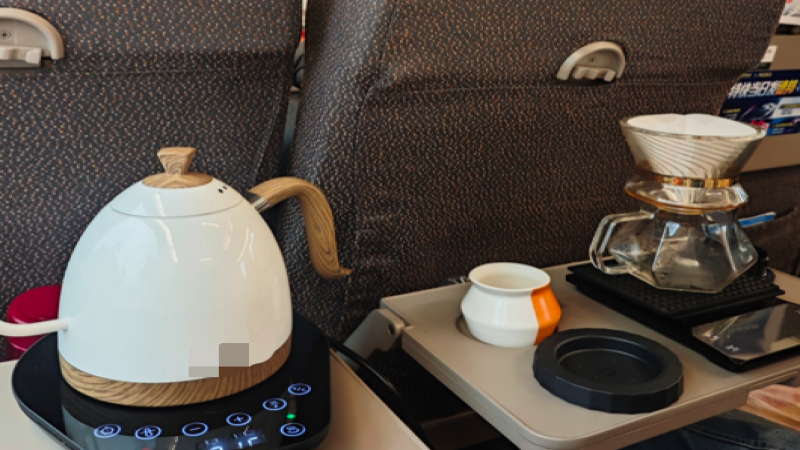
During the Spring Festival return rush, a passenger on a high-speed train pulled out a full pour-over setup and brewed coffee at the borrowed tray table of the person beside her. The story spread quickly online, and the brewer himself responded, with users calling it a high-speed rail drama.
Safety concerns followed. Carriage sockets deliver limited power, so a high-wattage electric kettle can overload the circuit, and unstable supply may damage devices. A seat reclining in front could also knock over hot water and cause scalds. Unlike brew in the bag coffee, this method needs boiling water and open gear, which raises the risk.
During the Spring Festival return-travel peak, a netizen on a high-speed train was approached by the young man sitting next to her, who surprisingly pulled out a full set of coffee gear and borrowed her tray table to boil water and make pour-over coffee. This romantic and novel experience quickly sparked heated discussion online, and the young man himself also posted a response, leading netizens to jokingly call it a "high-speed rail idol drama." However, beyond the gossip and amusement, many users pointed out that the power output of high-speed train carriage sockets is limited, and using a high-wattage electric kettle carries a risk of overload. Moreover, the train's power supply is unstable, which may damage devices, and the person in the row ahead adjusting their seat could knock over hot water and cause scalds. As good as coffee is, safety matters more.
▲
Click to follow | Daily specialty coffee culture magazine Coffee Workshop
As the Spring Festival holiday draws to a close, people are setting off on high-speed trains for their return journeys, heading from the warmth of their hometowns back to the cities where they work. On a long trip, encountering a romantic interlude would undoubtedly add a bit of memorable pleasure to an otherwise dull journey.
Recently, a netizen was approached by the passenger next to her on a return train. According to her account, she was dozing off when the young man in the adjacent seat suddenly asked if she would like a cup of coffee. No sooner had he spoken than he took out a complete set of coffee equipment from his bag and even borrowed her tray table to place a hot water kettle, boiling water on the spot and making a cup of pour-over coffee.
In fact, with the growing popularity of coffee culture, making coffee on a high-speed train is no longer anything new. But for those who have never seen it with their own eyes, watching someone boil water and brew coffee on a speeding train is still quite astonishing. That was exactly the case for this person, who recorded this special experience and shared it with netizens.
Interestingly, the young man who made the pour-over coffee also posted on the same platform about how he used coffee to strike up a conversation on the high-speed train, and onlookers jokingly dubbed it a "high-speed rail idol drama." Many even left comments urging the original poster to reveal what happened next.
Beyond the gossip, some users, after carefully observing the coffee-making scenes captured by the two parties, pointed out that while striking up a conversation with freshly made pour-over coffee was romantic and fun, using an electric kettle to boil water on a high-speed train hides no small risk.
It is understood that the electricity on a high-speed train mainly comes from the pantograph on the roof drawing power from the overhead catenary. Part of it serves as vehicle power, while the other part, after transformer processing and AC-DC conversion, becomes 220V 50Hz single-phase AC electricity for use in the carriages.
However, the power of high-speed train carriage sockets has an upper limit. If the total rated power of a carriage is about 3,200 watts, the share allocated to each socket may be only around 100 watts. In this case, plugging in an electric kettle with a rated power of more than 1,000 watts could very likely cause the entire carriage to exceed its rated power, thereby triggering the power protection mechanism.
In addition, the current output by the train more or less contains high-level pulses. Moreover, traction substations are set up every 50 kilometers along the line to supply power to the train. To prevent short circuits, a neutral section is left between the power supply lines of adjacent substations, which causes the socket current to be intermittent. Affected by various objective factors, the current and voltage of carriage sockets are actually far less stable than household electricity.
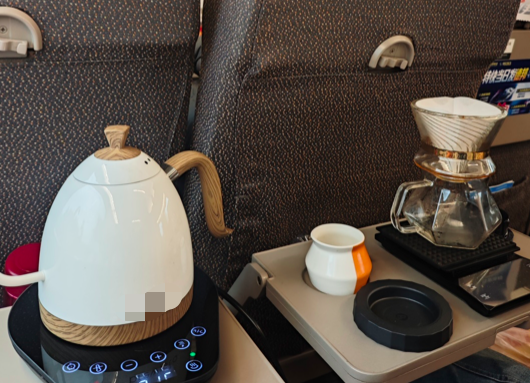
For this reason, low-power devices such as phones and computers also face the risk of damage from current and voltage fluctuations when plugged into the carriage circuit. If high-power appliances such as electric kettles are used, the risk is self-evident.
In addition to electrical hazards, many netizens also pointed out that although the train runs smoothly, if the passenger in front suddenly adjusts their seat back, it could very likely knock over the equipment on the table and the freshly boiled hot water, with unimaginable consequences. Some people who have made coffee on high-speed trains before said that the train itself provides boiling water, which can be collected and used directly, or that hot water can be put in a thermos before boarding, so there is no need to bring a kettle to boil water.
Many netizens believe that while brewing coffee on a high-speed train can indeed relieve the boredom of travel and satisfy a "coffee craving," it is essential to pay attention to electrical safety during the process, and never shift danger onto other passengers just to strike up a conversation over a cup of coffee.
Image source: internet screenshots
Disclaimer: Some images in this article are from the internet. For some content on the website, such as images, we will respect the original author's copyright and indicate the source. However, due to the large quantity, there may be individual images or texts that have not yet been credited. Please forgive us. If the original author has any dispute, they may contact the website for handling. Once verified, we will correct it immediately. Compiled and edited by "Coffee Workshop." Please indicate the source when reposting. If there is any infringement, please inform us for deletion. Thank you~!
The above content is compiled by CoffeeHunters, a coffee news website.


