







When Should Bypass Brewing Be Used in Pour-Over Coffee?
Bypass brewing, often called truncation, means discarding the tail-end liquid of a pour-over. It is not a universal fix. Bitterness dissolves throughout extraction, not only at the end, so under reasonable parameters the tail adds no negative flavor. Bypass suits two cases: when built into the brewing framework, or when clogging forces it.
Bitter compounds are large molecules that dissolve slowly. Once sweet and sour substances finish dissolving, continued extraction releases mainly negative flavors. Setting the extraction framework before brewing lets the process end when sweet and sour notes are nearly complete. Understanding the coffee extraction process beverage helps enthusiasts apply bypass more scientifically.
In the practice of pour-over coffee, truncation is a commonly mentioned technique. Many enthusiasts believe that the tail-end coffee liquid carries bitterness, so they habitually remove this portion at the end of brewing. However, truncation is not a universal key; improper use can instead ruin the coffee's complete flavor. From Front Street Coffee's perspective, this article delves into the dissolution patterns of bitter substances, explains why the tail end does not produce negative flavors under reasonable parameters, and distinguishes in detail between the powder-to-water ratio and the powder-to-liquid ratio. It also outlines the two scenarios where truncation is truly applicable—actively incorporating truncation into the brewing framework, and being forced to truncate due to clogging. By understanding these principles, coffee enthusiasts can use truncation more scientifically to improve brewing quality.

Since truncation discards the coffee liquid from the tail end of extraction, and many coffee enthusiasts firmly believe that bitterness mainly comes from the tail-end liquid, truncation has gradually become a fixed step for many during brewing. But Front Street Coffee needs to remind you that whether to use truncation should be flexibly decided based on the specific situation and brewing method. If truncation is done at an inappropriate time, it will not only fail to improve the coffee's taste but may also lead to putting the cart before the horse.
Why can't truncation be used arbitrarily?
First, we need to clarify one point: bitterness is not only dissolved in the tail end. Front Street Coffee has pointed out many times that the release of bitter substances runs through the entire extraction process. It is just that bitter compounds are large molecules, so their dissolution rate is relatively slow. When the sweet and sour substances have basically dissolved completely, the bitter substances continue to be released due to their difficult-to-dissolve nature. If extraction continues after the sweet and sour substances have finished dissolving, then the substances dissolved afterward will mainly be negative flavors.
However, under normal circumstances, we set the extraction framework before brewing begins, so that the extraction process ends promptly when the sweet and sour flavors have dissolved almost completely, thereby avoiding the precipitation of negative substances and allowing the coffee to show its ideal performance. Front Street Coffee's written description alone may not be intuitive enough; we suggest you try it yourself.
Under the premise of a reasonable brewing framework, we can collect the tail-end coffee liquid separately during brewing and taste it. You will then find that the last liquid flowing out has almost no bitterness; it is merely weaker in sweetness and acidity, with a faint tea-like quality, and does not have the bitterness and off-flavors you might imagine. The reason is simple: when the parameters are reasonable, even the tail-end liquid will not extract negative substances; its main role is actually to dilute the concentration of the whole cup of coffee.

If the tail end you brew shows obvious bitterness, then what really needs attention is the brewing parameters. It is unreasonable parameter settings that cause the tail end to dissolve negative components. Otherwise, under normal conditions (excluding sudden situations such as clogging), unless the coffee beans themselves are of poor quality, it is difficult to extract negative flavors under reasonable parameters.
Take Front Street Coffee's commonly used light-roast bean brewing framework as an example: 15 grams of coffee, caster sugar grind size, a 1:15 powder-to-water ratio, 92°C water temperature, and a two-minute extraction time. If the tail end is removed before the coffee has finished dripping, the cup may show the following negative effects: higher concentration, incomplete flavor, and lack of aftertaste.
Because in the framework we set, the tail-end coffee liquid is itself one of the components. Once it is cut off, the coffee will increase in concentration due to the lack of enough water to dilute it, and the mouthfeel will worsen. At the same time, the tail-end liquid also contains certain flavor substances; cutting it off means losing part of the flavor performance, including the aftertaste that needs bitter substances to build. It can thus be seen that truncation cannot be applied arbitrarily.
So, under what circumstances is truncation suitable?
There are mainly two situations for using truncation. The first is to actively incorporate truncation into the brewing process and take it into account when formulating the extraction plan. For example: when using the powder-to-liquid ratio as the measurement unit.
Truncation is not a new technique that appeared only in recent years. As early as the end of the last century, it was already widely adopted in coffee circles. However, at that time, using truncation was a helpless move. Because there was no convenient measuring tool like today, neither water temperature nor liquid weight could be estimated except by experience or the capacity of the cup.
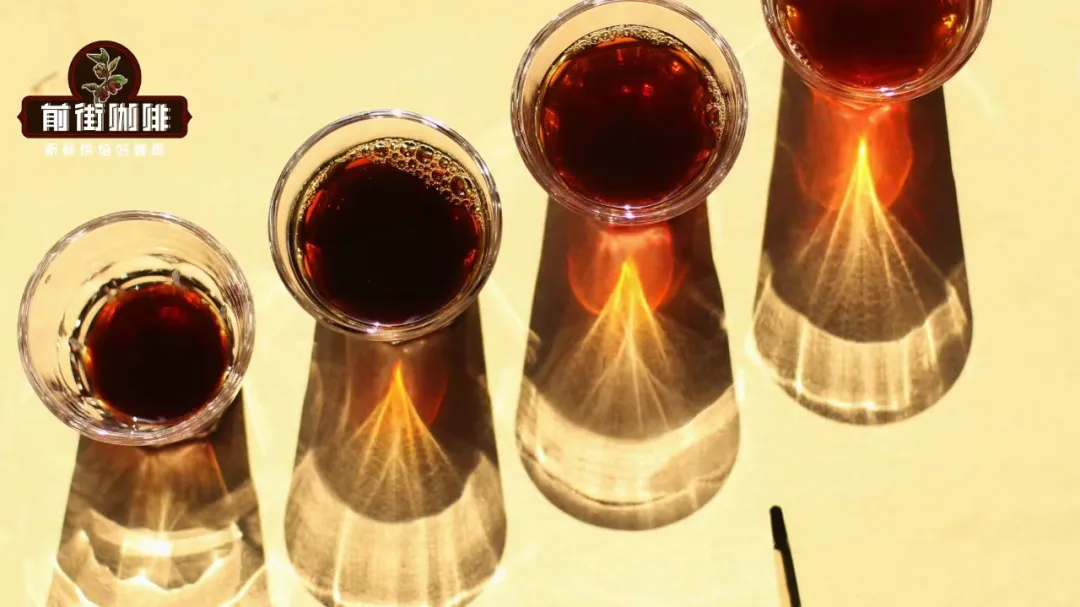
Therefore, in that era, people generally used the "powder-to-liquid ratio" when brewing coffee. The so-called powder-to-liquid ratio refers to the ratio between coffee powder and the coffee liquid obtained by dripping. Since the amount of water poured in could not be measured accurately, the liquid weight was converted by observing the water level of the coffee liquid in the cup and combining it with the cup's capacity. When the coffee liquid reached the target level, the dripper needed to be removed to stop the remaining liquid in the dripper from continuing to drip.
Because the coffee liquid seeping out afterward had already exceeded the target liquid amount and was outside the extraction range, it would most likely carry negative substances. So at this point it had to be removed by truncation to prevent the coffee from showing obvious negative flavors.
The other situation is a passive choice, and I believe everyone is familiar with this scenario. When coffee beans are roasted too light, have a too-hard texture, or contain too many fines, clogging is very likely to occur during brewing.

Once clogging occurs, the extraction time is forced to lengthen. If countermeasures are not taken immediately, the coffee can easily be over-extracted due to the long extraction time, thereby dissolving negative flavors such as bitterness, off-flavors, and astringency. Therefore, in this situation, we can only be forced to use truncation to reduce the incorporation of bitter substances, and then judge based on the coffee's concentration whether bypass water needs to be added for dilution.
- END -
The above content is compiled by CoffeeHunters, a coffee news website.


