







What Cotti's Exit Says About International Coffee Brands
Cotti Coffee's Sinchon branch in Seoul ceased operations on November 10, and its Gangnam store was also reported closed, pointing to a possible full withdrawal from South Korea. The brand entered the market in August 2023 with directly operated stores in Gangnam and Sinchon. No official statement has confirmed a complete exit, and the chain has not responded publicly.
South Korea is a crowded market, with per capita annual coffee consumption of 405 cups. Local netizens said Cotti's management lacked Korean experience, the ordering process was cumbersome, and the products struggled against domestic chains. For international coffee brands, the case shows that an americano cafe format and low pricing do not offset unfamiliar ordering habits or weak local operations.
Recently, a post on social media about a Chinese coffee brand closing stores in South Korea sparked heated discussion. The poster discovered that Cotti Coffee's store in Sinchon, Seoul, had ceased operations on November 10, and the Gangnam store was also reported closed, seemingly withdrawing from the South Korean market. Cotti chose South Korea as its first overseas market in August 2023, opening directly operated stores in Gangnam, Sinchon, and other areas of Seoul. However, South Korea's coffee market is fiercely competitive, with per capita annual consumption reaching 405 cups, and Cotti faced challenges adapting in terms of ordering experience, promotional strategies, and product taste. Local netizens pointed out that Cotti's management lacked local Korean experience, the ordering process was cumbersome, and it struggled to compete with domestic brands. As of now, there has been no official response on whether it has fully withdrawn. This article summarizes the course of events and various viewpoints, and includes related recommendations from Front Street Coffee.
▲
Click to follow | Daily specialty coffee culture magazine Coffee Workshop
Recently, a post on social media titled "A Chinese coffee shop has gone out of business in South Korea..." attracted netizens' attention and discussion.
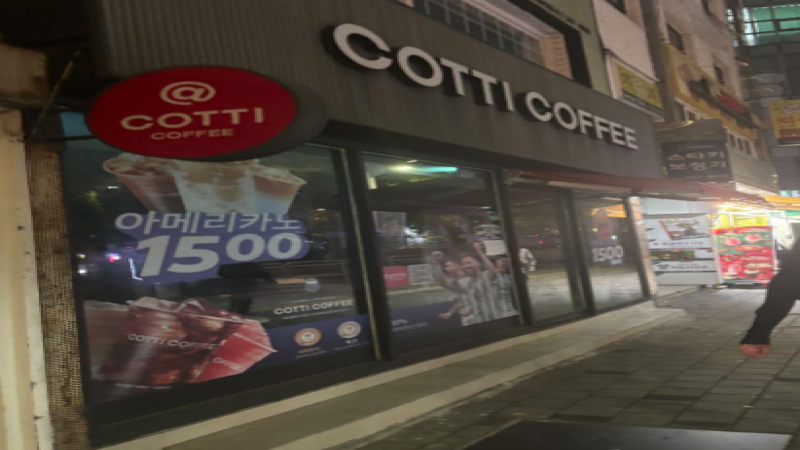
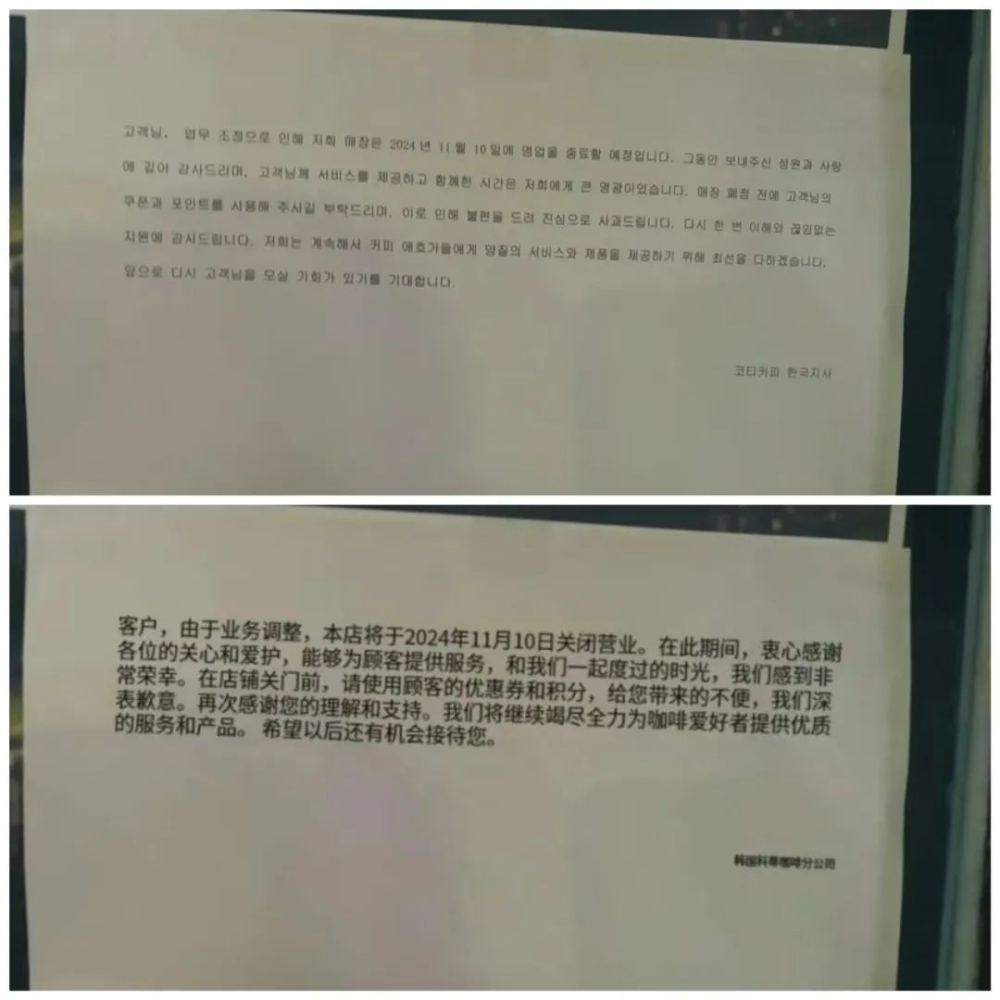
The poster, located in South Korea, said that when passing by the Cotti store in Sinchon, Seoul recently, she found that the coffee shop, which should have been brightly lit, had its doors tightly shut and was pitch dark inside. She walked up and saw a notice posted on the door, only then learning that the store had ceased operations on November 10.
This scene couldn't help but remind this regular customer of the day before the closure, when she went to the store to redeem points and, as usual, asked the staff if they had muffins for sale. She said the staff member who served her at the time had a faint sadness about them but did not tell her the store was about to close. Because of this, when she noticed the store was not operating normally, the poster lamented how unexpected it was.
(The image above is the original notice; the image below is a machine translation)
For South Koreans, coffee has long become an indispensable beverage in their life and work. According to a July report by South Korea's JoongAng Ilbo, South Korea's per capita annual coffee consumption in 2023 was 405 cups, more than double the global average of 152 cups.
Coffee consumption above the global average naturally means there is a vast coffee market locally. Therefore, in August last year, Cotti chose South Korea as its first overseas market, opening directly operated stores in Gangnam, Sinchon, and other areas of Seoul.
At the time, although netizens understood Cotti's overseas expansion move, they were not optimistic about it. Undeniably, South Koreans, who have "iced Americanos flowing through their veins," have a huge demand for coffee. At the same time, South Korea's coffee market is severely involuted, with industry competition no less intense than domestically; local coffee shops are numerous and densely distributed, truly a case of "a cafe every three steps."
Although Cotti is one of the representative affordable coffee brands in China and meets locals' consumption demand for large-volume, well-priced coffee drinks, many still believed that "a strong dragon cannot beat the local snake," and that Cotti, having entered the South Korean market, would find it hard to compete with local Korean brands.
The facts now before us seem to confirm netizens' earlier prediction that "Cotti feels like it can't survive in South Korea." South Korean netizens in the comments section revealed that besides the Sinchon store, the Gangnam store has also closed. "The staff told me the Gangnam one closed too; with Sinchon closed, that's a market exit."
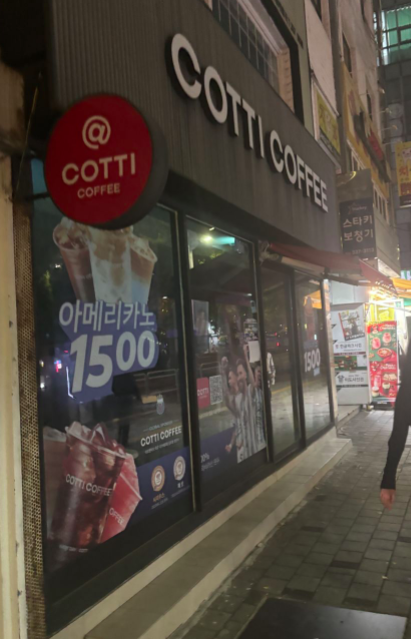
Through Cotti's South Korea ordering interface, the two stores currently searchable are both marked as resting, one of which is the Sinchon store mentioned in the post. However, regarding whether Cotti has completely withdrawn from the South Korean market, there is currently no official news.
As for the reasons behind Cotti's quiet closure, local netizens have different views: "There are many street coffee shops in South Korea; Cotti has no competitiveness," "Cotti's management in South Korea are all Chinese who haven't studied or lived in Korea, and they don't listen to part-time international students' suggestions for promotion methods," "You have to download various apps and then scan a code to order; the ordering process is rather annoying."
They said that in South Korea, where cafes are everywhere, Cotti was "not acclimated," its product flavors did not quite match local coffee lovers' preferences, and its ordering and promotion aspects failed to cater to local consumption habits. Under the influence of multiple factors, even though Cotti is a fairly well-known chain brand in China, it is not surprising that it struggles to sustain itself in South Korea's extremely involuted coffee market.
Image source: Internet
Disclaimer: Some images in this article are from the Internet, and some content on the website, such as images, will have their sources credited with respect for the original authors' copyright. However, due to the large quantity, a few images and texts may not have been credited in time; please forgive us. If the original author has any disputes, they may contact the website for handling, and once verified, we will promptly correct it. Compiled and edited by "Coffee Workshop"; please indicate the source when reposting. If there is infringement, please inform us for deletion. Thank you~!
The above content is compiled by CoffeeHunters, a coffee news website.


