







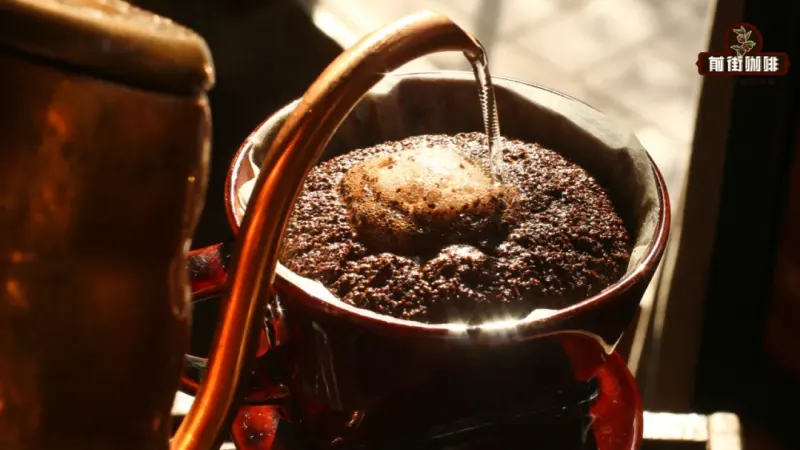
How does volcano pour-over work with Japanese dark roast coffee?
Volcano pour-over is a Japanese hand-drip technique built for dark-roasted coffee. Instead of one large stream, it uses a thin stream and small, repeated interval pours during the main extraction phase, which makes the coffee bed heave and bubble. The result is a cup with pronounced sweetness, a smooth body, and less bitterness, because the method relies on high strength with low extraction.
The bubbling comes from carbon dioxide released by the grounds during blooming. Water links the grounds into a kind of cage, so the gas has nowhere to go and pushes upward. Front Street Coffee demonstrates the method with its Golden Mandheling, a dark-roasted Indonesian bean, and gives full brewing parameters in a step-by-step walkthrough.
Volcano pour-over is one of the most distinctive brewing methods in the Japanese pour-over system, named for the way the coffee bed heaves and bubbles like an erupting volcano during extraction. It is designed specifically for dark-roasted coffee, using a thin stream, small and repeated interval pours, combined with a high-strength, low-extraction approach, to ultimately present a cup of coffee with prominent sweetness and a rich, smooth body. Drawing on Front Street Coffee's experience shared many times, this article takes a deep dive into the underlying logic of volcano pour-over: why it produces a volcano-eruption spectacle, why only dark-roasted beans can handle it, and how high-strength, low-extraction avoids bitterness while improving extraction efficiency. The article also provides complete brewing parameters and a hands-on demonstration with Front Street Coffee Golden Mandheling, walking you step by step through this brewing experience that is both visual and gustatory. [Image 1] [Image 2] [Image 3] [Image 4] [Image 5] [Image 6] [Image 7] [Image 8] [Image 9] [Image 10] [Image 11]
Front Street Coffee has shared this brewing method more than three times already, for a simple reason: it is completely different from conventional techniques, not only brewing out the full sweetness of dark-roasted beans, but also making the entire brewing process particularly captivating to watch. In the past, Front Street Coffee mostly taught everyone directly how to brew; today, we take a different angle and break down the principles behind this method. Almost forgot to mention — it is a very classic one in Japanese-style brewing: the volcano pour-over method.
What is volcano pour-over?
This technique is called volcano pour-over because during brewing the coffee bed continuously presents a scene resembling a volcanic eruption, and the name comes from this.
The key to producing this erupting sensation is that during the main extraction phase, no large stream is used; instead, a thin stream with small, repeated interval pours is used from beginning to end.
Everyone knows that the coffee grounds in the dripper swell up after blooming, caused by the coffee grounds continuously releasing carbon dioxide. But water connects the coffee grounds to one another, turning the entire coffee bed into a giant "cage." The carbon dioxide being released has nowhere to go and can only accumulate inside the coffee bed, and so the swelling appears.
When the main extraction phase begins, the hot water poured in breaks open this "cage," allowing carbon dioxide to escape — this is why a large amount of foam surges out when water is poured after blooming. With volcano pour-over, each pour is very small in volume and the circling motion is not large either, so only a small portion of carbon dioxide is released each time. Naturally, every pour shows foam continuously bubbling out — it simply never finishes escaping.
However, to form such a spectacle, the coffee beans must meet two conditions: first, the expansion rate must be high enough; second, carbon dioxide must be abundant enough. Therefore, this brewing method is not suitable for light-roasted beans, which have high density, low expansion rate, and low carbon dioxide content. It is mainly intended for dark-roasted coffee. After all, this method was originally designed specifically for dark-roasted coffee.
Next, Front Street Coffee will talk about the second characteristic of volcano pour-over: the coffee brewed has particularly high sweetness!
Why does volcano pour-over produce dark-roasted coffee with such high sweetness?
Volcano pour-over is not only famous for its unique coffee bed appearance; the coffee it brews also has notably prominent sweetness. This is mainly achieved through an extraction approach different from the usual — high strength, low extraction.
A large dose of coffee and a small liquid yield is practically the standard configuration of almost all classic Japanese-style brewing. In an era when measuring tools were not yet widespread, this approach could be said to be the best setting for avoiding bitterness. Reducing the hot water poured in limits the substances the hot water can carry out, thereby avoiding the release of bitterness.
But a small liquid volume inevitably means lower extraction efficiency in terms of water volume. To extract a sufficient amount of flavor compounds from the coffee, one must improve other parameters besides water volume to raise extraction efficiency. Thus came the practice of pouring the total water volume in small, repeated increments.
The essence of coffee extraction is that water, as a solvent, contacts the coffee grounds and, based on the concentration difference, carries out the soluble substances from the coffee grounds. The fewer substances the water contains, the more coffee substances it can carry out. Pouring in small, repeated increments ensures that the water contacting the coffee grounds is always low in concentration, so the extraction rate naturally increases.
At the same time, the intervals between pours lengthen the total extraction time. As time increases, the water and coffee grounds contact more fully, and extraction efficiency can be further improved.
But too many segments and too long a time can easily bring out undesirable substances. So at this point, the coffee grounds should be ground appropriately coarser, so that even under prolonged extraction, the coffee grounds will not easily release off-flavors, bitterness, and other negative substances. Alright, without further ado, next Front Street Coffee will share how to brew the classic volcano pour-over!
How to brew volcano pour-over?
First, we need to choose a dark-roasted coffee bean that meets the goal. On Front Street Coffee's bean list, Front Street Coffee Golden Mandheling is clearly the most suitable choice. Under deep roasting, the unique aged-wood, earthy aroma and dark chocolate flavors expressed by Front Street Coffee Golden Mandheling, combined with extremely high sweetness, are simply too tempting. Well then
Based on the above approach, the brewing parameters used for Front Street Coffee volcano pour-over are as follows:
Bean used: Front Street Coffee Sumatra · Golden Mandheling (dark roast) Coffee dose: 20g Grind setting: Ek43 setting 11 (60% pass rate on a No. 20 sieve, coarse sugar texture) Coffee-to-water ratio: 1:12 Brewing water temperature: 88°C Dripper used: Kalita trapezoidal dripper
Although there will be many pours, the entire pouring process is actually mainly divided into two parts: blooming and multiple uninterrupted pours. So the first thing to do is still blooming! Just bloom with 40ml of hot water (more is useless) , and the time is still 30 seconds.
After blooming ends, we pour in small, repeated increments. Pour 20ml each time, in a small circle at the center of the dripper, with the interval between pours determined by seeing the coffee bed about to collapse (about 5 seconds) . Then, during brewing, you will continuously see the entire coffee bed heaving, with bubbles constantly rising where the water is poured — truly a scene of "volcanic eruption."
After extraction ends, it is not ready to drink directly, because the amount of water used is relatively small, so at this point the coffee concentration is extremely high, and it is hard for us to accept such a high-concentration cup of coffee. Therefore, it needs to be diluted by adding extra water to bring the concentration down to a range we can accept.
Generally, Front Street Coffee adds 50–60ml of hot water for dilution, yielding a coffee with moderate concentration — neither too strong nor too weak. Drinking it, one can clearly perceive the aroma of pine and spices, prominent caramel sweetness, rich dark chocolate notes, with a moderate overall body and a smooth, gentle mouthfeel. Simply put, it is very comfortable to drink, with no burden at all.
If you also like dark-roasted coffee, then why not try this simple, easy-to-do brewing method that is full of therapeutic charm — not only can you enjoy a visual treat during brewing, but you also end up with a cup of coffee with extremely high sweetness~
- END -
The above content is compiled by CoffeeHunters, a coffee news website.


