







What makes Tarrazú a specialty coffee leader?
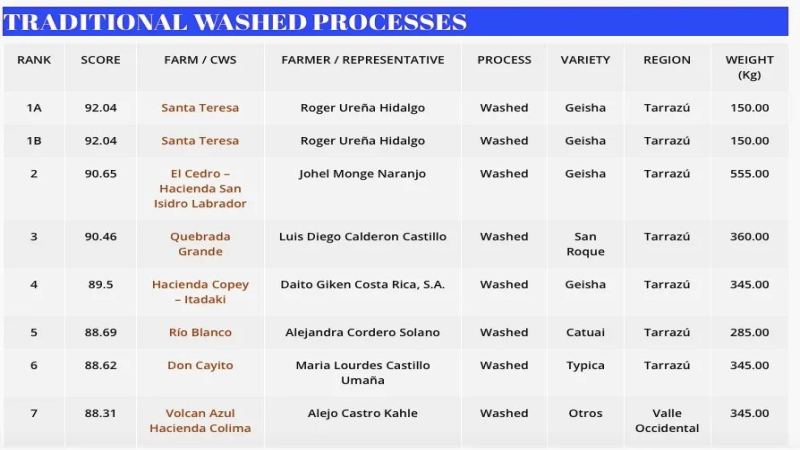
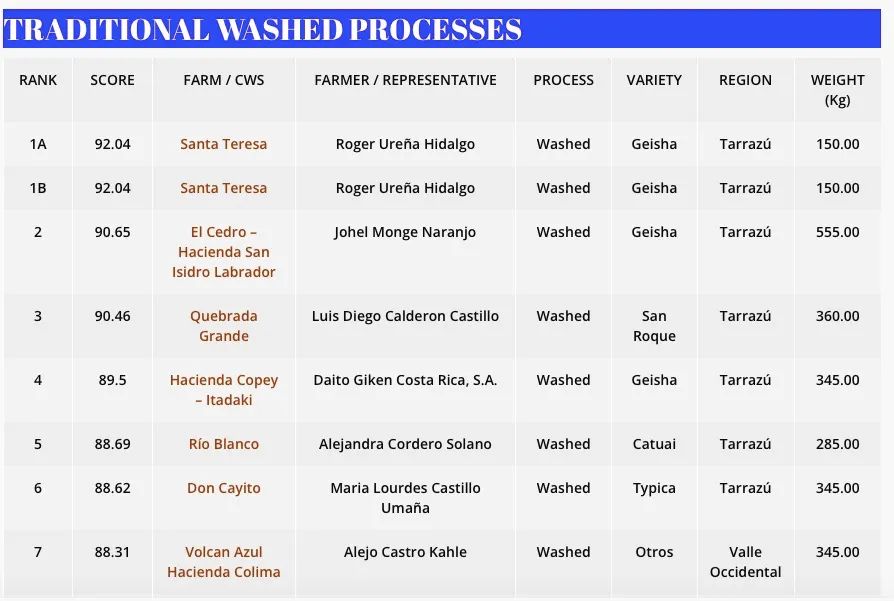
Tarrazú is Costa Rica's most prominent coffee region and a consistent high performer at the Cup of Excellence, with 22 of this year's 30 winning coffees coming from there. Its edge comes from early coffee cultivation in the 18th century, a microclimate shaped by volcanoes and two oceans, and the fact that 95% of its output is classified Strictly Hard Bean.
Coffee trees in Tarrazú grow on slopes between 1,500 and 2,100 meters, with no pesticides or chemical fertilizers used. Costa Rica legislated a ban on growing varieties other than Arabica, and in 2019 the government applied for protected designation of origin for Café de Tarrazú. These factors together support the region's recognized specialty coffee quality.
Tarrazú is Costa Rica's most prestigious coffee region, not only the largest in production and the highest in altitude, but also a consistent high achiever in the Cup of Excellence (COE)—22 of this year's 30 winning coffees came from here. What gives it this edge? From its historical head start in coffee cultivation in the 18th century, to its microclimate shaped by surrounding volcanoes and air currents from two oceans, to the advantage of 95% Strictly Hard Bean (SHB) classification, Tarrazú combines the right timing, location, and people. In 2019, the Costa Rican government even applied for protected designation of origin for "Café de Tarrazú." This article will take you deep into Tarrazú's terroir secrets, its notable sub-regions and estates, and the Tarrazú flavor profile available at Front Street Coffee.
Thanks to its exceptional quality, coffee from Tarrazú (Tarrazú) is renowned in specialty coffee circles and firmly holds its place as one of Costa Rica's most representative and outstanding regions. On the Cup of Excellence (COE) award lists, Tarrazú appears almost every year—this year, for example, 22 of the 30 winning coffees came from this region. What exactly is Tarrazú's unique secret?
Looking back at history, Costa Rica was a pioneer in coffee cultivation and export in Central America: it began planting coffee in the early 18th century and started exporting in the early 19th century. The country is naturally suited to coffee growing, and the entire nation is exceptionally devoted to the coffee industry, consistently investing in producing high-quality coffee—even legislating a ban on growing any variety other than Arabica.
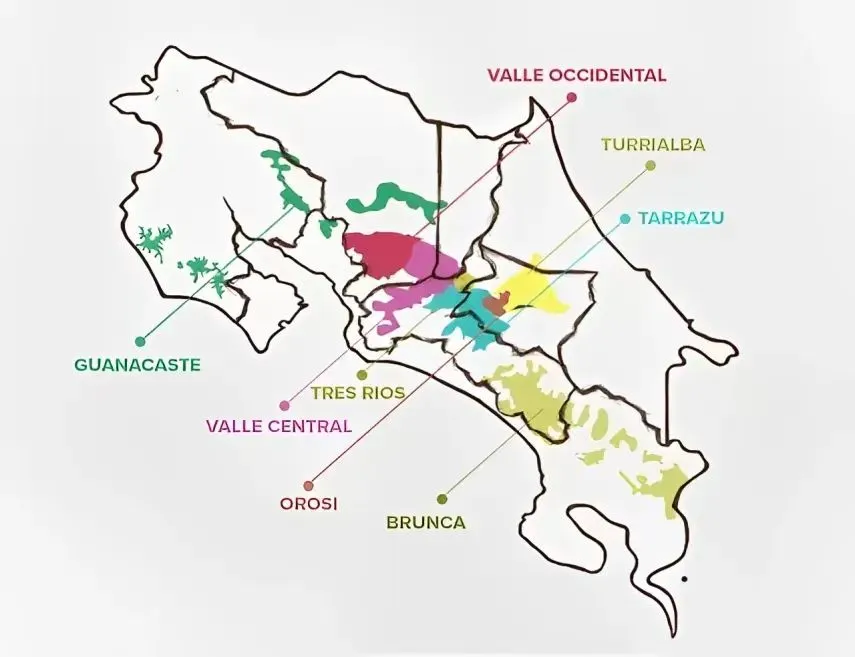
Costa Rica's coffee-growing belt is mainly distributed across the central mountains, and the country is divided into eight major regions, the most famous of which is Tarrazú (Tarrazu), also one of the largest and highest in average altitude.
Tarrazú is located southeast of the capital province of San José, surrounded by volcanoes and embraced by national forest parks. Ocean currents and sea breezes from the Pacific and Atlantic converge here, moderating the climate and making the area cool and pleasant, with an average annual temperature of about 19°C. Coffee trees grow on mountain slopes at altitudes of 1,500 to 2,100 meters, with no pesticides or chemical fertilizers used throughout—truly blessed with natural advantages.
Because the coffee industry started early, Tarrazú's farmers have accumulated generations of cultivation experience and are relatively well-funded. With the right timing, location, and people all in place, the region's development has entered a virtuous cycle, and coffee quality has remained high over the long term. The coffee produced here has a mild taste, bright acidity, abundant aroma, and good body, with excellent overall balance, making it highly favored by the market.
The heart of Tarrazú has also nurtured many well-known sub-regions, such as Los Santos and Dota; it is also home to several renowned estates, such as Mirazu Estate and Hacienda San Isidro Labrador.
Fame brings trouble, and Tarrazú's reputation has attracted many producers to impersonate it in order to sell at higher prices. To curb such practices, in 2019 the Costa Rican government applied to the European Union and the World Intellectual Property Organization (WIPO) to register "Café de Tarrazú" as a coffee designation of origin, aiming to protect this unique Tarrazú region and its coffee reputation.
Of the coffee beans produced in Tarrazú, 95% are Strictly Hard Bean (SHB). Costa Rica's grading system is similar to that of most Central American producing countries, using growing altitude as the basis for classification. The logic is that the higher the altitude, the lower the temperature, and the longer the coffee cherries take to mature, allowing for fuller sugar accumulation, richer flavor layers, and better density and hardness.
The grading is mainly divided into three levels: SHB, GHB, and MHB. SHB (STRICTLY HARD BEAN) corresponds to green beans grown at altitudes above 1,200 meters; GHB (GOOD HARD BEAN) corresponds to altitudes between 1,000 and 1,200 meters; and MHB (MEDIUM HARD BEAN) corresponds to altitudes below 1,000 meters.
At Front Street Coffee (FrontStreet Coffee), five Costa Rican coffee beans are currently offered, all from the Tarrazú region. The entry-level selection series uses Tarrazú beans, with the varieties being the common Costa Rican Caturra and Catuai. When brewed, they present flavors of sweet orange, chocolate, and nuts, with a smooth mouthfeel and a long, sweet finish.
For more coffee origin information, please scan the QR code to follow: Coffee Review
Long-press the QR code to follow:
The above content is compiled by CoffeeHunters, a coffee news website.


