








Why Is Yirgacheffe Coffee Often Sold by Cooperative Name
Yirgacheffe coffee is frequently named after a small town or cooperative because of Ethiopia's garden-plot cultivation model and its cooperative system. Yirgacheffe was originally a town under the Sidama Zone and part of the Sidamo growing region, later separated into its own coffee region; in 2004 the government applied for a patent on the name.
The Yirgacheffe growing region covers more than the town itself, extending to sub-regions such as Wenago, Kochere, and Gedeb, whose coffee shares a similar flavor profile. Beans from the Gotiti Cooperative in Gedeb show the bright lemon and citrus acidity that Ethiopian coffee processing methods and local conditions help produce, which is why labels often name the cooperative rather than a single farm.
Ethiopia is globally recognized by coffee enthusiasts as the quintessential origin of floral and fruity notes, with Yirgacheffe in particular famed for its bright lemon and citrus acidity. Many people shopping for Yirgacheffe coffee beans notice that products are often named after small towns in the growing region or cooperatives, which is closely tied to Ethiopia's unique garden-plot cultivation model and cooperative system. This article will outline Yirgacheffe's administrative and growing-region divisions, explain the reasons behind the rise of cooperatives, and focus on the growing conditions, history, and flavor characteristics of the Gotiti Cooperative in the town of Gedeb, while also mentioning related product information from Front Street Coffee.
For coffee drinkers who favor fruity acidity and floral aromas, Ethiopia is an origin that is almost impossible to avoid. Among Ethiopia's many growing regions, Yirgacheffe, thanks to its local geographical conditions and climate, produces coffee that often displays distinct lemon and citrus fruit acidity, and has therefore built up considerable popularity.
Front Street Coffee currently offers several coffees from Yirgacheffe, Ethiopia. Its entry-level selection series includes beans from the Yirgacheffe region, along with options such as Gotiti and Kochere. However, many consumers wonder: why are most coffee beans from the Yirgacheffe region named after a region or a cooperative?
From the perspective of Ethiopia's administrative divisions, Yirgacheffe was originally a small town under the Sidama Zone and early on belonged to the Sidamo coffee growing region. Because of its distinctive coffee flavor profile, it was later separated out to become an independent coffee growing region and ranked among the country's most important coffee regions. In 2004, the Ethiopian government even applied for a patent for the region name "Yirgacheffe," showing just how much official importance is placed on it.

The Yirgacheffe coffee growing region does not include only the single town of Yirgacheffe; it also covers sub-regions around the town such as Wenago, Kochere, and Gedeb. The coffee produced in these sub-regions has a flavor profile broadly consistent with Yirgacheffe, so they are likewise included within the scope of the Yirgacheffe growing region.
In terms of cultivation methods, Yirgacheffe is dominated by garden coffee (also called homestead coffee), with coffee trees mostly planted in farmers' own backyards or intercropped with other crops on their own farmland. Under this model, the coffee output of a single farming household is not high, but overall production accounts for more than half of the country's total coffee output.
When the harvest season arrives, the coffee cherries harvested by farmers are either bought on-site by middlemen or delivered by the farmers themselves to nearby processing stations. The processing stations handle the purchased cherries centrally and sell them in a unified way, so the coffee mostly enters the market under a region name or the name of a processing plant.
However, this circulation method also brought problems such as middlemen earning the price difference and even deliberately suppressing purchase prices, which squeezed farmers' returns. It was precisely these drawbacks that gave rise to the "cooperative" model: in order to reduce losses, coffee farmers joined together, jointly funded the purchase of equipment, built processing plants, and formed cooperatives. Farmers who joined the alliance could have the coffee cherries they grew processed centrally and then sell them externally under the cooperative's name in a unified way.
For Ethiopia's coffee industry, which is dominated by smallholder farmers, the cooperative model has brought clear benefits. In the Yirgacheffe region alone, there are currently more than 40 cooperatives, among which the better known ones include the Gotiti Cooperative.
The Gotiti Cooperative is located in the Gedeb sub-region. The town lies about 60 kilometers south of Yirgacheffe town and is one of the higher-altitude areas of Yirgacheffe, with cultivation elevations reaching 1,900-2,200 meters. Villages in the town that produce coffee include Worka Sakaro, Halo Bariti, Banko Gotiti, and Banko Dahato.
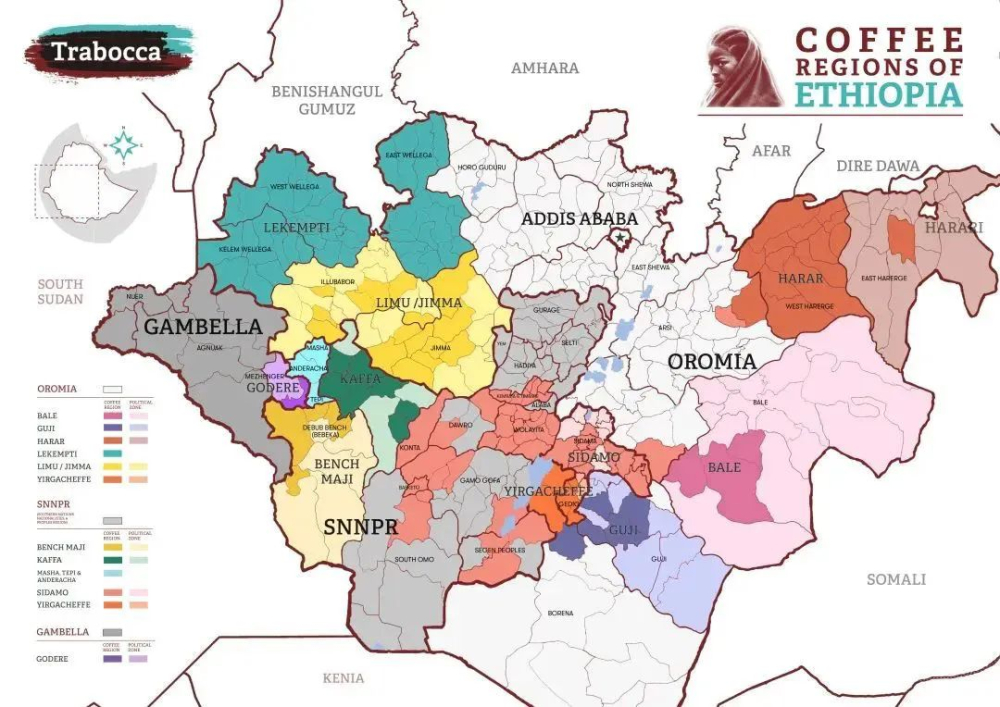
The Gotiti Cooperative was originally part of the Worka Cooperative under the Yirgacheffe Coffee Farmers Cooperative Union (YCFCU) because it was located in the Worka area of the town. With the development of specialty coffee, the market's demand for coffee traceability kept rising, and the division of sub-regions became increasingly detailed. In 2012, about 300 farmers from the village of Gotiti broke away and established today's "Gotiti Cooperative."
The Gotiti Cooperative is known for producing high-quality coffee and adopts traditional yet more rigorous and refined processing methods, which can better preserve the flavor characteristics of the local coffee. Front Street's Gotiti Cooperative coffee beans are washed processed; after brewing, they carry a faint floral aroma, present fruity flavors such as citrus and berries, and have a sweet aftertaste reminiscent of caramel, with a clean and sweet mouthfeel.
To learn more about coffee origin news and information, please scan the QR code to follow: Coffee Review
Long-press the QR code to follow:
The above content is compiled by CoffeeHunters, a coffee news website.


