







What happens to green coffee beans during roasting?
From green coffee beans to finished roast, moisture leaves the bean as it moves through dehydration and yellowing, then reaches first crack, the point at which it becomes edible and mature. Continue heating past that and the bean advances to second crack. The temperature gap between light and dark roast is only about 10°C, yet flavor changes completely.
Roasting reshapes aroma and taste through the Maillard and caramelization reactions, altering color, volume, density, and brittleness. The SCAA uses an infrared caramelization tester to read bean surface color and sort roasts into eight levels, though daily brewing rarely needs that precision. A Yirgacheffe lot such as Red Cherry shows how roast depth shifts acidity and bitterness.
Coffee beans range from light to dark roast with a temperature difference of only about 10°C, yet the flavors can be completely different. The degree of roasting not only affects the color, volume, density, and brittleness of the beans, but also reshapes the aroma and taste through the Maillard reaction and caramelization reaction. This article starts with roast classification, explains the SCAA color value standards, the flavor characteristics of light, medium, and dark roasts, and combines the specific performances of Front Street Yirgacheffe·Red Cherry and Front Street Warm Sun Blend to help readers understand the effects of different roast levels on the balance of acidity and bitterness, aroma complexity, and refreshing effect.
What exactly are the differences? This is precisely the topic Front Street wants to discuss today: how roast depth affects coffee, and what different appearances beans at different roasting stages will show?
How are roast levels classified?
First, a brief explanation of the changes in green coffee beans during heating: from green beans to roasted beans, moisture gradually dissipates, and the beans go through dehydration, yellowing, and then enter first crack and rolling first crack. The moment first crack begins actually indicates that the beans have reached an edible, mature state; if heating is not stopped at this point and continues, the beans will move on to second crack and even rolling second crack.
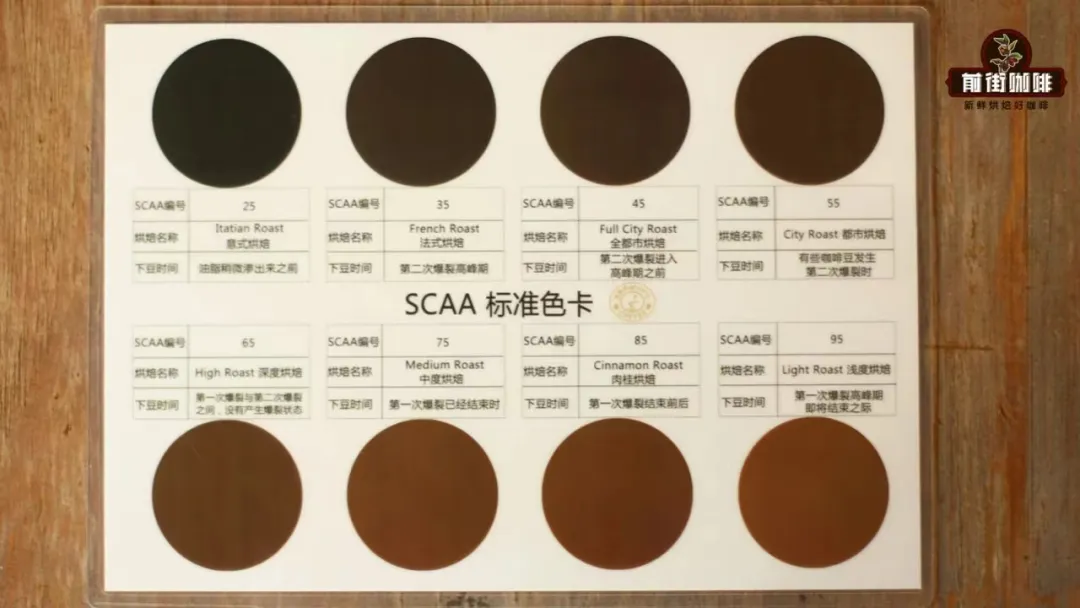
Because the degree of roasting itself lacks a hard, unified standard, what different people consider "medium" and "dark" is often inconsistent. For example, what Person A considers a medium roast may already count as a dark roast in Person B's view. To unify terminology as much as possible and reduce communication偏差, the SCAA uses an infrared caramelization tester to read the color value of coffee beans (that is, the surface color of the beans), and classifies roast levels accordingly.
The figure breaks the degree of roasting into eight levels, with values from large to small corresponding to roasting from light to dark.
A rough look is enough; in daily life it is actually rarely used, because it is difficult to accurately judge with the naked eye which bracket a bean's color value falls into and what roast level it corresponds to. Moreover, different sugar content on the bean surface affects the speed of browning, so drawing conclusions based only on color can easily lead to misjudgment.
Therefore, this value is more of a reference for roasters. Usually, to judge the roast level of a bean, in addition to looking at the external color, one must also combine the bean's shape and taste to reach a relatively reliable conclusion, and then simply classify it into three major categories: light, medium, and dark.
How does roasting affect coffee?
From a physical perspective, the effect of roast level on beans is the shape (volume) and color (color) mentioned earlier by Front Street. The darker the roast, the higher the expansion rate of the beans (larger particles), and the darker the color (discussed later).
At the same time, the beans become more brittle, and the moisture content continues to decrease. Once more brittle, grinding and extraction both become easier.
The decrease in moisture content combined with the increase in expansion rate causes the density of the beans to decrease, meaning that the darker the roast, the lower the density.
From a chemical perspective, the effect of roast level on beans falls on "taste," that is, the presentation of aroma and the transformation of flavor.
After coffee beans pass through the dehydration period, as long as the moisture content is low enough, the beans immediately enter two stages of non-enzymatic browning reactions: the Maillard reaction and the caramelization reaction. These two reactions have been explained in detail by Front Street before, so only a brief account is given here.
The "Maillard reaction," also called the "Maillard reaction," is crucial to the formation of coffee aroma, and many coffee aromas and flavors originate from this reaction. Not only that, the color change of coffee beans is also presented by the Maillard reaction, which is precisely why the classic Maillard color system gets its name. Caramelization begins at first crack; it decomposes and transforms the residual sugars in the beans, causing the beans to brown further on top of their original state, and then develops new aromas, especially enhancing the bitterness of coffee.
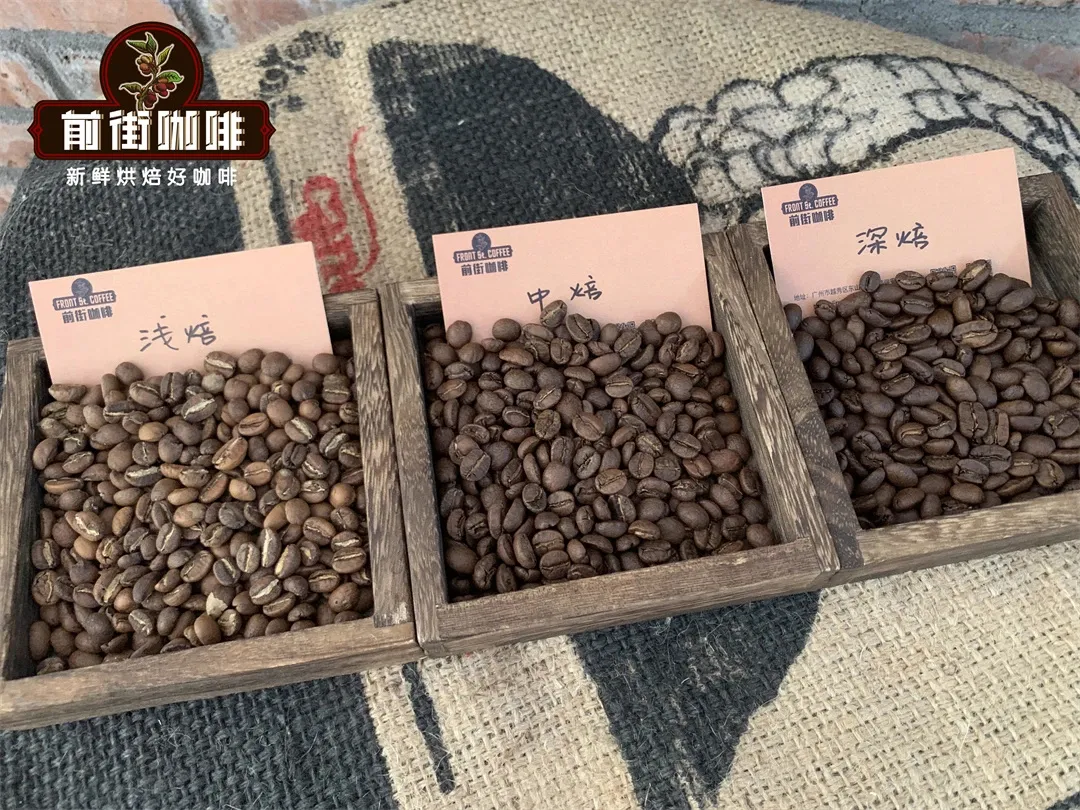
A bean goes from light roast to dark roast in just a few short minutes, with a temperature difference of only about 10°C, yet the aroma and flavor undergo tremendous changes.
Light roast refers to beans discharged between the middle of first crack and just after first crack ends. At this point, the organic acids in the beans have not yet been completely decomposed, so the coffee shows obvious acidity, relatively little bitterness, and a complex and rich aroma. Taking Front Street's Yirgacheffe·Red Cherry as an example, lightly roasted Red Cherry releases berry- and lemon-like acidity, with strawberry and wine aromas.
Medium roast refers to coffee beans discharged after first crack ends and before second crack begins. Because they undergo more caramelization reactions, the proportion of acidity in the whole cup decreases and is less prominent than in light-roasted beans, but the sweetness is higher. Aroma complexity decreases slightly, which instead makes other flavors more distinct.
Front Street's Warm Sun Blend uses medium-roasted (slightly darker medium) Red Cherry. At this point, the flavor brewed from Red Cherry has very high sweetness, with caramel chocolate aroma and a slight berry acidity.
The above content is compiled by CoffeeHunters, a coffee news website.


