








Why does iced pour-over coffee extraction weaken flavor?
The same bean can taste full and aromatic in hot pour-over yet vague, thin, and sometimes watery when brewed iced. Cold temperatures suppress aroma release and perceived sweetness, so fruit and floral notes that read clearly while hot fade, and the mouthfeel thins out in the iced coffee extraction.
A comparison of four styles, washed medium-light roast, natural medium-light roast, dark roast, and fermented beans, brewed both ways and judged on aroma, flavor, and mouthfeel, showed the gap widens with delicate washed and floral lots. Beans with heavier body, darker roast, or fermented character hold up better when brewed over ice.
During the National Day holiday, many coffee enthusiasts visited the shop to buy coffee beans, and also consulted Front Street about a common confusion: the same bean performs excellently in hot pour-over with great aroma and taste, but when made into iced pour-over, the flavor becomes vague, the body thin, and it can even taste like water. Why exactly is this? Front Street selected four coffee beans with distinct styles and conducted hot pour-over and iced pour-over extractions respectively, comparing them across three dimensions: aroma, flavor, and mouthfeel. This article will use washed medium-light roast, natural medium-light roast, dark roast, and fermented beans as examples, presenting the real performance of each under the two brewing methods one by one, and deeply analyzing the reasons why iced pour-over flavor weakens. Finally, it will offer suggestions for selecting coffee beans suitable for making iced pour-over, helping everyone enjoy a rich yet refreshing iced coffee even in hot weather.

During the National Day long holiday, many coffee enthusiasts visited the shop to purchase coffee beans, planning to leisurely brew a cup of freshly ground coffee at home, while also not forgetting to ask Front Street about questions encountered in daily brewing. One customer mentioned this phenomenon:
If she particularly likes a certain bean, she usually uses both hot pour-over and iced pour-over to experience it. She noticed that some coffee beans perform quite well in hot pour-over, with aroma and taste both satisfying, but once switched to iced pour-over, the effect drops significantly—not only are the various flavors less clear than when hot, but the overall mouthfeel also becomes very thin, sometimes even making one feel it's no different from drinking water. What exactly causes this?
How big is the gap between hot brew and iced brew for different coffee beans?
In order to make the comparison as comprehensive as possible, Front Street selected four coffee beans with vastly different styles, making hot pour-over and iced pour-over respectively, and comparing them from three angles: aroma, flavor, and mouthfeel.
Washed medium-light roast coffee bean recommendation: Front Street Ethiopia Kaffa Forest
Hot pour-over performance: Prominent white floral and lemon aromas; flavors show tangerine, honey, grapefruit, and caramel notes, high cleanliness, with a mouthfeel as clear as green tea.
Iced pour-over performance: Aroma is weak, leaving only a faint fruity scent; on the palate, there's a sweet-tart sensation of green grape, pear juice, and green tea, low in body, with a refreshing, cool mouthfeel.

Natural medium-light roast coffee bean recommendation: Front Street Panama Emerald Red Label Geisha
Hot pour-over performance: Smells of rich fruity aroma and red floral notes; flavors cover cranberry, grape, pineapple, orange, Da Hong Pao, and a distinct fermented note, smooth on the palate, with outstanding juice-like quality.
Iced pour-over performance: The aroma trend is similar to the previous group, overall weaker, mainly citrus freshness; flavors are berry, dried fruit, pineapple juice, with moderate fruity sweetness and a light texture.
Dark roast bean iced pour-over coffee bean recommendation: Front Street PWN Golden Mandheling
Hot pour-over performance: Caramel and chocolate aromas; flavors of chocolate, nuts, spices, caramel, rich and aromatic, with a full-bodied mouthfeel.
Iced pour-over performance: Mainly roasted nut aroma, overall showing a chocolate, herbal, nut flavor direction, clean but one-dimensional. Mandheling's signature full-bodied mouthfeel is almost impossible to express in iced pour-over.
Fermented iced pour-over coffee bean recommendation: Front Street Finca La Divisa Big Belly
Hot pour-over performance: Smells of intense fruity aromas of orange and grape with almond nuances; on the palate, citrus, blackcurrant juice, black tea, spices, and fermented wine notes, with bright, solid fruit acidity and rich layers.
Iced pour-over performance: The aroma still has a clear fermented note, and it drinks with fresh blueberry, pineapple, and sweet dried apricot flavors, a rounded mouthfeel, overall like a glass of iced prune juice, with a hint of cinnamon in the aftertaste.
Why does coffee taste good hot-brewed but easily loses flavor when iced?
In fact, many coffee drinks had a hot version before an iced version, such as the well-known Americano, which existed as a hot drink for a long time after its birth, and only later followed the trend to launch an iced version. Pour-over, as a representative of drip extraction, is the same—hot pour-over appeared far earlier than iced pour-over, and the equipment and brewing methods born in that era also gradually evolved around hot brewing.
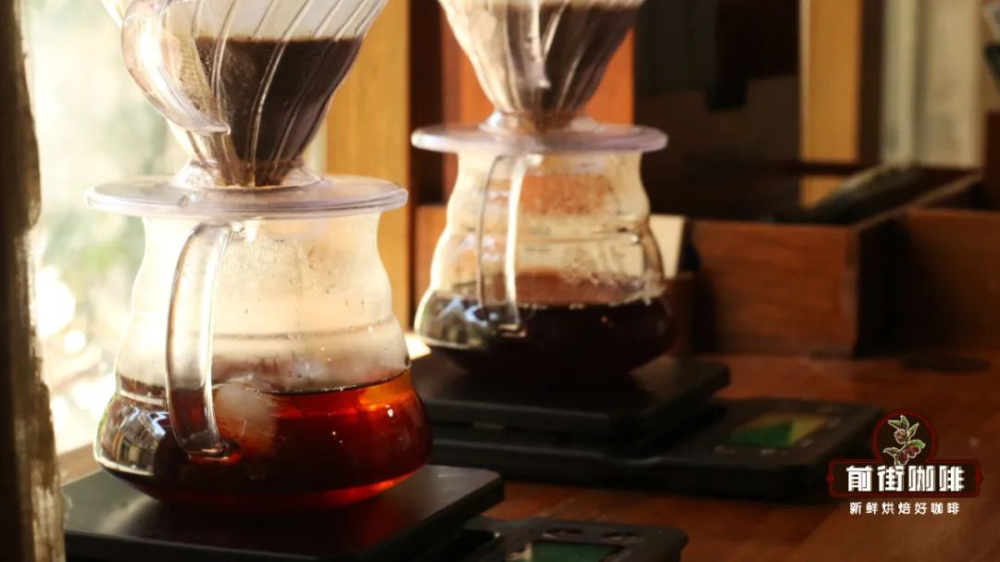
Generally speaking, when you get a coffee bean, you first determine its flavor characteristics through cupping, then build the hot pour-over brewing parameters based on that (usually combining roast level and processing method), and the iced pour-over preparation plan is gradually adjusted from the hot brew.
The most common iced brew method is: on the basis of hot brew, adjust to a finer grind, reduce the water amount, and appropriately adjust the technique, first making a high-concentration hot coffee, then rapidly cooling it with plenty of ice, while using the melting ice to reduce concentration, ultimately obtaining an iced drink with moderate concentration and sufficient flavor.
As Front Street shared at the start of summer, the "universal formula": iced pour-over = coffee grounds (fine grind) + 10 times hot water + 5 times ice. The ice here is split out from the total water amount of the original hot pour-over (1:15 coffee-to-water ratio), meaning the ice replaces a portion of the hot water that would have rinsed the coffee bed and is separated out on its own, thus not participating in the coffee extraction process.
With reduced water amount, the coffee's extraction range narrows accordingly, and substances concentrated in the mid-to-late stage may not have had time to release before the pouring is finished. These substances are precisely the main sources of sweetness, body, and aftertaste, so the final flavor performance naturally falls short compared to hot pour-over.
From the above comparison, it is clear that regardless of which group of coffee, hot pour-over is significantly stronger than iced brew in terms of aroma fullness, flavor complexity, layering, fruity sweetness, and solidity. And dark roast beans, which feature caramel-type aromas, body, balance, and sweet aftertaste, perform even more dimly in iced brew.
However, iced pour-over also has an irreplaceable advantage—adding a refreshing, icy mouthfeel on top of the original coffee flavor, which is exactly an important reason many people can't give up iced drinks. Imagine, on a hot afternoon, drinking a cup of icy, refreshing beverage that also carries rich aroma—how delightful that would be.
For this reason, we can use this characteristic of iced pour-over to select suitable coffee beans. For example, medium-light roast coffee is mainly floral and fruity, and when made into iced coffee it often leans light, so you can prioritize natural or fermented beans, which retain rich fruity aroma or sweet-tart layers while still maintaining a clean, light character.
The above content is compiled by CoffeeHunters, a coffee news website.


