








Why Does Honduran Specialty Coffee Keep Winning at the Cup of Excellence?
Honduras now ranks third in Latin America and fifth globally in coffee export volume, and the El Naranjo estate in the Marcala region has become one of the country's representative specialty coffee farms. Sitting at 1,800 meters, it grows Catuai and Geisha varieties, takes its name from the orange trees that shade it, and has collected multiple Cup of Excellence awards.
The country's rise was not immediate. Coffee arrived in Honduras around the late 18th century, and small-scale cultivation existed by the 19th century, but mountain ranges, weak roads and a lack of ports kept exports limited to the domestic market. Industrialization, new roads and ports, and later international cooperation and an official coffee institution drove the growth.
Honduras has performed remarkably on the international coffee stage in recent years, with its export volume now ranking third in Latin America and fifth globally. From early industrial lag to today's frequent emergence of specialty coffees, this Central American country has completed a remarkable transformation. Among them, El Naranjo estate, located in the Marcala region, has become one of the representative estates of Honduran specialty coffee thanks to its high altitude of 1,800 meters, careful cultivation of Catuai and Geisha varieties, and the strong track record of multiple Cup of Excellence (COE) awards. Front Street Coffee takes you on an in-depth look at this estate, named for the orange trees that provide its shade, exploring its flavor characteristics, management philosophy, and sustainable development practices.
Recently, the first Coffee Summit was held in Tegucigalpa, the capital of Honduras, building a bridge for communication among representatives of the 33 member states of the Community of Latin American and Caribbean States (CELAC), with the aim of promoting agricultural and family economic development and advancing regional progress as a whole.
During this summit, Honduran coffee became a focal topic. The quality of the country's coffee beans has shown a year-by-year upward trend globally, and its export scale ranks third in Latin America and fifth in the world. However, Honduran coffee has not always been widely recognized; in the early days, the development of its coffee industry lagged behind neighboring countries such as Guatemala and El Salvador.
Coffee was introduced to Honduras around the late 18th century, and by the 19th century there was already small-scale cultivation. However, due to factors such as numerous mountain ranges, weak transportation infrastructure, and a lack of ports, coffee exports faced many difficulties and were basically limited to domestic sales. It was not until the mid-20th century that Honduras began its industrialization process and started building roads and ports; after entering the 21st century, it actively sought international cooperation, joined the Central America Free Trade Agreement, and established partnerships with neighboring countries, which finally drove substantive development of the coffee industry.

At the same time, the government specially established an official coffee institution, Instituto Hondureño del Cafe (IHCAFE), aimed at improving coffee yield and quality. Honduras's terrain conditions are uniquely favorable, with mountains, lava plateaus, and river valleys interwoven, making it very suitable for the growth of coffee and other crops. By 2011, the country's coffee production had risen significantly and surpassed neighboring countries such as Costa Rica and Guatemala in one leap, making it the leading coffee-producing country in Central America.
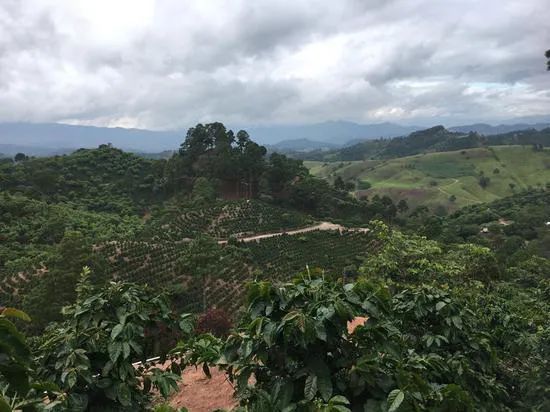
In recent years, while maintaining high production, Honduras has also shifted its focus toward quality improvement, during which many excellent estates have emerged, and El Naranjo is one of them. The estate is located in the Marcala region of La Paz Department in the Mentecillos production area, with obvious geographical advantages and abundant natural resources, mostly mountainous with river valleys and a mild, humid climate, suitable for both agriculture and tourism. The coffee produced here has rich fruit and sweet aromas, accompanied by notes of lemon and flowers. Lemon and fruit aromas are its signature flavors, especially the tonality of peach and orange, with lively and bright acidity, a velvety-smooth mouthfeel, and a long finish.
At present, El Naranjo is jointly managed by Roger Antonio Dominguez Marquez and his wife Carmen Fabiola Fiallos Melendez. Many tall orange trees are planted on the estate as shade trees, and the name El Naranjo comes from this. The estate owner Roger and his wife Carmen have long been committed to coffee production in the Marcala region, thereby enhancing the influence of the community.
Roger was born into a coffee family and has had a strong interest in coffee cultivation since childhood. After his father passed away, he took over the estate and ran it together with his wife Carmen. To this day, the couple also own several estates, including Las Flores, El Guatal, and La Cueva. Most of these estates are distributed in the 1,300-1,500 meter zone, among which El Naranjo has the highest altitude, reaching 1,800 meters, making it one of the highest-altitude estates in the country. At present, the estate mainly cultivates two varieties: Catuai and Geisha.
In addition, they are extremely rigorous about every stage of coffee production, implement strict quality standards, and continuously send samples to the IHCAFE laboratory to test coffee quality. Under the careful management of these estates, the high-quality coffee produced has won awards multiple times in Honduras's Cup of Excellence (COE) competition. At the same time, the estate has also consistently participated in the Origin Denomination program supported by IHCAFE, is committed to environmental protection and sustainable production, and actively promotes the local community and the international influence of Honduran coffee.
To learn more about coffee origins and related information, please scan the QR code to follow: Coffee Review
Long-press the QR code to follow:
The above content is compiled by CoffeeHunters, a coffee news website.


