







Does Instant Coffee Have Carcinogens in the Bromate Debate?
Nongfu Spring has sent a lawyer's letter demanding a written clarification and apology from the Hong Kong Consumer Council after the council's Choice magazine reported that its bottled water sample and one from Ganten contained 3 micrograms of bromate per liter, exactly the EU limit for natural mineral water. Ganten said it has engaged its legal department, and the China Beverage Industry Association said it would respond later.
The Consumer Council stressed that none of the 30 bottled waters tested exceeded WHO guidelines and that all samples are safe to drink; the report focused on value for money and plastic bottle impact. Bromate forms when ozone disinfects water containing bromide, and the WHO's IARC classifies it as a Group 2B possible carcinogen. This mirrors questions people ask about whether instant coffee has carcinogens.
Recently, the Hong Kong Consumer Council published a bottled water test report in its "Choice" monthly magazine, pointing out that bromate levels in samples of Nongfu Spring and Ganten reached the EU limit for natural mineral water, sparking widespread attention. Nongfu Spring immediately commissioned a lawyer to send a letter to the Consumer Council, demanding a written clarification, an apology, and the elimination of the impact; Ganten also stated that it had already engaged through its legal department, emphasizing that the product was at the critical value of the EU standard rather than exceeding it. The China Beverage Industry Association said it would respond to the matter later. The Consumer Council reiterated that none of the 30 samples were found to contain harmful substances exceeding WHO guidelines, and that the article focused on value for money and the environmental impact of plastic bottles, and that all samples are safe to drink.
▲
Click to follow | Daily specialty coffee culture magazine Coffee Workshop
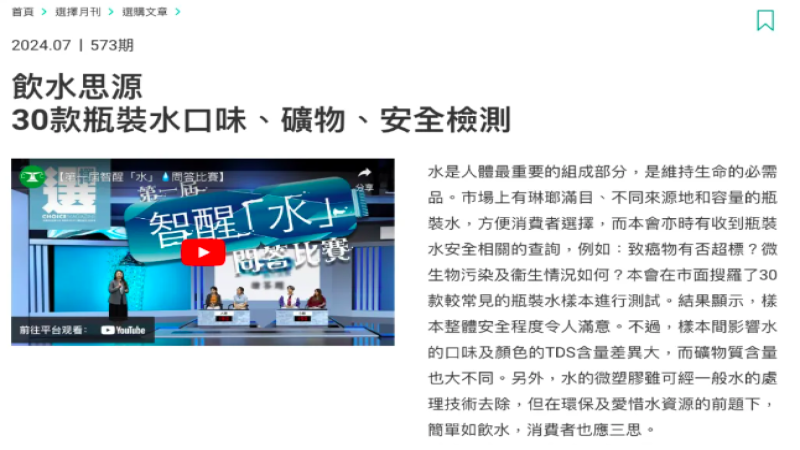
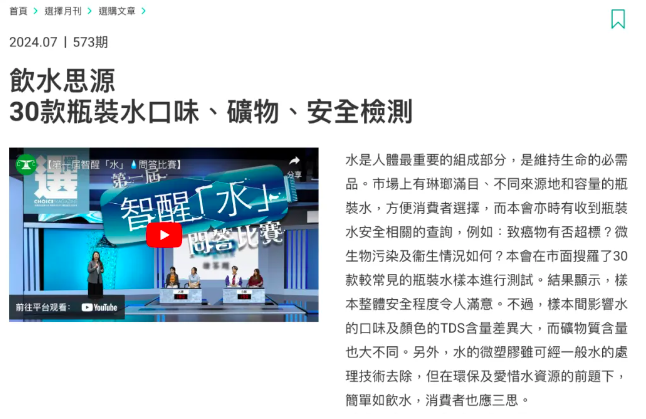
A while ago, the Hong Kong Consumer Council published an article titled "Think of the Source When Drinking Water: Taste, Mineral, and Safety Tests of 30 Bottled Waters" in the latest issue of its "Choice" monthly magazine. The article mentioned that the Consumer Council tested 30 common bottled water products on the Hong Kong market and classified and discussed the samples based on the test results.
In the natural mineral water testing section, samples of two brands, Nongfu Spring and Ganten, were found to contain 3 micrograms of bromate per liter of drinking water, a value that exactly reached the maximum bromate limit set by the European Union for natural mineral water and spring water treated with ozone.
It is understood that when ozone is used to disinfect and sterilize drinking water, naturally occurring bromide in the water is converted into bromate substances under the action of ozone. If a large amount of bromate is ingested, drinkers may experience symptoms such as nausea, abdominal pain, vomiting, and diarrhea, and in severe cases it may also affect the kidneys and nervous system. According to the classification by the World Health Organization's International Agency for Research on Cancer (IARC), bromate belongs to Group 2B carcinogens and carries a potential carcinogenic risk.
(Image source: Hong Kong Consumer Council)
In response to this test result, Nongfu Spring issued a statement this morning on multiple platforms, saying that it had commissioned a Hong Kong lawyer to submit a lawyer's letter to the Hong Kong Consumer Council. Nongfu Spring believes that after the Consumer Council article was published, it triggered panic among consumers in both Hong Kong and the mainland, bringing huge losses and negative impact to the company behind a product that is itself fully compliant and qualified, and therefore solemnly demanded: the Hong Kong Consumer Council should immediately issue a written clarification, make an apology, and eliminate all negative effects caused by the article.
The full text of the lawyer's letter is as follows:
Ganten, which was named by the Hong Kong Consumer Council, also made a public statement today, saying that it "has already engaged with the Hong Kong Consumer Council through its legal department." Yesterday, a person close to Ganten told Xiaoshidai: "The product is at the critical value of the EU standard; strictly speaking, it is not exceeding the standard. Ganten has contacted the Hong Kong Consumer Council to request a re-test."
The incident has also attracted attention from all sectors of society. The China Beverage Industry Association said it will later make a statement in response to the incident.
At present, a relevant person in charge of the Hong Kong Consumer Council told a reporter from Nandu Bay Finance and Economics that it has confirmed receipt of a letter from the lawyer representing one of the test samples, "Nongfu Spring," and is now studying and following up on it.
The Hong Kong Consumer Council reiterated that, whether in the monthly magazine article, press release, and other communication documents, or in statements at the press conference, it clearly pointed out that none of the 30 test samples were found to contain harmful substances exceeding the relevant WHO guideline values, and all samples are safe to drink. The focus of the article was the value for money of each sample and the impact of plastic bottles for bottled water on the environment, not product safety issues. The person in charge said, "If there is further information, the Consumer Council will announce it in due course."
Image source: Internet
Disclaimer: Some images in this article are from the Internet, and for some content on the website, such as images, we will respect the copyright of the original creators and indicate the source. However, due to the large volume, some images and texts may not have been credited in time. Please understand. If the original creator has any dispute, they may contact the website for handling. Once verified, we will correct it immediately. Compiled and edited by "Coffee Workshop." Please indicate the source when reposting. If there is infringement, please inform us for deletion. Thank you~!
The above content is compiled by CoffeeHunters, a coffee news website.


