







Why did coffee manner part-time layoffs hit workers so suddenly?
Manner Coffee drew attention after part-time workers reported abrupt dismissal notices, sometimes on their first day or within a few days, with vague reasons such as possible feedback from the store or monitoring inspectors. Workers said they arrived early and followed their duties without violations.
The brand had recruited heavily to ease staffing shortages after repeated employee-customer conflicts, adding part-time shifts across stores. When holiday students flooded in, shifts became oversubscribed and grabbing one grew much harder. Full-time staff point to lax recruitment screening as a root cause behind the barista coffee origin controversy.
Recently, Manner Coffee has drawn attention after part-time workers were abruptly dismissed. Many netizens reported on social media that they had not committed any violations during their part-time work, yet received dismissal notices on the same day or within a few days, with the brand giving vague reasons. At the same time, as large numbers of students flooded in for holiday part-time work, shifts became oversubscribed and grabbing one became dramatically harder. Some suggest that Manner had previously recruited heavily to ease staffing shortages, and now, with insufficient positions, chose to simply cut workers to reduce redundancy. Full-time employees pointed out that while some of those dismissed did lack food-service experience, the root cause was the brand's lax recruitment screening. Behind this part-time controversy lies the deeper tension facing chain coffee brands between cost-cutting and efficiency gains on one hand and workforce management on the other.
▲
Click to follow | Daily specialty coffee culture magazine Coffee Workshop
Recently, many netizens have posted on social media saying they were suddenly dismissed while working part-time at Manner.
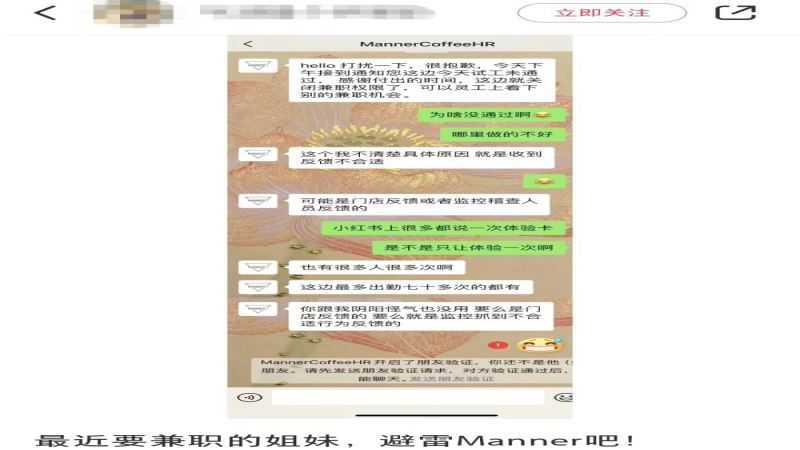
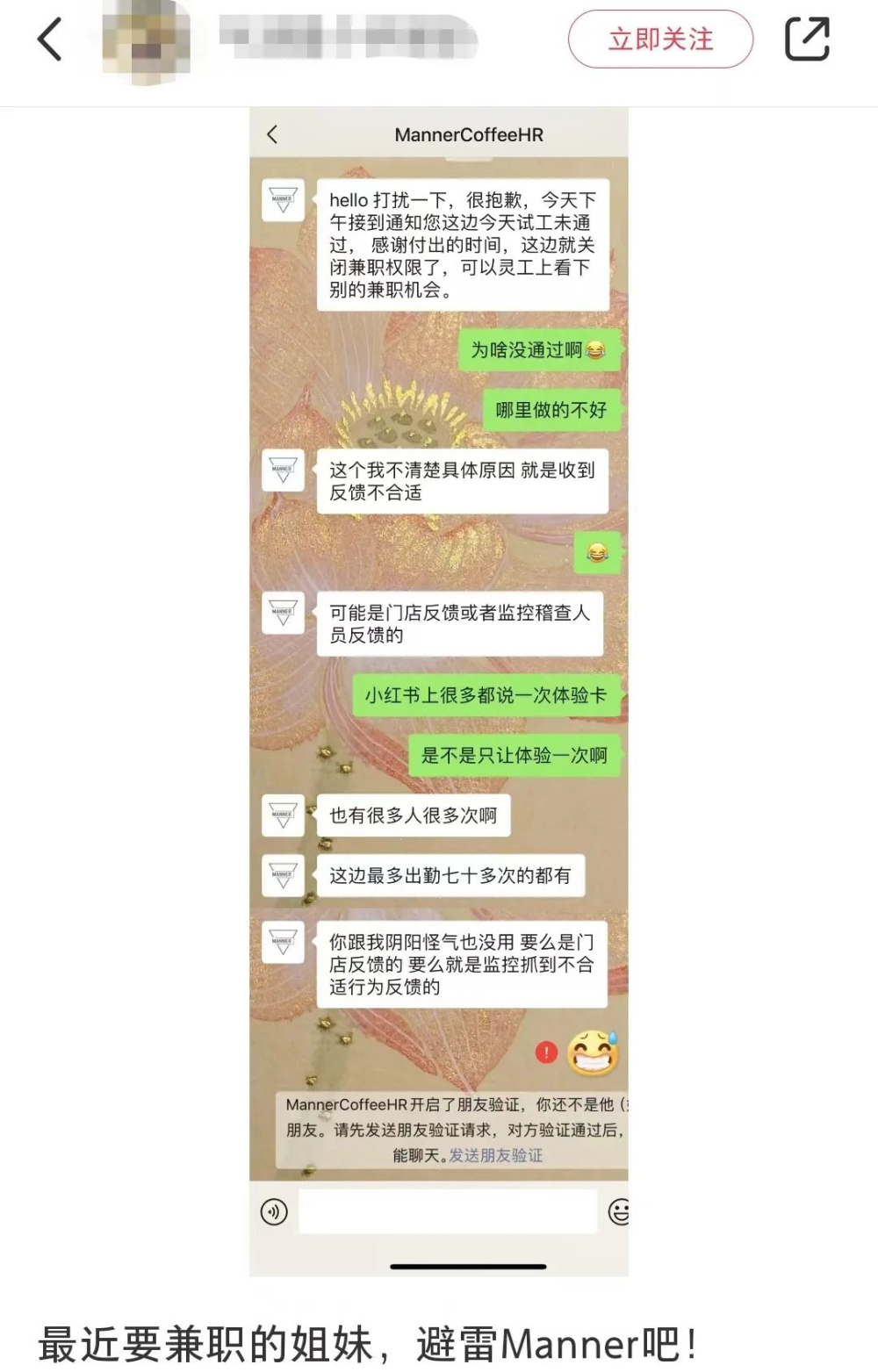
These posters mentioned that they arrived at the store early that day, packing what needed to be packed and cleaning what needed to be cleaned during their shift, not daring to slack off for a moment, and believed they had not violated any rules. Yet that afternoon they received a notice saying they were unsuitable. When they pressed for the specific reason for dismissal, the staff's answer was very vague, saying only that it "might be feedback from the store or from monitoring inspectors."
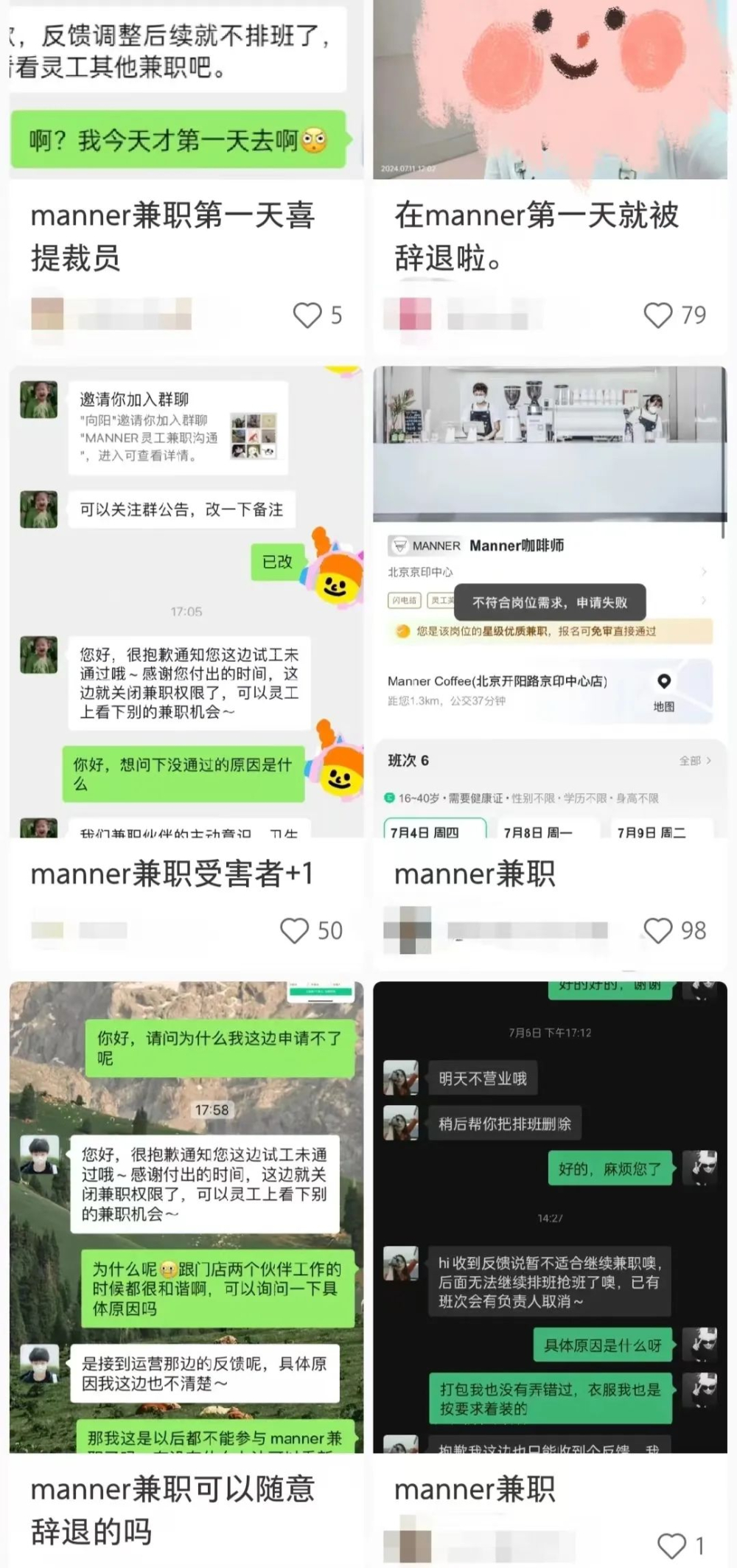
Part-time workers with similar experiences are not uncommon. Some had worked part-time at multiple stores for three or four days, while others received a dismissal notice right after their first day's shift. Whenever they asked why, the staff's replies were vague and they never gave a clear explanation.
After three consecutive conflicts between employees and customers, the brand, in order to address the manpower shortage, recruited a large number of part-time workers on recruitment platforms and increased part-time shifts at each store, thereby sharing the workload of full-time employees and giving them more rest time.
At the same time, as the holidays arrived, many students looking for part-time work poured in, and the large influx of new people gradually turned what had been ample shifts into something "in short supply." According to long-term part-time workers, grabbing shifts has now become dramatically harder, the mini-program often crashes, and if you're even slightly slow you get nothing, with many saying outright that they have no shifts to work.
Therefore, some speculate that perhaps Manner recruited too many part-time workers and could not provide enough positions, so to reduce redundancy it adopted dismissal as a direct way to solve the problem.
But full-time employees believe that some of the dismissed part-time workers may indeed have been unsuited to Manner's positions. They said that although Manner's part-time work does not include making drinks, there are many trivial tasks behind the bar, and it is not easy for someone with no food-service experience to get up to speed in a short time.
Yet employees reported that recently the brand seemed not to screen strictly during recruitment, and many people without relevant work experience were able to join the part-time team, competing for shifts alongside others and being randomly assigned to work at a certain store.
So full-time staff joke that starting work every morning feels like opening a blind box: if you get a quick and experienced part-timer, the day's work may be a bit easier; but if you get a complete novice, you may end up rushing and stressing while making orders and teaching someone at the same time, with pressure doubling.
They therefore suggested that rather than using part-timers who can't help much to fill the manpower gap, the brand should hire more full-time employees with barista experience to solve the problem at its root.
However, after making this suggestion, most Manner staff believed the brand would not listen. For the brand, widely handing out part-time trial cards on recruitment platforms is more economical than taking the trouble to train qualified full-time employees, and it also better fits management's goal of cutting costs and increasing efficiency.
Image source: Xiaohongshu
Disclaimer: Some images in this article are from the internet, and for some website content such as images, we will respect the original author's copyright and indicate the source. However, due to the large volume, a few images and texts may not have been credited in time; please forgive us. If the original author has any dispute, they may contact the website for handling, and once verified we will correct it immediately. Compiled and edited by "Coffee Workshop"; please indicate the source when reposting. If there is infringement, please inform us for deletion. Thank you~!
The above content is compiled by CoffeeHunters, a coffee news website.


