







Why Are Robusta Coffee Beans Driving Prices Higher?
Italian coffee giant Lavazza has warned that climate change, transport disruptions and upcoming EU regulations are pushing up roaster costs, so retail coffee prices will keep climbing. London robusta futures reached a record high of $4,844 per ton, up about 70 percent over the past year. Instant coffee prices in UK supermarkets have already risen around 15 percent this year.
Chairman Giuseppe Lavazza said instant coffee may rise nearly another 10 percent next year and prices will stay very high rather than fall. Robusta coffee beans, widely used at lower cost in espresso and instant coffee, are behind much of the shock: poor harvests in Southeast Asia and forecasts that Vietnam's next crop cannot replenish supplies have tightened the market, pressuring every coffee roaster along the chain.
The global coffee market is facing an unprecedented price storm. Italian coffee giant Lavazza recently issued a warning that climate change, transportation disruptions, and upcoming EU regulations are together driving up roasters' operating costs, and coffee prices will continue to climb. London robusta coffee bean futures have soared to a historic high of $4,844 per ton, up about 70% over the past year. Lavazza Chairman Giuseppe Lavazza pointed out that retail prices for instant coffee have already risen about 15% this year and may rise nearly another 10% next year. This wave of price increases, driven jointly by supply shortages, an influx of speculative capital, and rising shipping costs, is putting heavy pressure on the entire coffee industry chain.
▲
Click to follow | Daily specialty coffee culture magazine Coffee Workshop
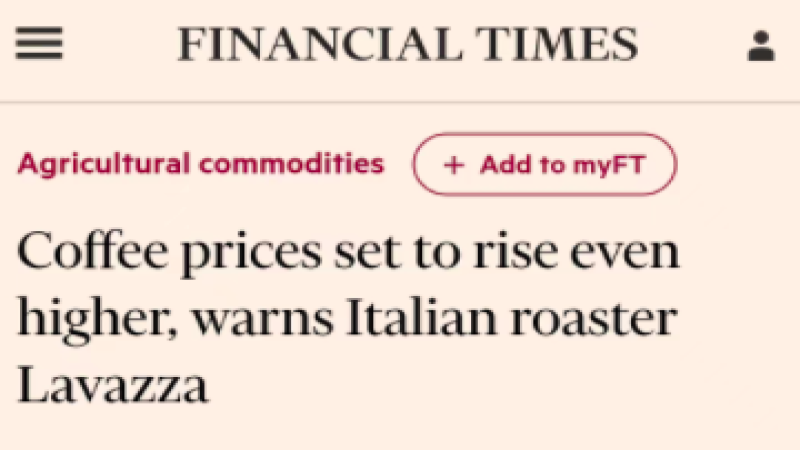
According to a Financial Times report on the 9th, Italian coffee giant Lavazza warned that coffee prices will rise further because climate change, transportation disruptions, and new EU regulations have pushed up roasters' costs.
On the day of the report, global benchmark London robusta futures reached a high of $4,844 per ton. Due to poor harvests in major coffee-growing Southeast Asian countries, the price has soared about 70% over the past year.
Robusta coffee beans are widely used at relatively low prices in the production of espresso, instant coffee, and more. Because of the sharp price increase, coffee-related companies are facing pressure on profits due to higher costs. Lavazza Group Chairman Giuseppe Lavazza pointed out that the price of instant coffee on UK supermarket shelves has already risen about 15% this year, and "may rise nearly another 10% next year."
He said coffee prices will not fall, but will remain at very high levels, and the coffee supply chain is therefore under tremendous pressure. In fact, as raw material costs soar, coffee roasters such as Lavazza are forced to raise prices and accept lower profit margins.
Moreover, Giuseppe believes the industry has grown used to dealing with price fluctuations in high-end arabica coffee beans, but the recent surge in the price of cheap robusta coffee is unprecedented, bringing a major shock and impact to the coffee industry and creating more problems as well.
The report noted that, according to weather forecasts, Vietnam's next harvest will be unable to replenish the dwindling supply of robusta coffee beans. Giuseppe also pointed out that climate change has mainly affected Vietnam and Indonesia, among the world's most important robusta coffee bean producing countries, greatly reducing the supply of robusta coffee beans.
"Rare things are precious." Reduced coffee bean supply has driven up raw material prices, and hedge funds and other speculators have also seized the opportunity to flood into the market, which in Giuseppe's view further pushed up futures prices.
In addition, rising freight costs are also a factor driving the price surge. Since last October, in order to avoid attacks by Yemen's Houthi armed forces in the Red Sea, ships transporting coffee beans have been forced to detour. For a company that purchases coffee beans from countries in Asia and East Africa, more circuitous shipping routes undoubtedly mean higher shipping costs.
Besides the above two reasons, Giuseppe also believes that the EU's Regulation on Deforestation-Free Products, which takes effect next year, will also drive up coffee prices across the board. The regulation explicitly prohibits the import of coffee and six other commodities grown on deforested land, and will also require food companies operating in the EU to precisely identify the plots where their goods are produced.
Giuseppe said only 20% of producers in the coffee industry comply with the new rules, and constrained by the regulation's content, European coffee roasters may be forced to buy all their coffee beans from Brazil, the only country that meets the requirements. He said that if the content of the EU's new rules is not revised, once the current provisions take effect, about 8 million coffee farmers will lose the opportunity to sell coffee.
Image source: Internet
Disclaimer: Some images in this article are from the Internet. For some content on the website, such as images, we will respect the original author's copyright and indicate the source. However, due to the large quantity, some images and texts may not have been credited in time. Please forgive us. If the original author has any dispute, they may contact the website for handling. Once verified, we will correct it immediately. Compiled and edited by "Coffee Workshop." Please indicate the source when reprinting. If there is infringement, please inform us for deletion. Thank you~!
The above content is compiled by CoffeeHunters, a coffee news website.


