







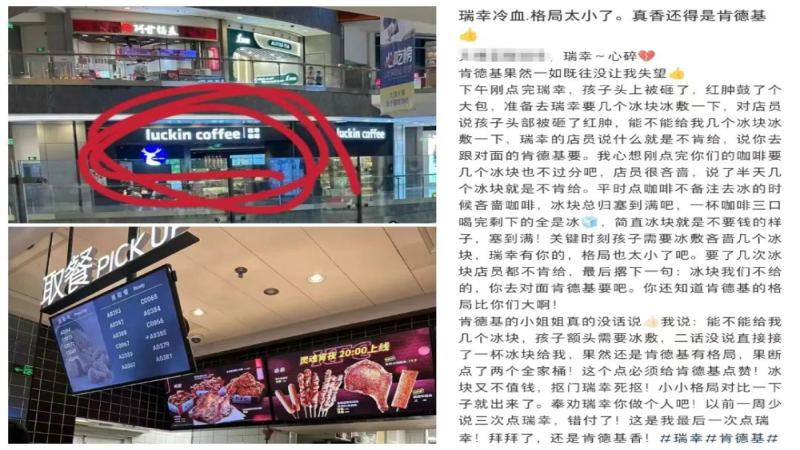
Why did a Luckin coffee store refuse to hand out ice cubes?
A post described a Luckin Coffee store declining to give a customer ice cubes for a cold compress on her child's swollen head injury. Staff politely refused, citing company rules, and suggested the KFC across the street, which did provide ice. The incident sparked online discussion about food safety rules and emergency needs.
Employees said the no-separate-ice rule follows an earlier case where someone sent store ice for testing, leading to a financial dispute. Since then, bar area surveillance has monitored in real time, and staff who break the rule may lose bonus pay, leaving little room for a coffee store to make exceptions on the spot.
Recently, a post about a Luckin Coffee store refusing to provide ice cubes to a customer for her child's cold compress to reduce swelling sparked widespread discussion online. The customer urgently needed ice for her child's head injury, but was politely declined by the staff citing company regulations, who suggested she go to the KFC across the street for help. Behind this incident lies the dilemma that chain beverage brands face between food safety control and customers' emergency needs. Luckin employees revealed that the rule against providing ice cubes separately stems from a previous incident where someone sent store ice for testing, leading to a financial dispute. Since then, bar area surveillance has been monitoring in real time, and violators may face bonus deductions. However, when facing a customer's special emergency, should there be flexibility? Front Street Coffee takes you into an in-depth discussion of this topic.
▲
Click to follow | Daily specialty coffee culture magazine Coffee Workshop
Yesterday, a post about "Luckin not providing ice cubes" sparked a heated discussion on social media.
The poster described how her child had suffered a swollen bump on the head from being hit, and she happened to have just ordered a coffee at a Luckin store, so she asked the staff if they could give her a few ice cubes for a cold compress to reduce the swelling. To her surprise, despite explaining the reason repeatedly, the staff still refused to provide ice cubes, and even threw out the remark, "We don't give out ice cubes, go ask the KFC across the street."
In the end, the blogger successfully got a cup of ice cubes from KFC to treat her child's injury, but this rather bumpy "ice-begging" experience left her quite dissatisfied. In her view, when a customer has an emergency and needs ice cubes, the staff could completely make an exception and lend a helping hand. However, the other party completely ignored the customer's actual situation and bluntly refused the request, which undoubtedly greatly diminished Luckin's image in her mind.
In fact, it is nothing new for Luckin employees not to provide ice cubes separately to customers, and complaints from consumers about "being refused when asking for ice" are not hard to find on major social media platforms. And whenever such content appears, Luckin employees will proactively explain to netizens that the rigid rule of "not giving ice cubes" has been in place for quite a long time.
According to the employees, someone earlier had asked a store for ice cubes and sent them to a testing agency for inspection, which subsequently triggered a financial dispute involving food safety and dealt a considerable blow to the brand's reputation and long-term development. Since then, Luckin has established relevant rules explicitly prohibiting employees from directly providing ice cubes to consumers, and surveillance has also been installed in the bar area for real-time monitoring. Once someone is found violating the rule by handing a whole cup of ice cubes to a customer, the employee involved may face a deduction of bonuses.
Besides Luckin, chain brands such as Starbucks, Cotti, and McDonald's also have similar rules of "not providing ice cubes to consumers." Even operators of some independent beverage shops say that in order to avoid getting involved in food safety disputes, they too will politely decline customers' requests for ice cubes.
However, regarding the situation described by the blogger, many netizens believe it is fundamentally different from the situation employees worry about. This consumer was eager to use ice cubes to reduce her child's swelling, which is a special emergency. If the staff were willing to provide ice cubes, it would be like timely help to the customer, not only winning word-of-mouth for the store, but perhaps even turning this customer into a loyal fan—a good deed that could be described as killing several birds with one stone.
After all, "rules are dead, but people are alive." Employees can absolutely handle things flexibly according to the urgency of the matter, rather than rigidly enforcing the company's cold clauses and refusing customers again and again, which not only provokes customers' resentment but also makes the brand appear unfeeling.
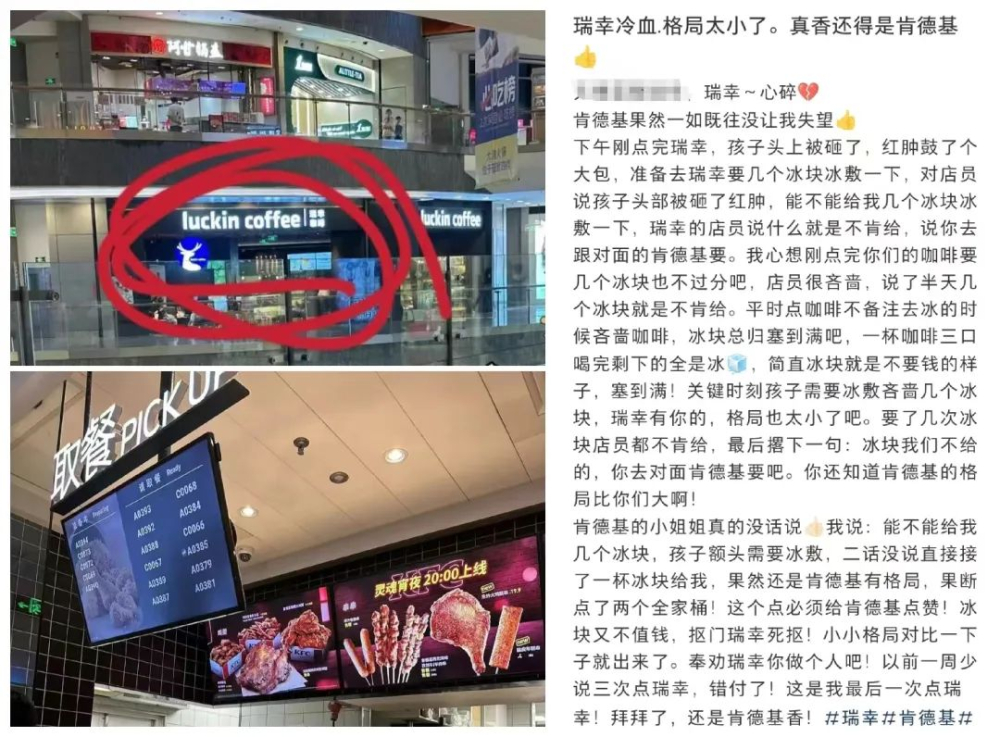
In response, some employees said there is actually a compromise. Ice cubes are a semi-finished product, and according to standards, semi-finished products are not within the scope of sellable products. But if drinking water is added to a cup of ice cubes, the ice-water mixture becomes a finished product that can be served. In this way, it neither violates store rules nor fails to meet the customer's needs.
However, this flexible approach is not allowed in every store, so the employee gave another suggestion that would neither get them fined nor fail to help the customer solve the problem—"go ask the KFC across the street."
Image source: Internet
Disclaimer: Some images in this article are from the Internet. For some content on the website, such as images, we will respect the original author's copyright and indicate the source. However, due to the large quantity, there may be individual images or texts that have not yet been credited in time. Please understand. If the original author has any dispute, they may contact the website for handling. Once verified, we will correct it immediately. Compiled and edited by "Coffee Workshop." Please indicate the source when reposting. If there is any infringement, please inform us for deletion. Thank you~!
The above content is compiled by CoffeeHunters, a coffee news website.


