







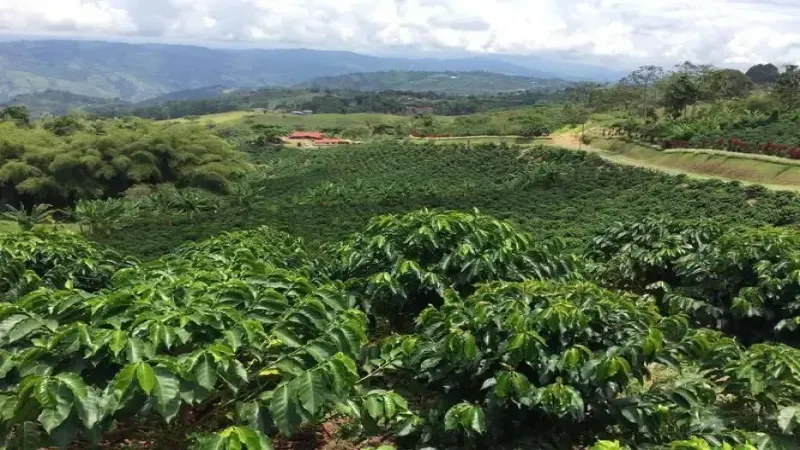
What makes Colombia's coffee producing regions so distinct?
Colombia ranks third in global coffee output after Brazil and Vietnam, and its flavor range comes from the Andes. Santander Department is a quieter origin but marks the starting point of the country's coffee history. Hacienda Casa Blanca there began large-scale planting in 1860, and owner Liliana Caballero Rojas and her family have driven its specialty transformation since 2006, winning the Colombian Yara Championship in 2016.
How is coffee grown in this setting? Three Cordillera ranges run north-south, and cultivation sits in high-altitude zones where temperatures hold near 18°C year-round, with volcanic soils and 2,000 to 3,000 millimeters of annual rainfall. Eastern plains and the Pacific coast see tropical rainforest conditions, while the mountains at 1,000 to 2,000 meters fall into a subtropical band, giving coffee producing regions across the country clearly different cup profiles.
Colombia, as an important member of the coffee landscape in South America, gives birth to diverse coffee flavors thanks to the unique conditions of the Andes Mountains. Among the country's many producing regions, Santander Department is low-key but richly endowed, and is the starting point of Colombia's coffee-growing history. Hacienda Casa Blanca, located here, began with large-scale planting in 1860, has been driven toward specialty transformation by current owner Liliana Caballero Rojas and her family since 2006, and won the Colombian Yara Championship in 2016. This article will take you deep into the terroir characteristics of this producing region and the varietal charm of the estate.
Coffee cultivation is spread across many countries on every continent, and in South America there are likewise many countries involved in the coffee industry, with Ecuador, Peru, and Colombia among the representatives. Colombian coffee enjoys an extremely high reputation in the international market, and its output ranks third globally, after Brazil and Vietnam.
Colombia
Colombia is located in the northwest of South America, with both marine and land advantages, bordering the Pacific Ocean to the west and the Caribbean Sea to the north. The country's terrain can be broadly divided into mountainous areas in the west and plains in the east; the west is dominated by the Andes mountain region, while the east includes the Orinoco Plains and the Amazon Plains.
Because it lies in the tropics, Colombia's climate varies with terrain: the eastern plains and the Pacific coast have a tropical rainforest climate, the mountains at elevations of 1,000 to 2,000 meters belong to a subtropical climate, and the northwest has a tropical savanna climate. In the Andes region, three Cordillera mountain ranges run north-south across the entire country, and coffee cultivation is mainly distributed in the high-altitude zones of these ranges. There, temperatures remain stable at around 18°C throughout the year, volcanic and forest resources are abundant, and annual rainfall reaches 2,000 to 3,000 millimeters, creating superior natural conditions for coffee growth.
Coffee Producing Regions
Colombia is vast, with many coffee-growing areas. Influenced by mountainous terrain and microclimate differences, coffee from different regions shows rich variations in flavor.
Colombia's main coffee origins include Cauca, Santander, Narino, Tolima, and Huila, among others. The country has two harvest seasons a year, with the main season concentrated from October to January of the following year, and the secondary season from April to July.
Santander Producing Region (Santander): This producing region is located in northern Colombia, nestled in the Andes Mountains, with a cultivation altitude of about 1,400 to 1,700 meters. Santander Department holds an important position in coffee cultivation but is rarely mentioned; in fact, this is the province where coffee was first grown in Colombia, and its coffee output currently accounts for about 5% of the national total. It is worth noting that the coffee varieties grown in this producing region are mostly leaf-rust-resistant varieties, which also makes Santander a low-incidence area for leaf rust in Colombia and even globally.
Hacienda Casa Blanca
Hacienda Casa Blanca is located in the Santander producing region at an altitude of 1,500 meters and is a sizable estate. The estate's coffee-growing history can be traced back to 1860, but in the early period it was dominated by mass-production varieties. Since 2006, current owner Liliana Caballero Rojas and her family have begun promoting the estate's transformation toward specialty coffee, and in 2016 it won the Colombian Yara Championship.
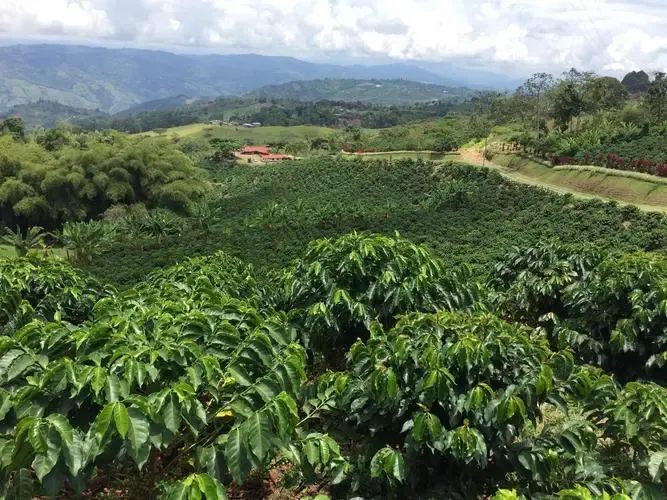
Hacienda Casa Blanca has a total area of 30 hectares, of which 10 hectares of natural primary forest are preserved. The estate also has natural streams and waterfalls, and producers can use the fresh water from the streams for coffee bean processing. At present, the coffee varieties grown on the estate include Geisha, Castillo, Pink Bourbon, and Wush Wush, among others.
The above content is compiled by CoffeeHunters, a coffee news website.


