








How do the 7 steps to make coffee work in the one-pour tornado pour-over method?
The one-pour tornado method splits the target water volume into two back-to-back stages: a blooming pour to release carbon dioxide, then a main extraction pour with no pause between them. Fast circular pouring plus a large steady stream at a fixed point spins the coffee bed into a vortex, which raises extraction efficiency and gives the cup a fuller body than a standard one-pour brew.
The trade-off is control. This technique demands precise flow rate and parameter coordination, and medium to dark roasted beans suit it better than very light profiles because of how quickly extraction advances. The steps can be grouped into the same 7 steps to make coffee used in any pour-over routine, but the second half runs faster and leaves less room to correct a mistake.
In the exploration of pour-over coffee, enthusiasts always manage to create eye-catching new brewing methods. Today, Front Street Coffee is going to try the "One-Pour Tornado Brewing," an aggressive technique that combines the traditional one-pour method with whirlwind-style pouring. It divides the target water volume into two stages: blooming and main extraction, with no pause in between, and then creates a vortex through rapid circular pouring and a large steady stream at a fixed point, resulting in higher extraction efficiency and a fuller body. However, this method demands extremely high flow control skills and parameter coordination, and not all beans are suitable for it. This article will break down the operational steps of the One-Pour Tornado, parameter adjustments, comparisons with the regular one-pour method, and recommendations for suitable bean types, giving you a comprehensive understanding of this brewing style that is both visually appealing and challenging.

However, in the circle of coffee enthusiasts, we often see many creative brewing methods. These methods not only boldly adopt tricky numerical settings but also place extra emphasis on operational skill. For example, the "One-Pour Tornado Brewing" that Front Street Coffee plans to try today—just the name alone makes it clear that this is no ordinary technique.
What is the "One-Pour Tornado"?
First, everyone should be familiar with the concept of "one-pour." Simply put, it means dividing the total water volume into two consecutive pours: the first stage for blooming, and the second stage for the main extraction. Since there is no pause between the two stages, the resulting coffee often presents a light mouthfeel, bright acidity, and a clean finish.
Literally, "One-Pour Tornado" means incorporating the "tornado technique" into the regular one-pour method, and it sounds like a rather "fierce" brewing approach. So the question arises—we often hear about tornadoes in the news, but how exactly does the "tornado" in pour-over coffee "spin"?
How do you do the tornado technique?
After combining brewing plans shared by multiple enthusiasts, Front Street Coffee has concluded that the "One-Pour Tornado" in mainstream understanding typically consists of three stages: the blooming phase for releasing carbon dioxide, the rapid circular water distribution phase, and the fixed-point large-stream phase for creating a "vortex."
Considering that the one-pour method, after blooming, relies on only one stage of hot water to wash through the coffee bed, resulting in a shorter duration compared to staged extraction, and that the whirlwind technique brings strong disturbance to the continuously rising water level, it is prone to under-extraction. Therefore, in terms of parameter settings, it is necessary to grind finer and increase the water temperature.
Without further delay, Front Street Coffee will now bring out the recently favored Ethiopian Natural Sidamo G1 coffee beans to replicate this. For easy comparison, a second pot will also be brewed using regular parameters and the standard one-pour method for tasting.
Regular One-Pour Group
Coffee beans: Ethiopian Natural Sidamo G1 Dose: 16 grams Coffee-to-water ratio: 1:15 Water temperature: 91°C Grind size: 80% passing through No. 20 sieve (EK43s setting at 10) Dripper: Hario plastic V60
Brewing method: One-pour
Procedure: First, pour 30–35 grams of hot water in a circular motion from the center outward with a slow stream for blooming, ensuring the entire coffee bed is saturated and entering the degassing state. After 30 seconds, begin the second pour, mimicking a mosquito coil pattern by steadily pouring the remaining hot water in an outward circular motion. Once all the coffee liquid has dripped into the server, the extraction is complete. Total time is approximately 1 minute 46 seconds.
One-Pour Tornado Group
Coffee beans: Ethiopian Natural Sidamo G1 Dose: 16 grams Coffee-to-water ratio: 1:15 Water temperature: 94°C Grind size: 85% passing through No. 20 sieve (EK43s setting at 7) Dripper: Hario plastic V60
Brewing method: One-Pour Tornado
Procedure: The first stage of blooming is the same as the regular one-pour method, using 30–35 grams of hot water for a 30-second bloom. Next, also pour the second stage in a circular motion from the center outward, but note that the stream should be raised appropriately, and the circular pouring speed should be faster than during the bloom to increase the agitation of the coffee bed.
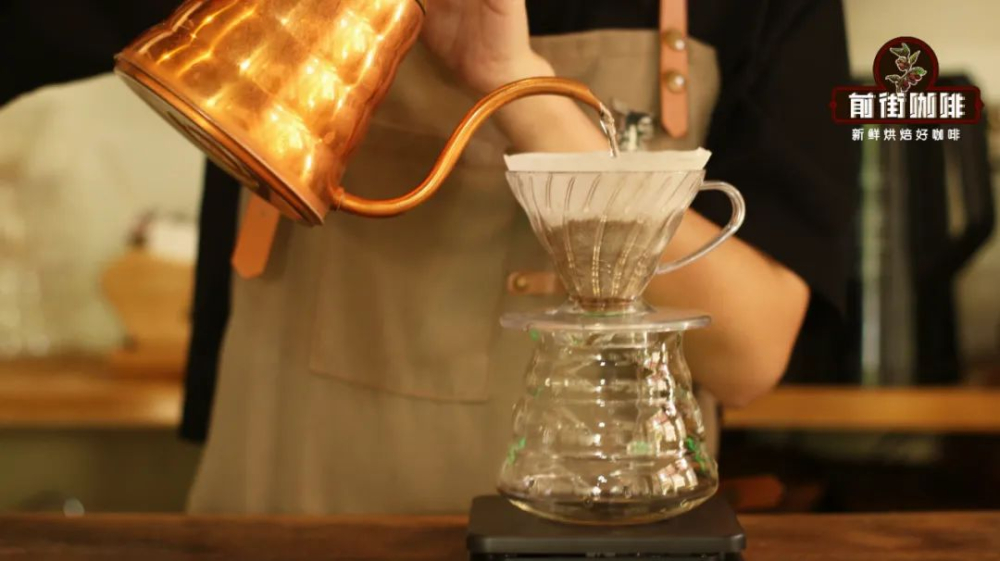
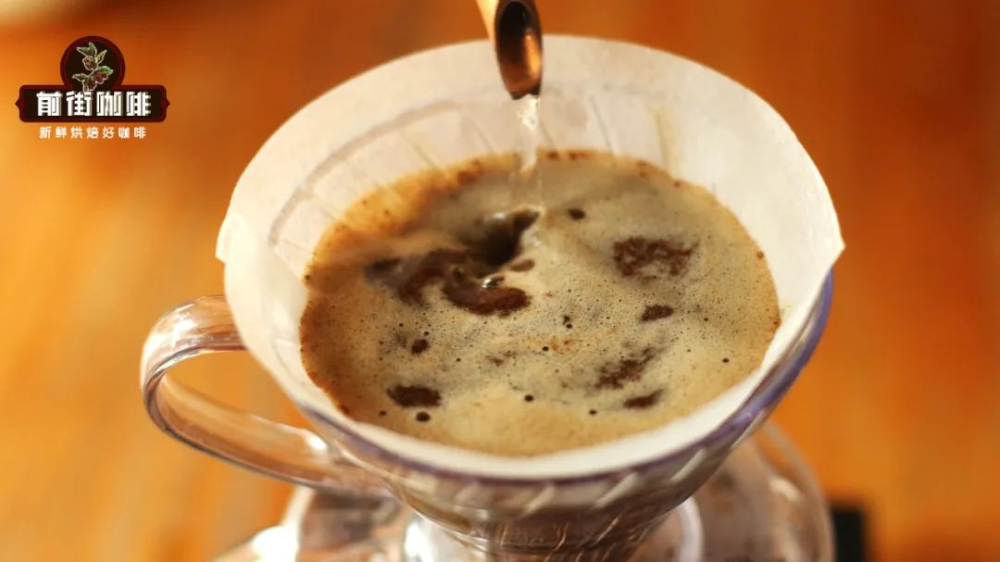
When the liquid level in the dripper reaches about 40–50% full, at around 40–45 seconds, begin moving the pouring point to one side of the dripper while lowering the spout as close to the liquid surface as possible, maintaining a large steady stream at a fixed point in one direction. At this point, you can see the foam on top rotating as the hot water drives the coffee particles into motion.
Once the scale shows 240 grams, stop pouring immediately, and finally wait for all the coffee liquid to drip into the server. The entire process should be controlled within 1 minute 20–30 seconds.
When Front Street Coffee places the drippers from both pots side by side for comparison, it is clearly visible that the coffee bed from the One-Pour Tornado is deeper, with the coffee wall shaved thinner, almost level with the edge of the dripper. Even though the coffee was ground very fine, there was no clogging during the entire pouring process. Of course, the most important thing is the flavor performance.
The natural Sidamo from the regular one-pour group exhibited aromas of mango, lemon, grape, and green tea, with bright acidity and a refreshing mouthfeel but relatively thin flavors. In contrast, the Sidamo from the One-Pour Tornado group had additional fermentation aromas, dominated by flavors of dried fruit, peach, cherry, guava, and blueberry, with a slight tea-like quality and the fresh fragrance of citrus fruits on the entry, higher body, and a thicker texture.
What happens when you brew other coffee beans with the "One-Pour Tornado"?
To gather more comparative data, Front Street Coffee tried the same method two more times, brewing a pot of medium-light roasted Tanzania Washed Kilimanjaro and a pot of dark roasted Indonesian Lintong Mandheling (paired with a Kono dripper), but the final results were somewhat disappointing.
The Tanzania brewed with the One-Pour Tornado was dominated by citrus-like fruit acidity, with a thin aroma, a single-layered profile, and a slight woody note in the finish, suggesting that the coffee experienced partial over-extraction and partial under-extraction. The Mandheling, on the other hand, under high water temperature and fine grind, exhibited a heavy smoky character and lacked many positive aromas.
It can be seen that compared to the regular one-pour method, the parameters paired with this whirlwind-style washing technique are relatively extreme, and the later stage involves large-amplitude rotation and tumbling, causing the coffee to release undesirable flavors. Therefore, when using this method to brew coffee, Front Street Coffee recommends choosing balanced types as extraction targets, such as some medium-roast beans.
How do you create a "tornado"?
Looking at the steps above, the most difficult part is undoubtedly the final "vortex creation" stage. In principle, it is about using the size, angle, and height of the water stream to make the hot water in the dripper drive the coffee particles into high-speed motion, spinning in a "vortex" pattern.
Therefore, we not only need to constantly observe the direction of coffee particle movement but also make timely adjustments based on changes in the water level inside the dripper. After multiple attempts, Front Street Coffee believes that maintaining three details can quickly create a "tornado": keep the spout as close to the liquid surface as possible, aim the pour toward the edge of the dripper, and increase the stream size.
When brewing coffee with the One-Pour Tornado, it indeed provides better visual appeal and makes it easier to form an even, deep coffee bed. However, precisely because the technique is so "tricky," achieving even extraction in the coffee bed requires higher demands on the brewer's flow control ability and circular pouring technique. Without a certain level of brewing experience, it is truly not easy to imitate.
- END -
The above content is compiled by CoffeeHunters, a coffee news website.


