







Where Are Sidamo Coffee Beans Grown and How Do They Taste?
Sidamo is one of Ethiopia's leading coffee regions, and beans grown in its sub-regions Arbegona and Bensa have gained attention in recent years. Rumudamo in Arbegona stood out at Ethiopia's first COE competition in 2020, and the Hamasho processing station in Bensa also scored well there.
Ethiopia is Africa's largest arabica coffee producer, and its high plateaus, rainfall and fertile soil suit coffee cultivation. Front Street Coffee cupped both lots: Rumudamo showed lime aroma with citrus and apple, while Hamasho carried floral, berry and grape juice notes.
African coffee enjoys a stellar reputation in the global market, and Ethiopia, as the recognized birthplace of coffee, is not only Africa's largest Arabica producer but also boasts a long history of cultivation. The country is predominantly mountainous plateaus, where high altitudes, abundant rainfall, and fertile soil provide an ideal environment for coffee. Sidamo is one of its most prominent regions, and in recent years its sub-regions such as Rumudamo in Arbegona and Hamasho in Bensa have gradually come into the public eye. Rumudamo made its name at Ethiopia's first COE competition in 2020, and the Hamasho processing station also performed impressively in the COE. Front Street Coffee has purchased both of these beans and completed cupping: Rumudamo presents lime aroma with citrus and apple flavors, while Hamasho carries floral, berry, and grape juice notes. This article will provide a detailed introduction to the background, company information, and coffee flavors of these two sub-regions.
African coffee enjoys very high recognition in the global coffee market, and among African countries, Ethiopia is the recognized birthplace of coffee. Moreover, Ethiopia is Africa's largest Arabica coffee producer and has a long coffee history.
Ethiopia is located in northeastern Africa and is a landlocked country with a land area of 1.1036 million square kilometers. Ethiopia is predominantly mountainous plateaus, most of which belongs to the Ethiopian Plateau, accounting for two-thirds of the country. The East African Rift Valley runs through the entire territory, with an average altitude of nearly 3,000 meters. Such high altitude gives Ethiopia an average annual temperature of 16°C. The country is vast in territory and rich in natural resources, with abundant water resources, high-altitude mountainous areas, and more than 50 volcanoes. These resources make the country an ideal region for coffee cultivation.
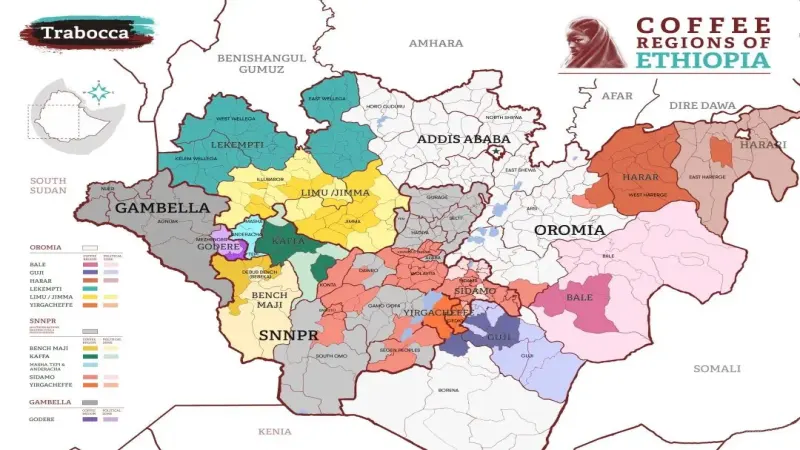
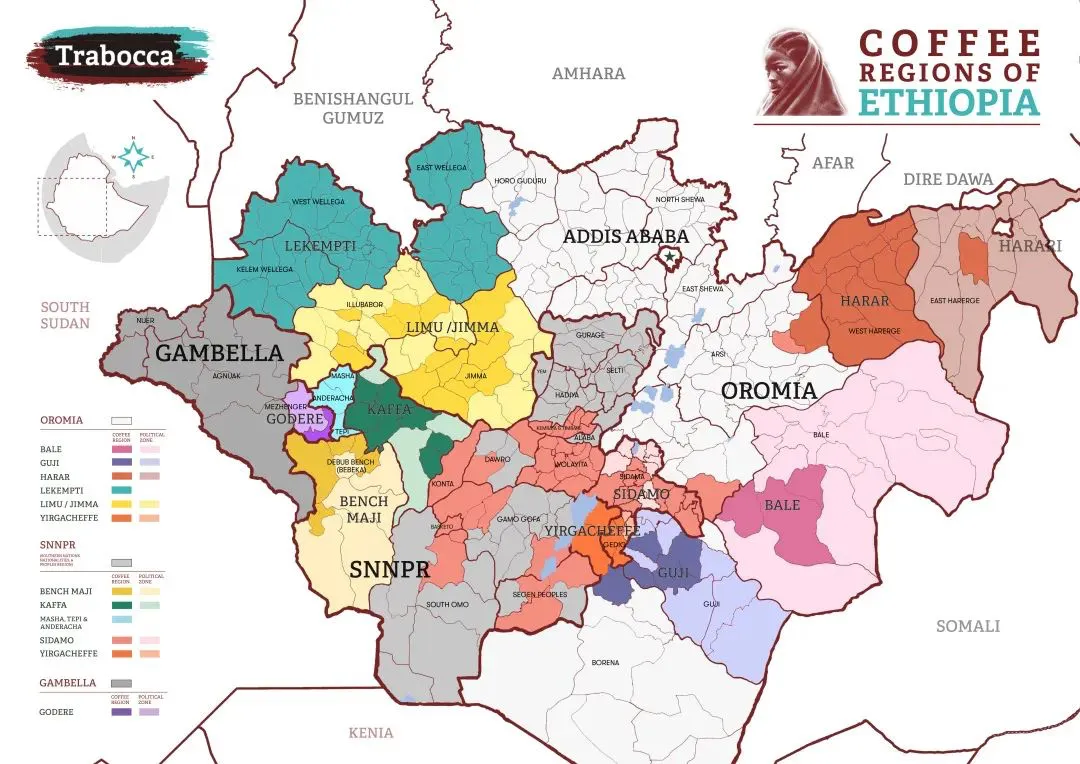
Ethiopia has multiple coffee regions, namely Sidamo, Harrar, Kaffa, Limmu, Lekempti, Tepi, Bebeka, and Bale. Now, with the development of specialty coffee, people's demand for traceability of coffee beans has increased. Therefore, coffee beans in Ethiopia are now more precisely identified by sub-region or processing station. For example, in recent years, sub-regions such as Arbegona and Bensa in the Sidamo region have gradually come into people's view.
Sidamo: Historically, Sidamo's original name was Sidama, but at the time, in order to strengthen the promotion of the uniqueness of coffee within the country, the Ethiopian government applied for patents for the names of three regions in 2004, choosing the old name Sidamo® as the registration for Sidama coffee. Until now, domestic consumers have always been accustomed to calling the coffee here "Sidamo."
Sidamo spans the fertile highlands south of Lake Awasa in the East African Rift Valley, with an altitude between 1,400 and 2,200 m and annual rainfall of 1,200 to 2,000 mm. High altitude, sufficient rain, a pleasant climate, and fertile geological nutrients provide an ideal environment for growing coffee. In addition, Sidamo has multiple well-known sub-regions. Coffee beans grown in sub-regions with different soils and microclimates give Sidamo coffee different flavor differences and characteristics.
Arbegona - Rumudamo
Arbegona is a small town located in the north-central part of Sidamo, adjacent to another sub-region, Bensa. In recent years, the relatively well-known RumuDamo Coffee Industry Trade PLC is located in this town.
It is understood that the company was established in 2015 by seven shareholders, owns 1,000 hectares of land for growing coffee beans, and cooperates with more than 300 coffee growers. The company focuses on improving processing technology and equipment, and in 2018 purchased a wet mill to process washed coffee beans.
Rumudamo became famous in 2020, when Ethiopia held the Cup of Excellence (COE) competition for the first time. Rumudamo participated in this competition and won second place, third place, and eighth place, making its name in one battle. At present, the company mainly grows digital varieties 74110 released by the Jimma Agricultural Research Center (JARC) and Ethiopian heirloom varieties.
Bensa - Hamasho
Bensa is also a town located in the north-central part of Sidamo, and recently Alo coffee beans from Alo village and Hamasho coffee beans in the Bensa area have become very popular. Many coffee roasters at home and abroad have listed these two coffee beans.
Hamasho is a processing station located in Bensa town. "Hamasho" means snake in the Sidamo language, symbolizing strength and divinity. It is one of 16 processing stations under the locally well-known coffee trader Daye Bensa, a company co-founded by Assefa and Mulugeta Dukamo in 1996. At present, it cooperates with 71 local washing stations, 2,500 farmers, 4 coffee villages, and 11 drying stations.
And Daye Bensa company is headquartered in the capital, Addis Ababa. The company owns 16 washing processing stations and 4 processing plants, and Hamasho ( Hamasho ) is one of them. This processing station is also very famous. It participated in the Cup of Excellence COE competition in both 2021 and 2022 , achieving eighth place in 2021 and second place in 2022 . In addition, the company also owns 2 coffee farms and cooperates with other small coffee farmers, aiming to research coffee cultivation, maintain equipment, and provide training and technical support.
At present, Front Street has purchased two coffee beans, Rumudamo and Hamasho, and conducted cupping. Rumudamo coffee beans have a lime-like aroma when smelled, and on the palate there are citrus acidity, apple juice flavors, a fructose-like sweetness, and a slight tea sensation.
As for Hamasho coffee beans, when smelling, there are slight floral and citrus aromas , and on the palate there are berry , grape juice, smoked plum, and plum flavors.
The above content is compiled by CoffeeHunters, a coffee news website.


