







What Does the Nicaragua Cup of Excellence Show About Coffee Origins?
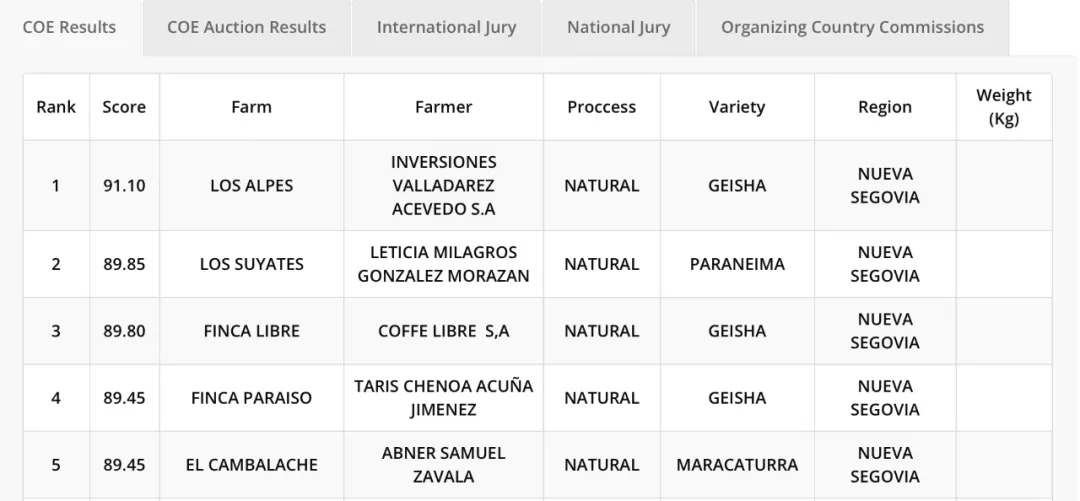
Results of the 2024 Nicaragua Cup of Excellence were announced, with the natural Geisha taking first place at 91.10 points and also placing third and fourth. The standout was the first appearance in Nicaragua of the Parainema variety, which took second with 89.85 points, a rare showing for a leaf rust-resistant variety in a competition long dominated by Geisha.
Parainema is genetically related to T5296 Sarchimor and was bred by the Honduran Coffee Institute, and it previously won the 2017 Honduras Cup of Excellence with 91.81 points. Run by the Alliance for Coffee Excellence since 1999, the COE uses blind cupping and auctions winning coffees. Debates over coffee originated from which country rarely settle, yet competitions like this show how varieties travel and continue to shift where did the coffee bean originate, since Parainema's genetics trace back to Central American breeding programs.
The results of the 2024 Nicaragua Cup of Excellence (COE) competition were recently announced, with the Geisha variety continuing its strong performance, sweeping first, third, and fourth places, among which the natural Geisha won the championship with 91.10 points. However, the most eye-catching aspect of this competition was the first appearance in Nicaragua of the Parainema variety, which took second place with 89.85 points. This rare variety, which previously won the 2017 Honduras COE, what is its genetic background? Can it break buyers' prejudice against the cup quality of leaf rust-resistant varieties? This article will provide a detailed interpretation of the origin, development, and outstanding performance of Parainema in this competition, while also introducing Front Street Coffee's attention to and recommendation of this variety.
COE is the abbreviation for "Cup of Excellence," translated into Chinese as 卓越杯, and was first established in 1999 in Brazil by the non-profit organization Alliance for Coffee Excellence (ACE), making it the world's first platform to auction award-winning coffees via the internet.
Any coffee-producing country can apply to host a COE event, and the participating beans all come from various regions of the host country. The competition uses a blind cupping scoring system, and after the event, the winning coffees are auctioned, allowing the winning estates to gain high reputation and considerable auction income.
Recently, the results of the 2024 Nicaragua Cup of Excellence (COE) competition were announced, with a rich variety of participating varieties, including Geisha, Parainema, Maracaturra, Pacamara, and others.

Among the top five, the Geisha variety took first, third, and fourth places, with the champion natural Geisha scoring 91.10 points.
The Parainema that scored 89.85 points and ranked second is a relatively rare variety. Despite being uncommon, this variety previously won the championship in the 2017 Honduras Cup of Excellence COE with 91.81 points.
It also appeared in the 2023 Honduras COE, but its performance was mediocre, ranking lower. This time, it reappeared at the Nicaragua COE competition, and it was its first appearance in Nicaragua.
Parainema
Parainema is genetically related to T5296 Sarchimor and was bred by the Honduran Coffee Institute (IHCAFÉ) from T5296.
T5296 originated from the "PROMECAFE" Central American regional alliance program. The alliance was established in 1978, funded by the Regional Office for Central American Programs (ROCAP) of the United States Agency for International Development (USAID) and the Brazilian Campinas Agronomic Institute (IAC), aimed at addressing the threat of coffee leaf rust in the region.
Thereafter, the Portuguese research institution (CIFC), known for its research on coffee leaf rust, received a large number of Timor (a natural hybrid of Arabica and Robusta) seeds from Timor Island.
From these seeds, CIFC selected two coffee trees with strong resistance to leaf rust for breeding, one of which was named HDT CIFC 832/2, and after crossing with the compact variety Villa Sarchi, produced H361, also known as Sarchimor.
Later, due to the PROMECAFE program, H361 was sent to the Tropical Agricultural Research and Higher Education Center (CATIE) in Costa Rica for breeding and selection, where researchers named "H361" as "T5296" (T stands for Turrialba, where CATIE is located), and it was subsequently distributed to other American countries.
In Honduras, IHCAFE selected and bred T5296, ultimately naming it the Parainema coffee variety. This variety is resistant to leaf rust and nematode attacks, has green new leaves at the top, is short in tree shape, suitable for dense planting, and has large, slender coffee beans.
However, some buyers have always shown little interest in such leaf rust-resistant varieties due to their lower cup quality, so this COE may help break these prejudices.
Front Street Coffee always pays attention to global coffee competitions and variety trends. The outstanding performance of Parainema in this Nicaragua COE also provides us with a new reference for cupping and selection. Front Street will continue to track the subsequent performance of this variety and bring more professional interpretations to coffee enthusiasts.
The above content is compiled by CoffeeHunters, a coffee news website.


