







Why Are Green Coffee Beans Rising Again After the Price Drop?
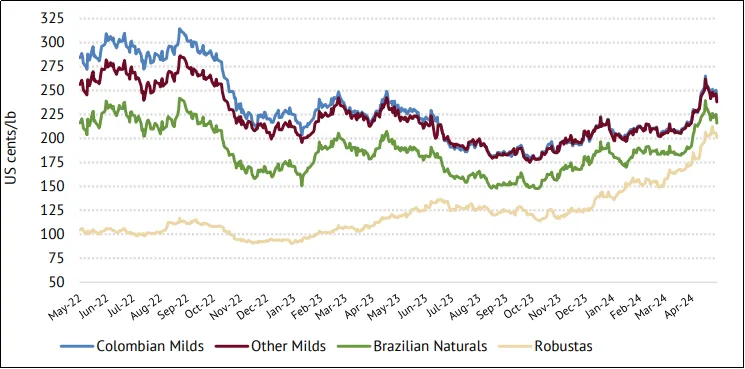
Robusta futures hit a record US$4,339 per tonne in late April and pulled arabica up with them. April export reports from Brazil and Vietnam both showed growth, and ICE inventories briefly calmed the market, sending tropical commodity prices down nearly 14%. Vietnamese purchase prices for green coffee beans then fell to 90 million dong per tonne before rebounding to 96-100 million dong.
Several forces point to further gains: drought in Vietnam, farmers switching to crops such as durian, a weakening Vietnamese dong, and higher Red Sea freight rates. Compared with the 120 million dong peak on May 4, prices had dropped 16%, but the spot cut-off date is approaching, so buyers and traders continue to watch how these factors develop.
In late April, robusta coffee futures surged to a historic high of US$4,339 per tonne, which in turn pushed arabica futures higher as well. Entering May, Brazil and Vietnam successively released their April export reports, both showing growth in production and export volumes. ICE coffee inventories briefly eased market anxiety, and the enthusiasm for chasing futures buying cooled somewhat. However, after tropical agricultural products fell by nearly 14% overall, the purchase price in Vietnam's central producing region quickly rebounded to 96 million to 100 million Vietnamese dong per tonne after dropping to 90 million dong per tonne. A mix of multiple factors—drought, competition from crops such as durian, the continuous depreciation of the Vietnamese dong, and rising freight rates on the Red Sea route—makes a rebound in coffee bean prices a highly probable event. Front Street Coffee will continue to monitor the deeper logic behind this round of volatility.
In late April, the coffee futures market experienced a sharp rally, with the robusta variety setting a new record, reaching a high of US$4,339 per tonne, a trend that also drove arabica futures prices higher in tandem.
In early May, the world's two major coffee-producing countries, Brazil and Vietnam, successively released their April export data, both showing growth in production and export volumes. The coffee inventories published by the Intercontinental Exchange (ICE) eased market tensions to some extent, and earlier this month, the rush to chase gains in coffee futures returned to a degree of rationality.
However, coffee was not the only commodity affected. The trading prices of most tropical agricultural products, including cocoa, coffee, and sugar, also declined under the influence of this factor, with drops approaching 14%. The decline in international futures prices quickly transmitted to the purchasing end at the origin. On May 8, local purchase prices in Vietnam briefly fell to 90 million Vietnamese dong per tonne (about US$3,500 per tonne), but then the purchase price of green coffee beans in the Central Highlands rebounded in the past two days to 96 million to 100 million Vietnamese dong per tonne (about US$3,900 per tonne). Compared with the peak of 120 million Vietnamese dong per tonne (about US$4,700 per tonne) on May 4, the decline reached 16%. With the spot cut-off date approaching, global coffee bean production has essentially taken shape under the influence of multiple factors, and a price rebound is almost a certainty.
The previous frenzied rise in Vietnamese coffee prices was rooted in the recent heatwave that hit Southeast Asia, causing severe drought and water shortages in Vietnam's central coffee-producing region. Coffee trees could not get enough irrigation, leading to reduced yields.
According to the latest report from the Vietnamese meteorological agency, some central provinces will receive rainfall in May, which will help alleviate the drought conditions for plants and river channels.
Beyond weather, Vietnamese coffee also faces competition from other fruit crops, with durian and mango being particularly prominent. According to local Vietnamese media reports, Vietnam's durian exports grew substantially in 2023, with exports to China reaching more than five times the 2022 level, and export value exceeding US$2 billion, prompting local farmers to switch to more valuable crops. Vietnam's coffee industry lacks investment, and farmers have been switching to higher-profit crops such as durian and mango, which is also the reason for the continuous shrinkage of coffee planting area and will affect Vietnam's future coffee output in the long run. A similar situation occurred in the global coffee market in 2012: the surge in coffee value attracted a large number of farmers to expand planting, but as rust disease eased and large-scale expansion took place, coffee prices plummeted by 70% several years later.
Vietnamese durian was only granted access to the Chinese market in 2022, yet by 2023 it had already captured 31.8% of China's durian market share, and the upward trend continued into 2024.
Meanwhile, the Vietnamese dong has been continuously depreciating, with the USDVND exchange rate hitting new highs in the past two days, once reaching 24,245.
Although depreciation can lower the relative price of export goods in the international market and enhance competitiveness, it also drives up import costs. As a major agricultural country, Vietnam is one of the important fertilizer importers in Southeast Asia, which will undoubtedly increase the planting costs of coffee and other agricultural products.
In addition, affected by factors such as the short-term accumulation of cargo volume on European routes and the low likelihood of a return to Red Sea shipping, shipping companies' European routes will see price increases, which may further push up the prices of Vietnamese coffee beans, which are mainly exported to European countries.
The above content is compiled by CoffeeHunters, a coffee news website.


