







How Will Water Shortages Affect India Arabica Coffee?
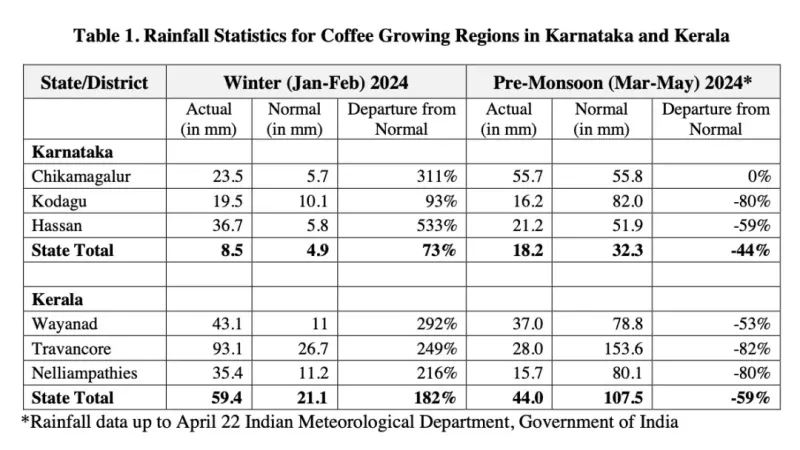
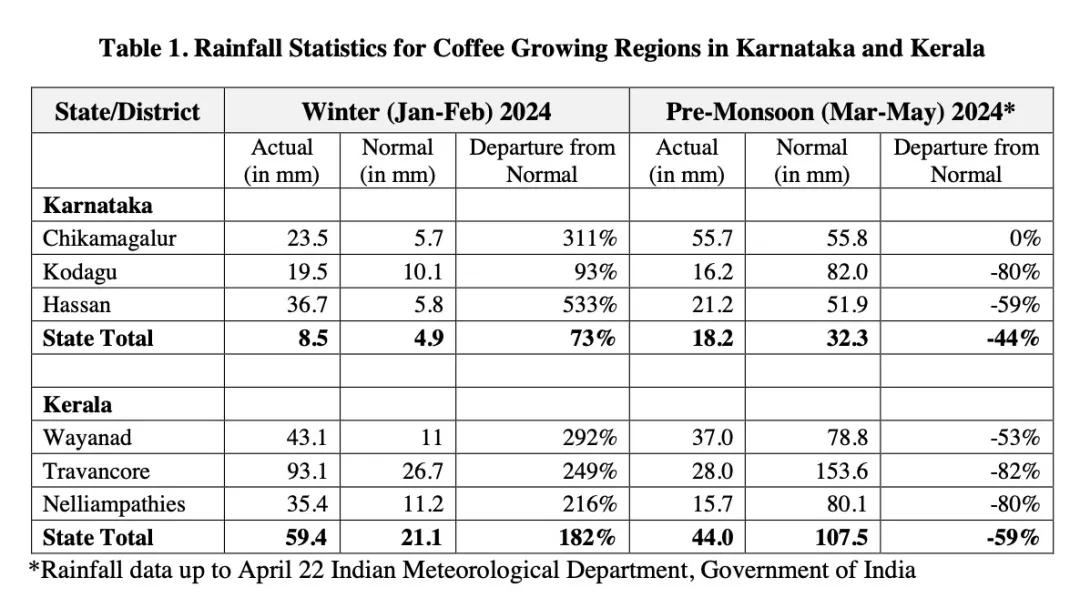
USDA's latest India coffee annual report puts 2024/25 total coffee production at about 6 million bags, including roughly 1.4 million bags of Arabica coffee and 4.6 million bags of Robusta, broadly stable versus previous years. The crop outlook is weaker: after heavy January-February rains, March-to-May precipitation fell below normal in many regions, and fruit set rates dropped sharply.
Groundwater overexploitation and climate change have turned intermittent shortages into a severe water crisis, and Robusta accounts for more than 70% of India's coffee production, with its harvest set from December to February. Red Sea tensions have also raised Asia-Europe freight rates, so exports face pressure from weather, shipping and high international coffee prices at once.
The latest India coffee annual report released by the USDA shows that total coffee production in India for the 2024/25 marketing year is expected to be about 6 million bags, including about 1.4 million bags of Arabica and about 4.6 million bags of Robusta, remaining generally stable overall. However, the outlook for the crop season is not optimistic: after heavy rains from January to February, many regions had insufficient rainfall from March to May, and combined with groundwater overexploitation and climate change, India is facing a severe water shortage crisis, with fruit set rates in major producing areas falling sharply. At the same time, continued tensions in the Red Sea have pushed up freight rates on Asia-Europe routes, and with international coffee prices at a ten-year high, India's coffee exports are facing triple pressure from weather, shipping, and prices. This article will combine the latest data to sort out India's coffee supply and demand structure and the risks ahead.
The India coffee annual report recently released by the USDA forecasts that India's coffee production in the 2024/25 marketing year will be about 6 million bags (60 kg each), including about 1.4 million bags of Arabica (69 kg each) and about 4.6 million bags of Robusta (60 kg each). Overall, the production scale remains stable compared with previous years.
Reports from India's meteorological department show that after heavy rains in January and February, precipitation from March to May was noticeably below normal in many parts of the country. Combined with factors such as groundwater overexploitation and climate change, India, which originally suffered only intermittent water shortages, has now fallen into a severe water resource crisis.
The water shortage has dealt a direct blow to coffee production. In major growing areas, the fruit set rate after flowering has dropped significantly, thereby dragging down yields. At present, Robusta accounts for more than 70% of India's total coffee production, and its new crop harvest is concentrated from December to February of the following year, so rainfall from March to May is crucial for the final determination of production.
Recently, major producing countries such as Brazil, Vietnam, and Indonesia have all been affected by adverse weather, coffee inventories in many countries have tightened, new-crop production expectations have been revised down, and pressure on global supply has increased. This background sharply pushed up Robusta coffee prices in late April and also provided support for Arabica prices. Although prices have now fallen somewhat, they remain significantly higher than levels in the past few years.
Driven by this, in April India's Arabica coffee prices rose 13%, and Robusta coffee prices rose 15%. As global coffee demand remains strong, India's exports are expected to remain at around 6.3 million bags. However, strong domestic demand for instant coffee in India is expected to increase domestic consumption by 2%, to 1.3 million bags.
Although the Indian government has plans to expand coffee planting area to increase production, with the planted area in 2024/25 expected to rise to about 475,000 hectares, insufficient rainfall and dry weather have led to a slight decline in yields, with Arabica production expected to fall 3% and Robusta 2%.
In addition to weather factors, Indian coffee also faces challenges in shipping and prices. Tensions in the Red Sea continue, and India's main coffee export destinations are European countries, so it has been deeply affected.
According to traders, current high prices have limited international buyers' willingness to place additional orders. Compared with October 2023, Arabica prices have risen 45%, and Robusta has risen 66%, setting a ten-year high for Indian coffee prices, and current levels are already higher than the International Coffee Organization (ICO) indicator price.
On the Red Sea front, a spokesperson for Yemen's Houthi armed group recently said that the group will carry out attacks on multiple ships related to Israel and will conduct operations in the Indian Ocean and the Arabian Sea.
Affected by factors such as the short-term backlog of cargo volume on Europe routes and the low possibility of a return to Red Sea shipping, shipping companies have raised freight rates on Europe routes. The original freight rate of US$2,755/TEU (twenty-foot equivalent unit) will increase by US$600 to US$1,000/TEU, and the average price may fall in the range of US$2,900 to US$5,000/TEU.
In addition, August is the peak shipping season for Asia-Europe routes, and freight rates are usually higher than current levels. If tensions in the Red Sea continue, there is still room for freight rates to rise further. Rising transportation costs may further push up coffee prices.
For domestic coffee enthusiasts, paying attention to supply fluctuations in producing areas such as India helps in understanding the logic behind changes in everyday coffee prices. Front Street Coffee suggests that when choosing everyday beans, consumers may appropriately consider Robusta and Arabica blended products to balance flavor and cost.
The above content is compiled by CoffeeHunters, a coffee news website.


